What Are Mycotoxins?
Mycotoxins are toxic secondary metabolites produced by various filamentous fungi that can contaminate agricultural commodities, particularly cereals, nuts, and spices. These naturally occurring toxins represent a significant threat to food safety and human health worldwide. The most concerning mycotoxins include aflatoxins (B1, B2, G1, G2), ochratoxin A, fumonisins, zearalenone, and deoxynivalenol, each with distinct chemical properties and toxicological profiles.
Aflatoxins, particularly aflatoxin B1, are among the most toxic mycotoxins known, classified as Group 1 human carcinogens by the International Agency for Research on Cancer (IARC). These compounds display strong immunosuppressive, mutagenic, teratogenic, and carcinogenic effects, with aflatoxin B1 being the most potent. Research has demonstrated that aflatoxin B1 has been classified as a group 1 (human) carcinogen, highlighting its significant health risks.
The chemical diversity of mycotoxins presents analytical challenges, as they range from non-polar compounds like aflatoxins to more polar metabolites. This diversity necessitates sophisticated extraction and cleanup methods to ensure accurate detection and quantification in complex food matrices.
Importance in Food Safety
Mycotoxin contamination represents a critical global food safety concern with significant economic and public health implications. The presence of these toxins in the food chain can lead to acute poisoning episodes, chronic health effects, and substantial economic losses through trade restrictions and reduced crop value.
Regulatory Framework
International regulatory bodies have established stringent limits for mycotoxin concentrations in food commodities. The European Union has mandated maximum limits of 5 μg/kg for aflatoxin B1 and 10 μg/kg for the sum of aflatoxins G2, G1, B2, and B1 in maize and maize products. Similarly, Brazil has established a limit of 20 μg/kg for corn contamination with total aflatoxins. These regulations underscore the importance of reliable analytical methods for compliance monitoring and exposure assessment.
Health Implications
Chronic exposure to mycotoxins, even at low concentrations, can lead to serious health consequences including:
- Hepatotoxicity and liver cancer (particularly from aflatoxins)
- Nephrotoxicity and kidney damage (from ochratoxin A)
- Immunosuppression and increased susceptibility to infections
- Developmental abnormalities and growth impairment
- Endocrine disruption (from zearalenone)
The development of multi-mycotoxin methods capable of detecting several mycotoxins in a single analysis has become increasingly important for comprehensive risk assessment and regulatory compliance.
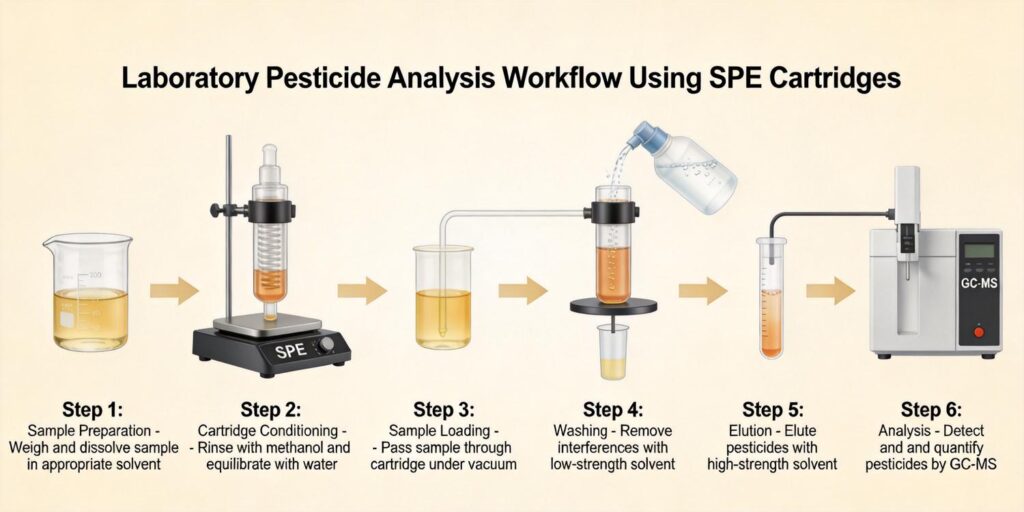
SPE Extraction Workflow for Mycotoxin Detection
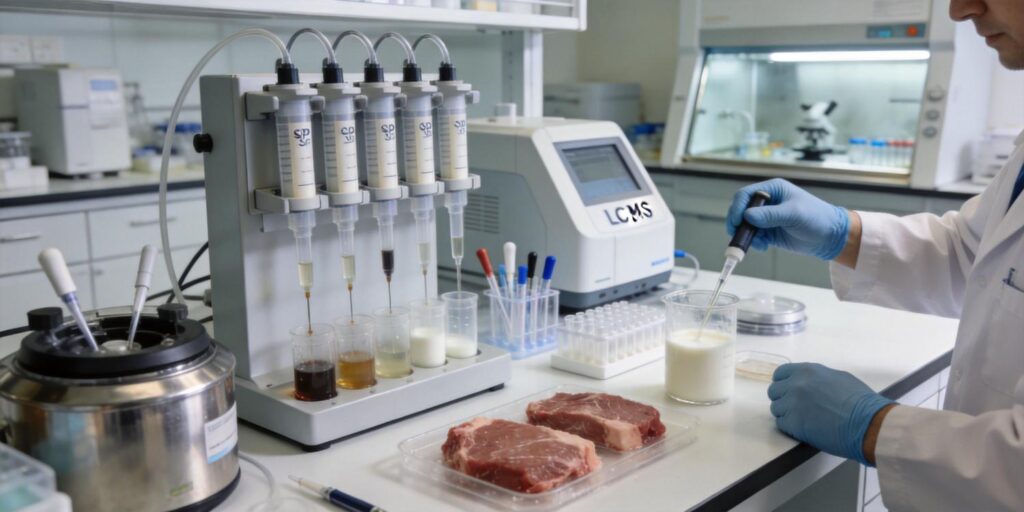
Solid Phase Extraction (SPE) has emerged as a powerful technique for mycotoxin analysis, offering superior cleanup efficiency, reproducibility, and recovery compared to traditional liquid-liquid extraction methods. The SPE workflow for mycotoxin detection typically follows a systematic approach optimized for specific toxin classes and food matrices.
Matrix Solid-Phase Dispersion (MSPD) Approach
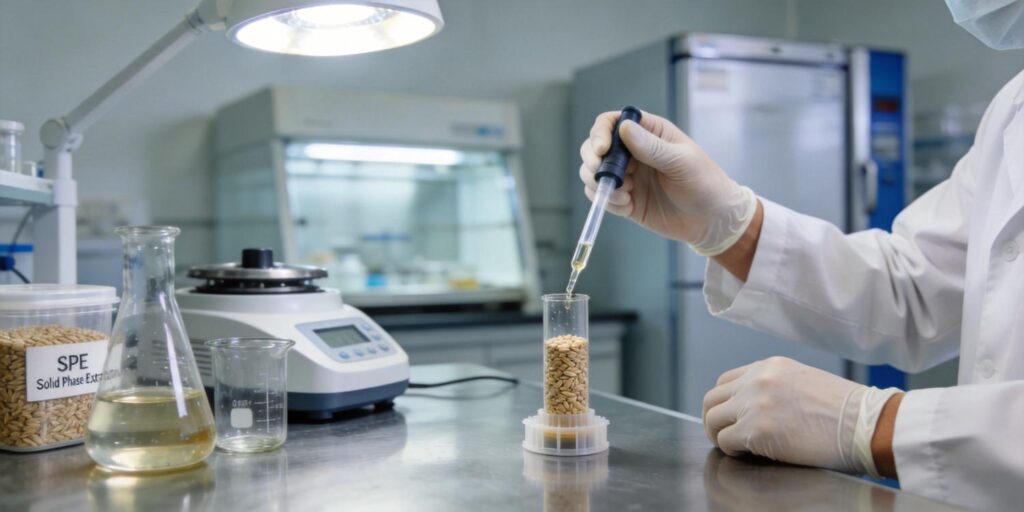
Matrix Solid-Phase Dispersion (MSPD) represents an innovative SPE technique particularly well-suited for mycotoxin extraction from complex food matrices. In MSPD, a small amount of sample and solid support are mixed homogenously, with the resulting powder then eluted with an appropriate solvent. This technique combines sample preparation and cleanup in a single step, using minimal amounts of solid support and solvent, thereby reducing analysis time and costs.
Research has demonstrated that MSPD offers several advantages for mycotoxin analysis:
- Feasibility and flexibility: Adaptable to various sample types and mycotoxin classes
- Low solvent consumption: Typically uses 10 mL or less of elution solvent
- Rapid processing: Combines extraction and cleanup in one step
- Reduced analyst exposure: Minimizes handling of toxic solvents and samples
SPE Sorbent Selection
The choice of SPE sorbent depends on the polarity of target mycotoxins and the matrix composition. For mycotoxin analysis in cereals, C18 sorbents are most commonly used due to their lipophilic characteristics, which allow good disruption, dispersion, and retention of lipophilic species. Studies have shown that C18 provides excellent recovery for aflatoxins in cornmeal, with recoveries ranging from 85.7% to 114.8% under optimized conditions.
Other sorbent options include:
- HLB (Hydrophilic-Lipophilic Balanced): For broad-spectrum mycotoxin extraction
- MAX (Mixed-mode Anion Exchange): For acidic mycotoxins
- MCX (Mixed-mode Cation Exchange): For basic compounds
- Immunoaffinity columns: For highly selective cleanup
Optimized Extraction Protocol
Based on research findings, an optimized MSPD protocol for aflatoxin extraction from cornmeal involves:
- Sample preparation: 1 g of cornmeal sample
- Solid support: 25 mg C18 sorbent
- Elution solvent: 10 mL of acetonitrile/methanol (50:50, v/v)
- Extraction method: Vortex-assisted dispersion and elution
- Chromatographic analysis: HPLC with fluorescence detection and post-column derivatization
This optimized method has demonstrated excellent performance characteristics:
| Mycotoxin | LOD (ng/g) | LOQ (ng/g) | Recovery Range (%) |
|---|---|---|---|
| Aflatoxin G2 | 0.04 | 0.10 | 98.4-114.8 |
| Aflatoxin G1 | 0.02 | 0.05 | 85.7-106.2 |
| Aflatoxin B2 | 0.01 | 0.02 | 88.5-94.1 |
| Aflatoxin B1 | 0.04 | 0.07 | 86.7-109.5 |
Method Validation and Quality Control
Proper method validation is essential for reliable mycotoxin analysis. According to European Commission guidelines, for mycotoxin concentrations less than 1 μg/kg, recoveries should range between 50% and 120%, while for concentrations between 1 and 10 μg/kg, recoveries should vary between 70% and 110%. The optimized MSPD method meets these criteria with relative standard deviations (RSD) typically below 20%.
Matrix effects should be carefully evaluated, with acceptable matrix effect values around 20% for trace-level contaminant analysis. Multivariate correlation analysis has identified proteins and sugars as the main interferers in mycotoxin determination, particularly for aflatoxins G2 and G1 in fine cornmeal.
Advanced SPE Formats
For high-throughput laboratories, 96-well SPE plates offer significant advantages:
- Parallel processing: Simultaneous extraction of multiple samples
- Reduced solvent consumption: Miniaturized format decreases solvent usage
- Automation compatibility: Suitable for robotic sample preparation systems
- Improved reproducibility: Consistent extraction conditions across samples
These formats are particularly valuable for regulatory laboratories and quality control facilities processing large numbers of samples.
Practical Considerations for Laboratory Implementation
When implementing SPE methods for mycotoxin detection, several practical considerations ensure optimal performance:
Sample Particle Size
Research indicates that particle size significantly affects extraction efficiency. The optimized MSPD method has proven suitable for coarse and medium grind cornmeals, while fine cornmeal may present challenges due to increased interference from proteins and sugars. Proper sample homogenization and particle size control are essential for reproducible results.
Solvent Selection and Optimization
The choice of elution solvent critically impacts mycotoxin recovery. Acetonitrile/methanol mixtures (50:50, v/v) have demonstrated excellent performance for aflatoxin extraction, providing optimal polarity for both hydrophobic interactions and efficient elution. Solvent composition should be optimized based on the specific mycotoxin class and matrix characteristics.
Green Chemistry Considerations
Modern SPE methods increasingly incorporate green chemistry principles by:
- Minimizing solvent volumes (typically 10 mL or less)
- Using less toxic solvent alternatives when possible
- Implementing vortex-assisted elution to reduce analyst exposure
- Optimizing methods for reduced environmental impact
Conclusion
Solid Phase Extraction, particularly in the form of Matrix Solid-Phase Dispersion, represents a powerful and efficient approach for mycotoxin detection in food commodities. The technique offers significant advantages in terms of sensitivity, selectivity, and practicality for routine laboratory analysis. With proper optimization and validation, SPE methods can achieve detection limits in the low ng/g range, meeting stringent regulatory requirements for food safety monitoring.
The continued development of SPE technologies, including advanced sorbent chemistries and high-throughput formats, promises to further enhance mycotoxin analysis capabilities. As food safety regulations become increasingly stringent worldwide, reliable and efficient SPE methods will remain essential tools for protecting public health and ensuring the safety of the global food supply.
For laboratories seeking to implement or optimize mycotoxin detection methods, SPE offers a robust framework that balances analytical performance with practical considerations of cost, time, and environmental impact. By selecting appropriate sorbents and optimizing extraction conditions, analysts can achieve reliable quantification of mycotoxins across diverse food matrices, contributing to improved food safety and public health protection.