Sample Cleanup

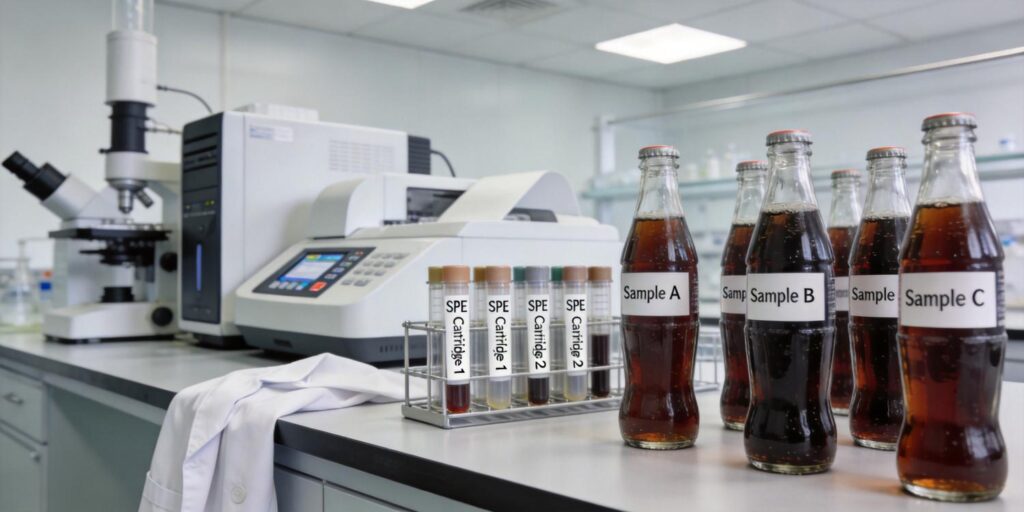
SPE purification workflow for sugar-rich beverage samples

SPE Cleanup for Sugar-Rich Beverage Matrices Before LC-MS

1. Analytical Challenges in Sugar-Rich Beverages Analyzing trace contaminants, additives, or natural compounds in sugar-rich beverages like soft drinks, energy drinks, fruit juices, and sports beverages presents unique challenges for LC-MS (Liquid Chromatography-Mass Spectrometry) workflows. These matrices contain high concentrations of carbohydrates—primarily sucrose, glucose, fructose, and high-fructose corn syrup—that can range from 5% to 15% […]

SPE Cleanup for Sugar-Rich Beverage Matrices Before LC-MS Read More »

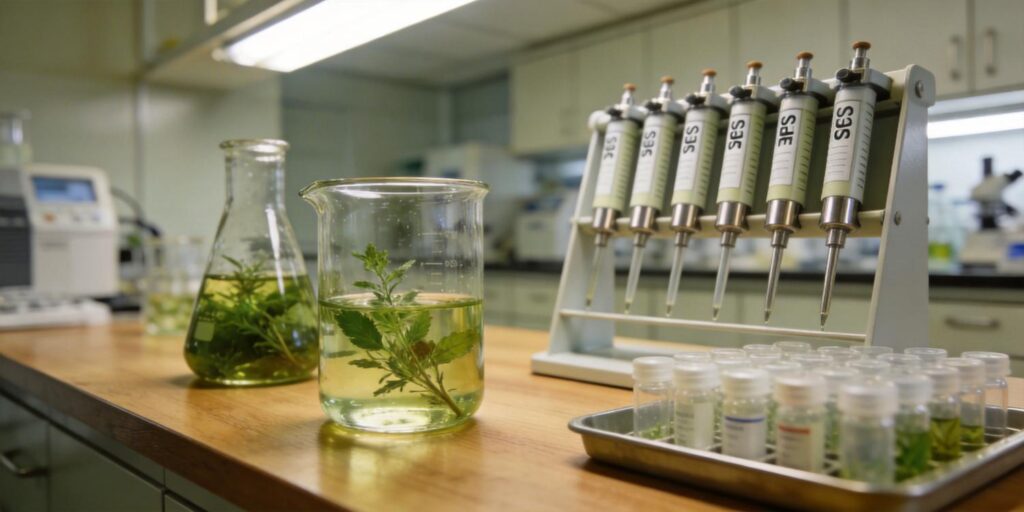
SPE cartridge purification of plant extract samples for LC-MS analysis

Sample Cleanup of Plant Extracts Using SPE Prior to LC-MS

1. Complexity of Plant Metabolite Extracts Plant extracts represent one of the most challenging matrices for analytical chemists, containing thousands of chemical components with diverse physicochemical properties. As noted in SPE literature, plants can be considered as consisting of “an aqueous portion, a fatty portion and an insoluble or fibrous portion” (Simpson & Wynne, 2000).

Sample Cleanup of Plant Extracts Using SPE Prior to LC-MS Read More »

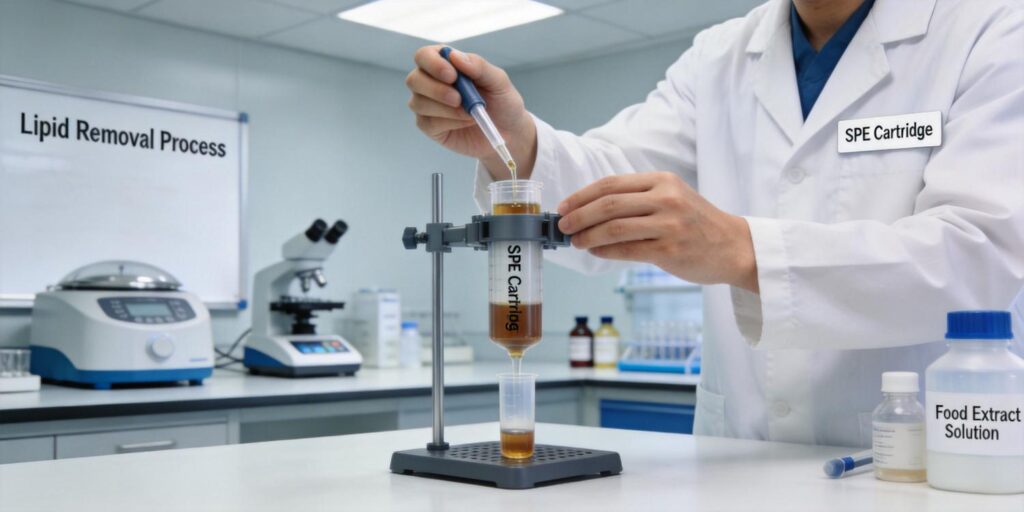
Solid phase extraction setup used for removing lipids from fatty food extracts

SPE Cleanup for Fatty Food Matrices Before LC-MS Analysis

Introduction: The Challenge of Fatty Food Matrices in LC-MS Analysis Liquid chromatography-mass spectrometry (LC-MS) has become the gold standard for food safety testing, contaminant monitoring, and nutritional analysis. However, when analyzing fatty food matrices like edible oils, meat extracts, dairy products, and processed foods, laboratories face significant challenges that can compromise analytical accuracy and instrument

SPE Cleanup for Fatty Food Matrices Before LC-MS Analysis Read More »

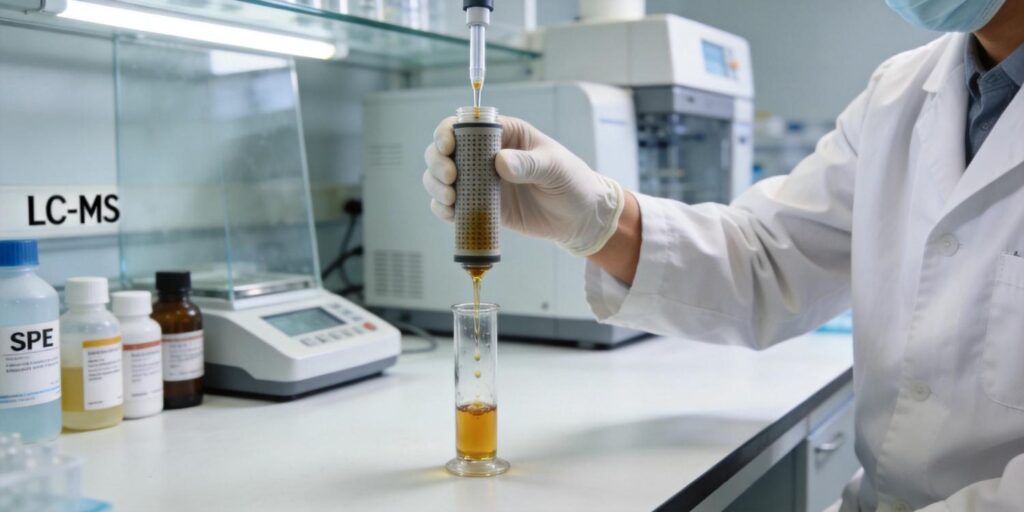
SPE cartridge removing lipids from food extract samples

Using SPE to Remove Interfering Lipids from Food Extracts

Lipid Interference in LC-MS Food Analysis In liquid chromatography-mass spectrometry (LC-MS) analysis of food extracts, lipid interference represents one of the most significant analytical challenges. Lipids can cause ion suppression or enhancement in the mass spectrometer, leading to inaccurate quantification and reduced method sensitivity. According to Simpson and Wynne (2000), co-extracted lipids from food matrices

Using SPE to Remove Interfering Lipids from Food Extracts Read More »

laboratory SPE wash step improving sample cleanup efficiency

Optimizing SPE Wash Steps to Improve Sample Cleanup

Role of Wash Steps in SPE Workflows Solid-phase extraction (SPE) wash steps serve as the critical bridge between sample loading and analyte elution, functioning as the primary mechanism for removing matrix interferences while preserving target compounds. As described in SPE literature, “To remove unwanted, weakly retained materials, wash the packing with solutions that are stronger

Optimizing SPE Wash Steps to Improve Sample Cleanup Read More »

mixed mode SPE cartridge used for complex laboratory sample cleanup

Improving Sample Cleanup Efficiency with Mixed-Mode SPE Sorbents

Principle of Mixed-Mode SPE Interactions Mixed-mode solid phase extraction represents a sophisticated advancement in sample preparation technology that combines multiple retention mechanisms within a single sorbent. According to established literature, mixed-mode SPE columns are prevalent in drug extractions because they offer multiple binding mechanisms for improved sensitivity and excellent sample cleanup. A mixed-mode sorbent employs

Improving Sample Cleanup Efficiency with Mixed-Mode SPE Sorbents Read More »

laboratory SPE cleanup workflow for fatty food samples prior to LC-MS testing

Using SPE for Cleanup of High-Fat Food Samples Prior to LC-MS Analysis

1. Analytical Challenges in Fatty Food Matrices (Oils, Dairy, Processed Foods) High-fat food matrices present unique analytical challenges that significantly complicate LC-MS analysis. Oils, dairy products, and processed foods contain complex mixtures of lipids including triglycerides, phospholipids, cholesterol esters, and free fatty acids that can range from 5% to over 40% of the total sample

Using SPE for Cleanup of High-Fat Food Samples Prior to LC-MS Analysis Read More »

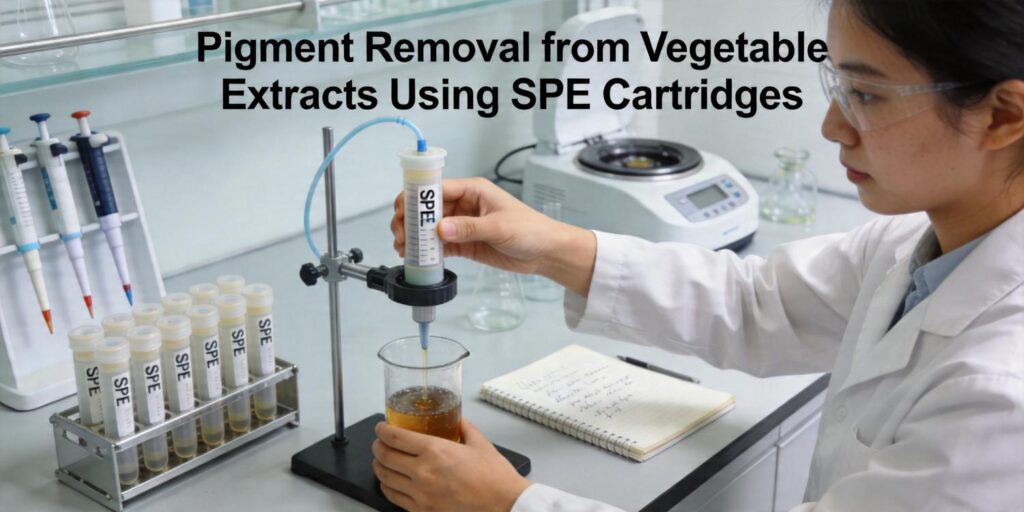
SPE cartridge removing chlorophyll pigments from plant extract

SPE Method for Removing Chlorophyll from Botanical Extracts Prior to LC Analysis

Challenges Posed by Chlorophyll and Plant Pigments in Chromatographic Analysis Chlorophyll and other plant pigments present significant analytical challenges in liquid chromatography (LC) analysis of botanical extracts. These highly colored compounds can cause severe interference through several mechanisms. First, chlorophyll’s strong UV-visible absorption can mask target analyte peaks, particularly when using UV detection at wavelengths

SPE Method for Removing Chlorophyll from Botanical Extracts Prior to LC Analysis Read More »

SPE cartridge purifying cosmetic extract before LC-MS analysis

SPE Cleanup Strategy for LC-MS Analysis of Cosmetic Preservatives

Common Cosmetic Preservatives: Parabens and Phenoxyethanol Cosmetic formulations present unique analytical challenges due to their complex matrices containing emulsifiers, surfactants, oils, waxes, and various active ingredients. Among the most commonly used preservatives in cosmetics are parabens (methyl-, ethyl-, propyl-, and butyl-paraben) and phenoxyethanol. These compounds serve as antimicrobial agents to prevent microbial growth and extend

SPE Cleanup Strategy for LC-MS Analysis of Cosmetic Preservatives Read More »

SPE cartridge cleaning cosmetic sample extract

SPE Sample Cleanup Strategy for Cosmetic Ingredient Analysis

Analytical Challenges in Cosmetic Formulations Cosmetic ingredient analysis presents unique challenges due to the complex nature of cosmetic formulations. These products typically contain a diverse array of components including oils, waxes, pigments, surfactants, and preservatives that can interfere with analytical measurements. The lipid-soluble nature of many cosmetic ingredients, combined with the presence of emulsifiers and

SPE Sample Cleanup Strategy for Cosmetic Ingredient Analysis Read More »

Shopping Cart
Poseidon Scientific
Privacy Overview

This website uses cookies so that we can provide you with the best user experience possible. Cookie information is stored in your browser and performs functions such as recognising you when you return to our website and helping our team to understand which sections of the website you find most interesting and useful.