Overview of PFAS Contamination Concerns
Perfluoroalkyl and polyfluoroalkyl substances (PFAS) are a class of synthetic chemicals widely used in industrial and consumer products due to their oil- and water-repellent properties. Their extreme persistence in the environment and bioaccumulative potential have raised significant human health concerns, including links to kidney cancer, thyroid disease, and developmental issues. In 2024, the U.S. Environmental Protection Agency (EPA) set maximum contaminant levels (MCLs) for six PFAS in drinking water, with limits as low as 4 parts per trillion (ppt) for PFOA and PFOS. Achieving such ultra-trace detection requires a robust extraction and cleanup method, and solid-phase extraction (SPE) has become the gold-standard technique for PFAS analysis in water.
Target PFAS Compounds
Regulatory methods, such as EPA Method 537.1 and 533, target a suite of perfluoroalkyl carboxylic acids (PFCAs), perfluoroalkyl sulfonic acids (PFSAs), and selected precursors. Typical target compounds include:
- Perfluorooctanoic acid (PFOA)
- Perfluorooctanesulfonic acid (PFOS)
- Perfluorohexanesulfonic acid (PFHxS)
- Perfluorononanoic acid (PFNA)
- Perfluorobutanesulfonic acid (PFBS)
- Hexafluoropropylene oxide dimer acid (HFPO-DA, GenX)
These compounds are anionic at neutral pH, making weak or strong anion-exchange (WAX or SAX) SPE cartridges ideal for selective retention from water samples.
Drinking Water Sampling Procedures
Sampling must be performed using PFAS-free containers (typically polypropylene or high-density polyethylene, HDPE), as glass can adsorb PFAS. Bottles should be pre-rinsed with sample water, and a field blank (laboratory reagent water) should be included to monitor contamination. Sodium thiosulfate is added to dechlorinate tap water, preserving sample integrity. Samples are kept at 4°C and extracted within 14 days; for longer storage, freezing at −20°C is acceptable.
Anion-Exchange SPE Cartridge Conditioning
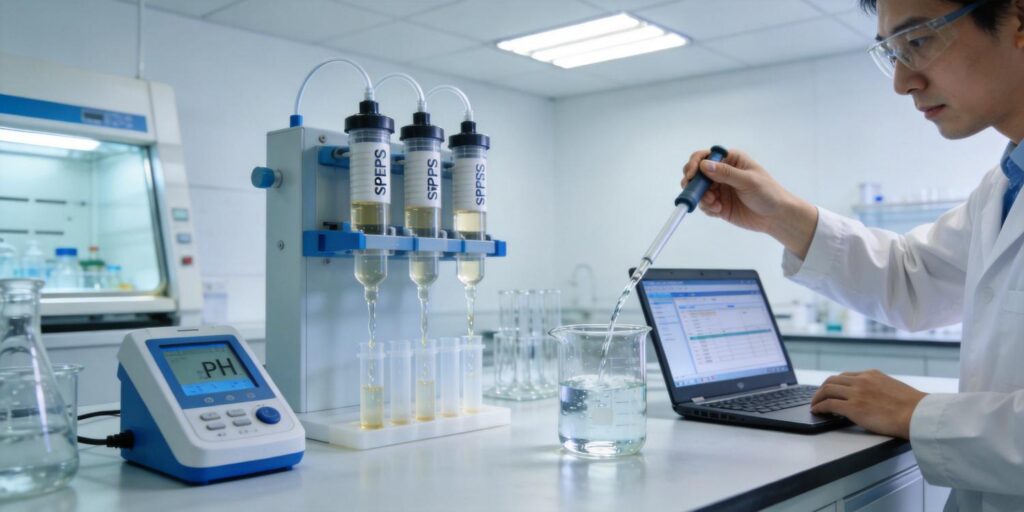
Anion-exchange SPE is the preferred sorbent for PFAS because of its high selectivity for ionic perfluoroalkyl acids. For a weak anion-exchange (WAX) cartridge (e.g., Poseidon WAX SPE Cartridges), conditioning involves:
- Rinse with 5 mL of 0.1% ammonium hydroxide in methanol (v/v) to activate the sorbent.
- Rinse with 5 mL of methanol to remove residual base.
- Equilibrate with 5 mL of reagent water (pH ~6–7).
For strong anion-exchange (SAX) cartridges (e.g., Poseidon MAX SPE Cartridges), the same sequence can be used, but SAX retains PFAS more strongly, requiring a higher pH elution. Note that the sorbent must never be allowed to dry, as this reduces reproducibility.
Large-Volume Sample Loading
To achieve sub-ppt detection limits, a large sample volume (250–1000 mL) is loaded onto the conditioned SPE cartridge. A vacuum manifold or positive-pressure system is used to maintain a flow rate of ~10 mL/min. Before loading, the sample is often adjusted to pH 6–7 to maximize retention of the anionic PFAS. Internal standards (e.g., ¹³C-labeled PFAS) are added to the sample prior to loading to correct for recovery variations.
Washing to Remove Natural Organic Matter
After sample loading, the cartridge is washed to remove co-adsorbed natural organic matter (NOM) and other matrix components that can cause ion suppression in LC-MS/MS. A typical wash uses 5 mL of reagent water followed by 5 mL of 25% methanol in water. The methanol percentage must be kept low (<30%) to avoid prematurely eluting early-eluting PFAS (e.g., PFBA). For challenging matrices, a second wash with 0.1 M formic acid can be applied to protonate weakly acidic interferences, but PFAS remains anionic and retained.
Elution with Basic Methanol
PFAS are desorbed from the anion-exchange sorbent by disrupting the ionic interaction with a high-pH solvent. Elution is performed using 4–5 mL of 0.1% ammonium hydroxide in methanol. The eluate is collected in a polypropylene tube and then concentrated under a gentle nitrogen stream at 40°C to a final volume of 0.5–1 mL. After concentration, the extract is transferred to an autosampler vial containing 10 µL of formic acid to neutralize the pH, ensuring stable PFAS in solution for LC-MS/MS analysis.
LC-MS/MS Detection Workflow
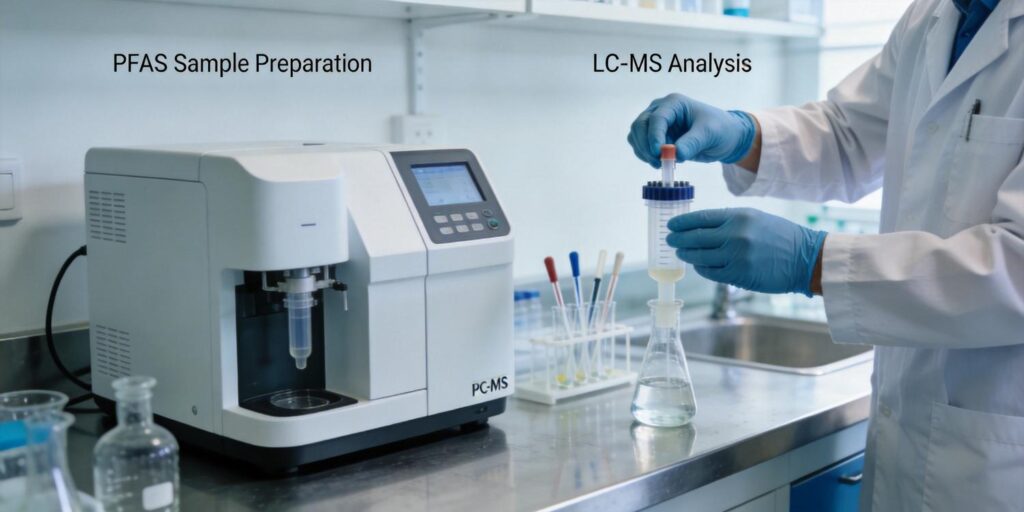
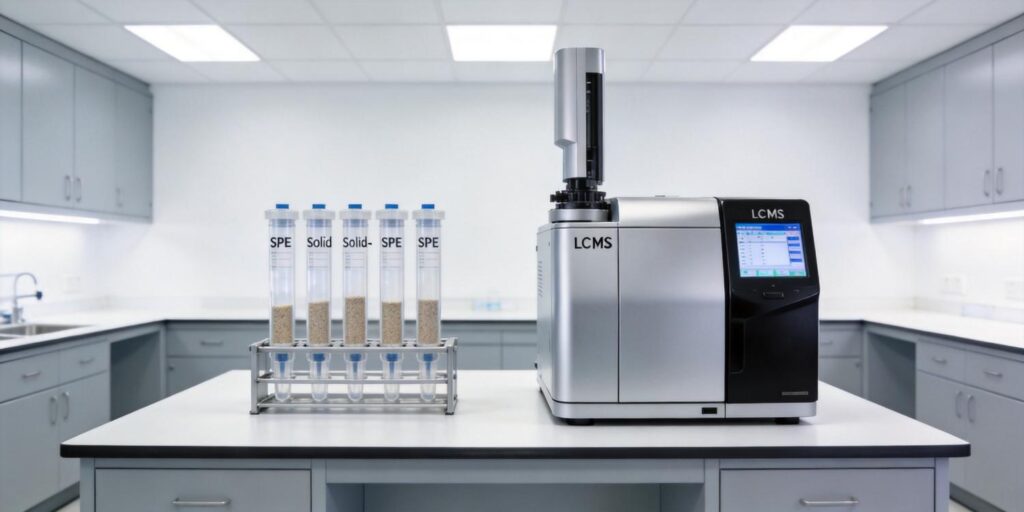
The final extract is analyzed by liquid chromatography-tandem mass spectrometry (LC-MS/MS) using a C18 reversed-phase column (e.g., 100 mm × 2.1 mm, 1.7 µm) with a mobile phase gradient of water (2 mM ammonium acetate) and methanol. The mass spectrometer is operated in electrospray negative ionization (ESI−) mode with multiple reaction monitoring (MRM) transitions for each target PFAS. Quantification is performed using isotope dilution with the internal standards. The method detection limits (MDLs) typically range from 0.5 to 4 ppt, meeting EPA regulatory requirements.
For laboratories seeking reliable, high-recovery SPE consumables, 96-well SPE plates are available for high-throughput PFAS analysis, offering the same WAX and MAX chemistries in a plate format. To further explore our product range, visit our HLB SPE cartridges, MCX SPE cartridges, and WCX SPE cartridges pages.