Overview of Plasticizer Migration from Packaging
Plasticizers, particularly phthalates, are widely used in polymer-based food packaging materials to enhance flexibility and durability. However, these additives are not chemically bound to the polymer matrix, allowing them to migrate from packaging into food under conditions of heat, prolonged storage, or contact with fatty foods. This migration raises significant health concerns, as certain phthalates are classified as endocrine disruptors and are regulated under stringent global standards such as EU Regulation No. 10/2011 and U.S. FDA 21 CFR. Robust analytical methods are therefore critical to monitor and quantify plasticizer levels in food simulants to ensure compliance and consumer safety.
Target Analytes: Phthalates and Beyond
Common target analytes in plasticizer migration studies include di(2-ethylhexyl) phthalate (DEHP), diisononyl phthalate (DINP), dibutyl phthalate (DBP), benzyl butyl phthalate (BBP), and diethyl phthalate (DEP). Non-phthalate plasticizers such as di(2-ethylhexyl) terephthalate (DEHT), acetyl tributyl citrate (ATBC), and dioctyl sebacate (DOS) are increasingly monitored due to substitution trends. The HLB SPE cartridges are particularly effective for retaining a broad range of plasticizers across different polarities.
Sample Extraction from Packaging Simulants
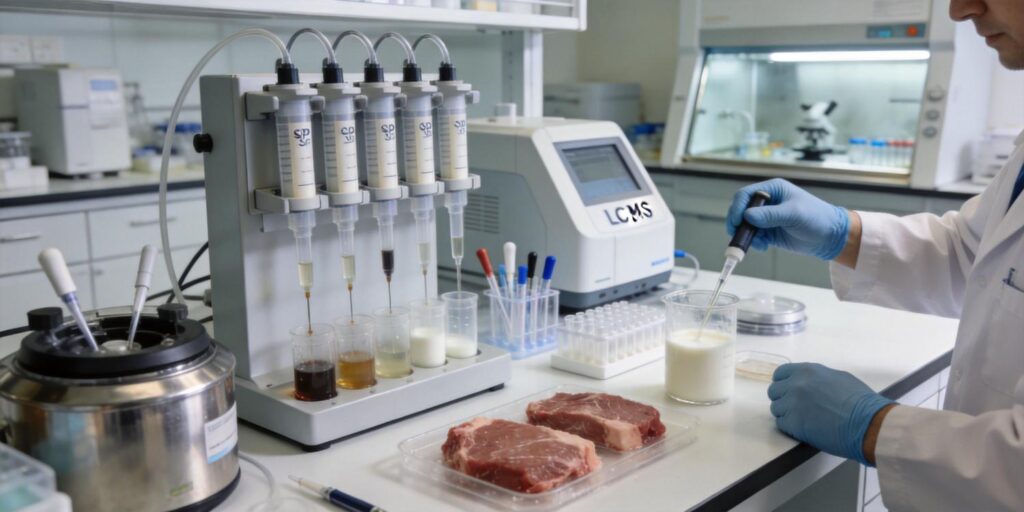
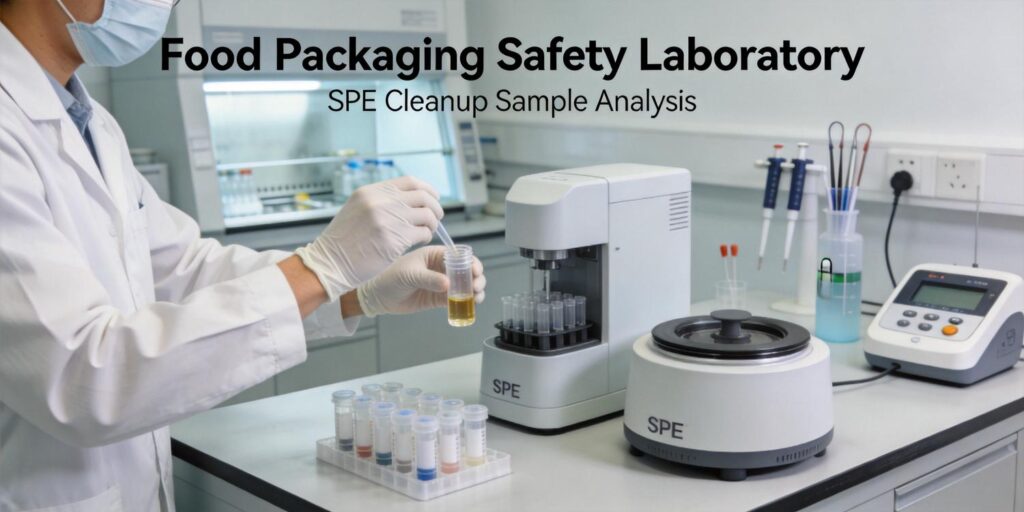
Migration testing typically uses food simulants like 10% ethanol (aqueous simulant), 95% ethanol (fatty simulant), and isooctane as alternatives. A representative extraction procedure involves immersing a defined area of packaging material in the simulant under controlled time and temperature conditions (e.g., 10 days at 40°C). After migration, an aliquot of the simulant is taken for SPE cleanup. For fatty simulants, a dilution with a non-polar solvent such as hexane is often necessary before loading to reduce viscosity and improve retention on the sorbent.
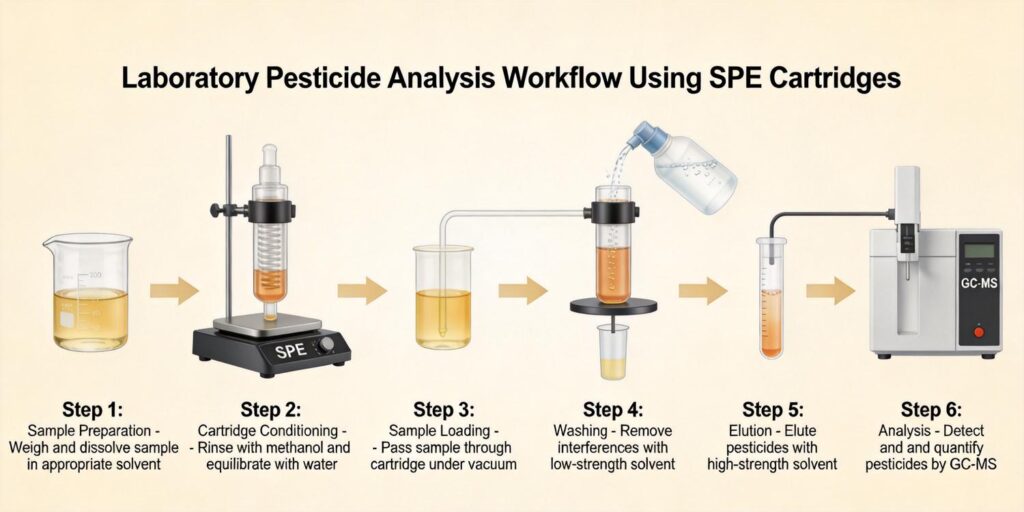
SPE Cartridge Conditioning
Proper cartridge conditioning is essential for reproducible results. For MAX SPE cartridges (mixed-mode anion exchange) or HLB cartridges, typical conditioning steps include passing 3–5 mL of methanol, followed by 3–5 mL of water or the simulant solvent (e.g., 10% ethanol). This step solvates the sorbent bed and activates the retention mechanism. For non-polar plasticizers, conditioning with the sample solvent ensures minimal breakthrough during loading.
Washing Steps Removing Matrix Contaminants
After sample loading, a washing step removes co-extracted matrix components such as fatty acids, triglycerides, and pigments. A typical wash for MCX SPE cartridges (mixed-mode cation exchange) is 5% methanol in water for aqueous simulants, or a small volume of hexane for fatty simulants. The wash solvent must be strong enough to elute interferences but weak enough to retain plasticizers. Optimization often includes testing different percentages of organic modifier to balance clean-up and recovery.
Elution with Non-Polar Solvents
Plasticizers are efficiently eluted using non-polar solvents such as ethyl acetate, dichloromethane, or a mixture of hexane and ethyl acetate (e.g., 1:1, v/v). For WAX SPE cartridges (weak anion exchange), elution with a basic solvent like 5% ammonium hydroxide in methanol may be used if anionic interactions are involved, but for neutral plasticizers, simple non-polar elution suffices. Typically, 3–5 mL of elution solvent is passed and collected. The eluate is then evaporated under nitrogen and reconstituted in a GC-compatible solvent (e.g., hexane) to a final volume of 1 mL.
GC-MS Detection
Gas chromatography-mass spectrometry (GC-MS) is the gold standard for phthalate analysis due to its sensitivity and selectivity. A typical GC-MS method uses a 30 m × 0.25 mm × 0.25 µm DB-5MS column with helium carrier gas. The injection port is maintained at 250°C with a splitless injection of 1 µL. The oven program: 60°C held for 1 min, ramped at 20°C/min to 220°C, then 5°C/min to 300°C, held for 5 min. MS detection in selected ion monitoring (SIM) mode targets the characteristic ions for each plasticizer. To avoid phthalate contamination from labware, all glassware should be baked at 400°C, and solvents should be tested for blank levels.
Food Contact Material Regulatory Testing
Regulatory limits for plasticizer migration vary globally. The EU sets specific migration limits (SMLs) for phthalates, e.g., 1.5 mg/kg for DEHP and 0.01 mg/kg for DBP. The U.S. FDA allows certain phthalates as indirect food additives under Good Manufacturing Practices. For comprehensive testing, laboratories often turn to validated SPE methods using 96-well SPE plates for high-throughput screening. These formats reduce solvent consumption and increase sample throughput, ideal for routine migration tests. For more details on SPE cartridge selection and method development, refer to our product lines: HLB, MAX, MCX, WAX, and WCX.