Importance of Phenolic Antioxidants in Olive Oil Quality
Phenolic compounds are minor yet critical constituents of olive oil, contributing significantly to its oxidative stability, sensory properties (bitterness, pungency), and health-promoting effects. Key phenolics such as hydroxytyrosol, tyrosol, oleuropein, ligstroside aglycones, and oleocanthal exhibit strong antioxidant activities that protect oil from rancidity and are linked to cardiovascular and anti-inflammatory benefits. Their quantification is essential for quality control, authenticity verification, and nutritional labeling. However, direct analysis is challenging due to the complex lipid matrix, making solid-phase extraction (SPE) a vital sample preparation technique.
Oil Sample Preparation and Dilution
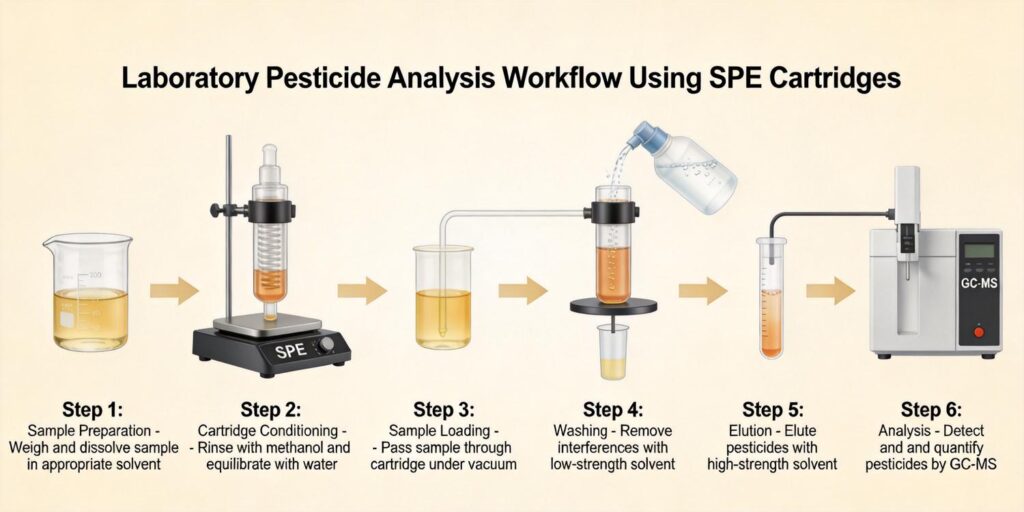
Olive oil samples are typically weighed (1–3 g) and dissolved in an organic solvent to reduce viscosity. A common protocol uses n-hexane, which effectively solubilizes the oil while allowing polar phenolics to remain extractable. Alternatively, a hexane–ethyl acetate mixture (e.g., 9:1 v/v) enhances solubility. The solution should be thoroughly mixed by vortexing or sonication. For low-concentration phenolics, larger sample masses (up to 5 g) can be used, but the solvent volume must be scaled accordingly to maintain proper flow through the cartridge. Some procedures add an internal standard (e.g., syringic acid) before dilution to correct for recovery losses.
SPE Sorbent Selection Rationale
The choice of SPE sorbent dictates selectivity and recovery. For olive oil phenolics, reversed-phase C18 or diol-bonded silica HLB cartridges are widely used. C18 retains moderately polar to nonpolar compounds, while HLB (hydrophilic–lipophilic balanced) provides enhanced wetting and retention for a broader polarity range. Diol phases mimic normal-phase behavior, retaining polar phenolics via hydrogen bonding. A typical HLB cartridge (e.g., 200 mg/6 mL) offers high capacity for lipid removal and good reproducibility. For acidic phenolics, MAX cartridges (mixed-mode anion exchange) provide additional selectivity, though neutral protocols are more common.
Cartridge Conditioning and Sample Loading
Conditioning is critical for reproducible retention. For HLB or C18: 6 mL methanol followed by 6 mL hexane. The methanol activates the sorbent, and hexane conditions it for the nonpolar sample matrix. The oil solution is then loaded at 1–2 mL/min. A slow loading rate ensures efficient adsorption of phenolics onto the sorbent while allowing triglycerides and fatty acids to pass through. The loading volume should not exceed the cartridge capacity (typically 10–20 mL of hexane solution). After loading, the cartridge is often washed with hexane to remove residual oil.
Washing Steps Removing Lipids
Lipid removal is achieved by washing with hexane (5–10 mL) after sample loading. This step elutes non-retained triglycerides and apolar components without disturbing retained phenolics. A second wash with hexane–ethyl acetate (e.g., 95:5) can be used to remove slightly more polar lipids. The wash volume must be optimized—excessive washing may cause premature loss of target compounds. In mixed-mode protocols, a 5% methanol in water wash (for WAX or WCX cartridges) can remove ionic interferences, but for neutral phenolic protocols, organic washes are preferred.
Elution of Phenolic Compounds
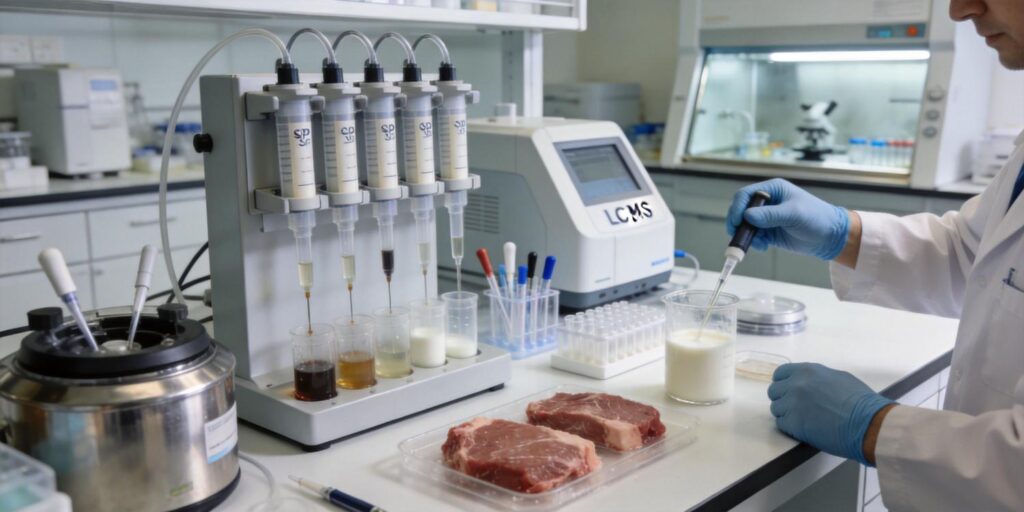
Phenolics are eluted with a polar solvent such as methanol or a methanol–water mixture (e.g., 80:20 v/v). Acidified methanol (0.1% formic acid) improves recovery of acidic compounds like caffeic acid. For diol sorbents, acetonitrile or methanol is effective. The elution solvent volume typically ranges from 3 to 6 mL. The eluate is collected, evaporated under nitrogen, and reconstituted in the mobile phase for analysis. In 96-well SPE plate formats, elution can be performed under vacuum, and the eluate directly injected.
HPLC or LC-MS Detection
Reversed-phase HPLC with UV (280 nm), diode array (DAD), or mass spectrometric detection is standard. A C18 column (e.g., 150×4.6 mm, 5 µm) with a gradient of water–acetonitrile (0.1% formic acid) provides good separation. LC-MS/MS offers higher sensitivity and selectivity for identification. Multiple reaction monitoring (MRM) transitions for common phenolics (e.g., hydroxytyrosol 153→123, tyrosol 137→106) enable quantification at low µg/L levels. Full-scan high-resolution MS can also be used for profiling. Deuterated internal standards (e.g., tyrosol-d4) improve accuracy.
Method Validation Metrics
Validation includes linearity (R² >0.99 over 0.1–50 µg/mL), precision (RSD <10% for repeatability), and recovery (85–110% for spiked samples). Lower limits of quantification (LLOQ) should be below 0.1 mg/kg for olive oil. Matrix effects in LC-MS are assessed by post-column infusion; if significant, matrix-matched calibration is used. The method should be tested on diverse olive oil varieties (extra virgin, virgin, refined) to ensure robustness. Interlaboratory validation further confirms transferability. For routine analysis, a quality control sample with known phenolic content is analyzed daily.