Why Alkaloid Monitoring Matters in Agriculture
Alkaloids are nitrogen-containing organic compounds that occur naturally in many plant species. While some alkaloids have beneficial pharmacological properties, others pose serious risks to human and animal health when present in food and feed crops. Regulatory bodies such as the FDA and EFSA have established maximum residue limits (MRLs) for certain alkaloids in agricultural products. Monitoring these compounds ensures compliance with food safety standards and helps protect consumers from toxic effects. Common alkaloids of interest include nicotine, caffeine, quinine, morphine, codeine, atropine, and pyrrolizidine alkaloids, which can contaminate grains, teas, herbs, and animal feed. Reliable analytical methods are essential for quantifying these compounds at trace levels in complex agricultural matrices.
Chemical Properties of Alkaloid Compounds
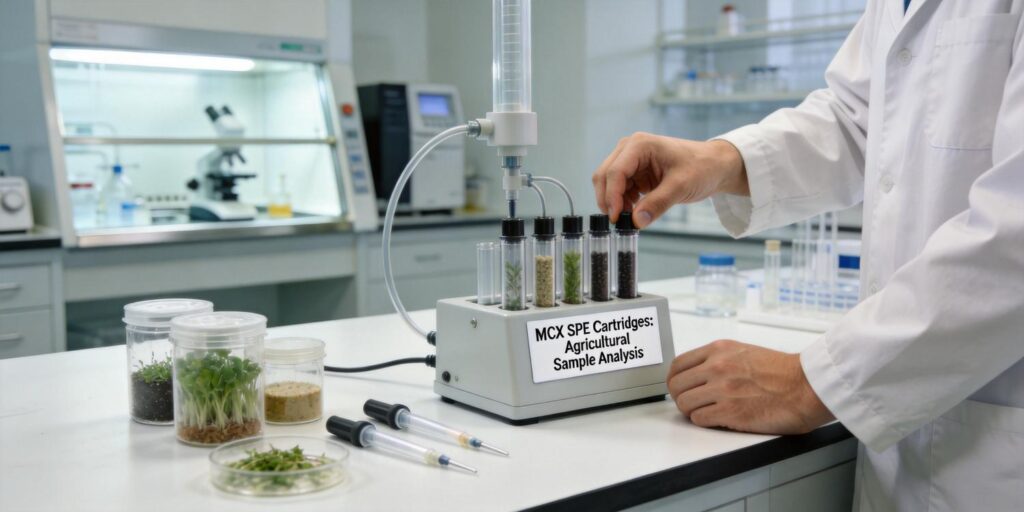
Alkaloids are basic in nature due to the presence of one or more nitrogen atoms, typically in a heterocyclic ring. Their pKa values generally range from 6 to 10, meaning they exist in protonated (cationic) form under acidic conditions and neutral (free base) form at higher pH. This pH-dependent ionization behavior makes them ideal candidates for mixed-mode solid-phase extraction (SPE) using MCX (mixed-mode cation exchange) sorbents. MCX combines a strong cation exchange functionality (sulfonic acid groups) with reversed-phase retention (C18 or polymeric backbone), allowing selective capture of basic compounds while allowing neutral and acidic interferences to be washed away.
Extraction of Plant Tissue Samples
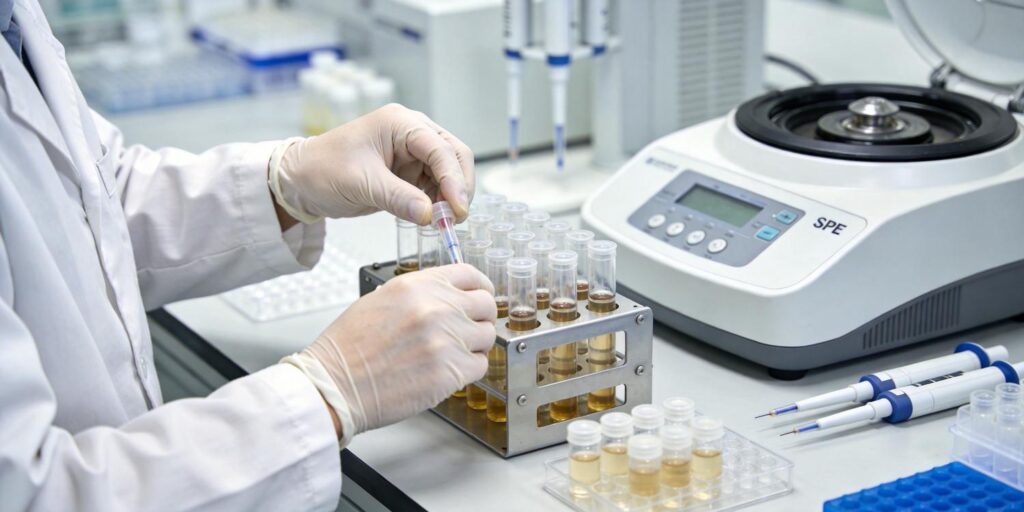
Plant tissue samples (e.g., leaves, seeds, roots) must be properly prepared to release alkaloids from the cellular matrix. The typical workflow begins with drying and grinding the sample to a fine powder. An acidified extraction solvent (e.g., 0.1% formic acid in water/methanol, 80:20 v/v) is added to protonate the alkaloids and improve their solubility. The mixture is homogenized using a high-speed blender or bead mill, followed by sonication and centrifugation. The resulting supernatant contains the alkaloids along with many co-extractives such as pigments, lipids, and sugars. A clean-up step using MCX SPE is crucial to isolate alkaloids before LC-MS analysis.
Conditioning and Equilibration of MCX Cartridges
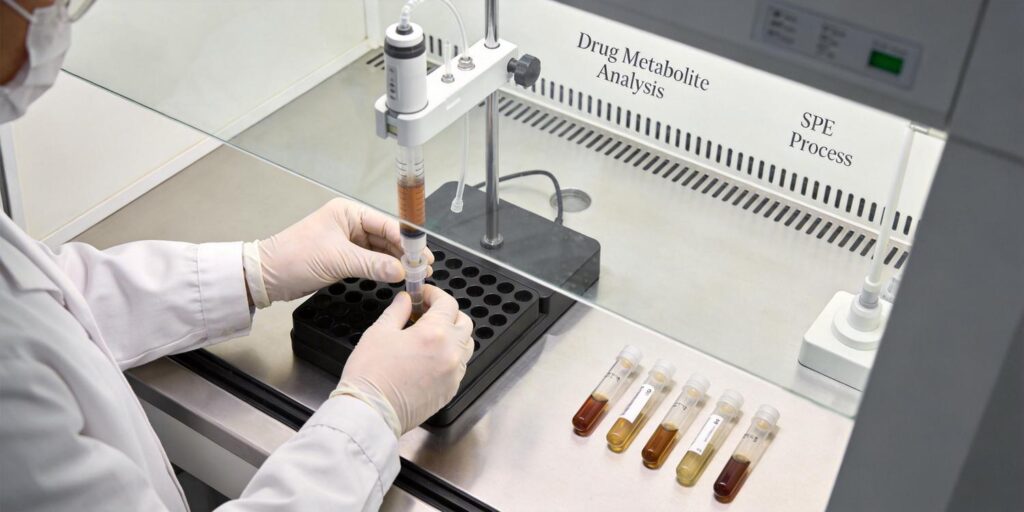
Before loading the sample, the MCX cartridge must be conditioned to activate both the ion exchange and reversed-phase retention mechanisms. Start with 3 mL of methanol to wet the sorbent and remove any impurities, followed by 3 mL of water to equilibrate. Methanol solvates the polymeric backbone, enhancing reversed-phase interactions, while water prepares the sulfonic acid groups for cation exchange. Some protocols recommend an additional conditioning step with a buffer at low pH (e.g., 0.1% formic acid in water) to ensure the sorbent is fully protonated for optimal cation exchange capacity.
Sample Loading with Acidified Solutions
The clarified plant extract is typically acidified to pH 2–3 using formic or hydrochloric acid to keep alkaloids in their protonated form. The sample is then loaded onto the conditioned MCX cartridge at a slow flow rate (1–2 mL/min) to ensure efficient binding. Protonated alkaloids are retained via strong cation exchange interactions with the sulfonic acid groups, while neutral and acidic compounds pass through. The cartridge can be loaded with up to several milliliters of extract, depending on the capacity specified by the manufacturer (e.g., 30 mg sorbent can retain about 0.3–0.5 meq/g).
Washing Steps Removing Pigments and Fats
After sample loading, a wash step removes weakly retained interferences. A typical wash uses 2–3 mL of 0.1% formic acid in water to rinse away residual matrix components that are not retained by ion exchange. For samples rich in pigments (e.g., chlorophyll) or fats, a second wash with 2 mL of methanol or acetonitrile (containing 0.1% formic acid) may be applied. The organic wash disrupts reversed-phase interactions, flushing out non-polar interferences while the cation-exchanged alkaloids remain bound. It is critical to ensure the wash solvent pH remains acidic to prevent premature elution of the target compounds.
Elution with Basic Organic Solvents
To elute the purified alkaloids, the ion exchange interaction must be neutralized and the reversed-phase interaction must be favored. Elution is achieved with a basic organic solvent mixture, typically 2–3 mL of 5% ammonium hydroxide in methanol (v/v) or 5% ammonia in acetonitrile. The high pH deprotonates the alkaloids and the sulfonic acid groups, breaking the ionic bond, while the organic solvent promotes desorption from the reversed-phase sites. The eluate is collected in a clean tube, then evaporated to dryness under nitrogen and reconstituted in a suitable LC-MS mobile phase (e.g., 0.1% formic acid in water/methanol).
LC-MS Detection Workflow
The final extract is analyzed by liquid chromatography coupled with mass spectrometry (LC-MS) or LC-MS/MS. A reversed-phase C18 column with a gradient of water and acetonitrile (both acidified with 0.1% formic acid) is commonly used for separation. The mass spectrometer is operated in positive electrospray ionization (ESI+) mode, where alkaloids form [M+H]+ ions. Multiple reaction monitoring (MRM) provides high selectivity and sensitivity, enabling quantification of alkaloids at parts-per-billion (ppb) levels. Calibration standards are prepared in blank matrix to compensate for matrix effects. The entire SPE procedure, when optimized, can achieve recoveries of 85–110% with relative standard deviations below 10%.
For more information on our MCX SPE cartridges and other SPE products, visit Poseidon Scientific MCX SPE Cartridges. Explore our full range of SPE solutions, including HLB, MAX, WAX, and WCX cartridges, as well as our 96-well SPE plates for high-throughput applications.