Environmental Concern of PAH Contamination
Polycyclic aromatic hydrocarbons (PAHs) are a class of persistent organic pollutants characterized by fused aromatic rings. They are primarily generated through incomplete combustion of organic matter, including fossil fuels, biomass, and tobacco. Common sources include vehicle emissions, industrial discharges, oil spills, and wildfires. PAHs are of significant environmental concern due to their carcinogenic, mutagenic, and teratogenic properties. The United States Environmental Protection Agency (USEPA) has listed 16 priority PAHs for monitoring, including benzo[a]pyrene, chrysene, and naphthalene. Soil acts as a major sink for PAHs, where they can accumulate and pose risks to ecosystems and human health through direct contact, food chain transfer, or groundwater contamination. Therefore, accurate and reliable analytical methods for PAH determination in soil are essential for risk assessment and remediation efforts.
Soil Extraction Methods Using Organic Solvents
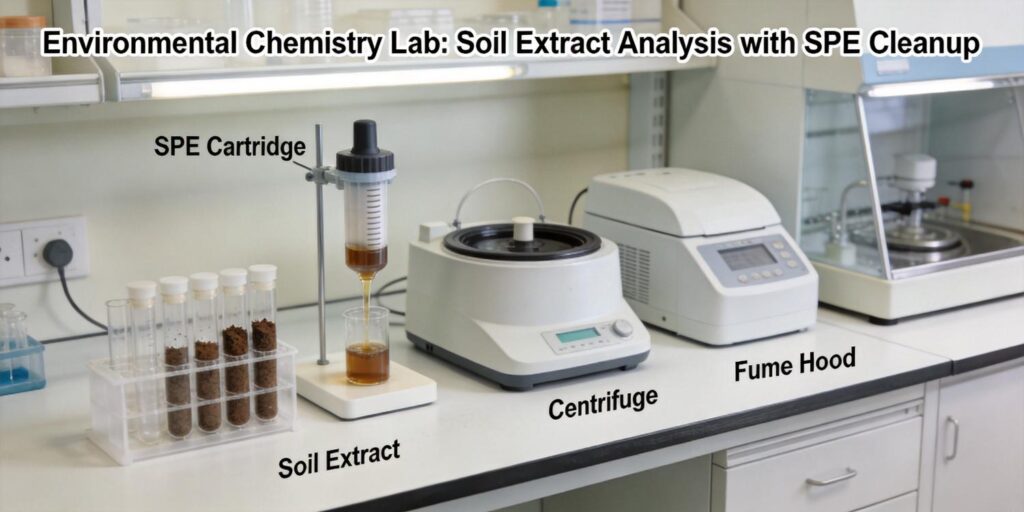
Extracting PAHs from soil typically begins with a solvent extraction step to transfer the analytes from the solid matrix into a liquid phase. Common techniques include Soxhlet extraction, accelerated solvent extraction (ASE), and ultrasound-assisted extraction. Solvents such as hexane, dichloromethane (DCM), acetone, or mixtures thereof are used due to their ability to solubilize non-polar PAHs. For example, a 1:1 (v/v) mixture of hexane and DCM is often employed for efficient recovery. The extraction process may involve 10–20 g of soil sample, with 30–100 mL of solvent, and extraction times ranging from 15 minutes (ASE) to several hours (Soxhlet). However, these crude extracts contain co-extracted interferences like humic acids, lipids, and other organic matter, which can compromise chromatographic analysis and detection. This necessitates a cleanup step prior to instrumental analysis, and solid-phase extraction (SPE) is a widely adopted technique for this purpose.
SPE Cleanup Advantages for PAH Analysis
Solid-phase extraction (SPE) offers several advantages over traditional cleanup methods such as liquid-liquid extraction or column chromatography. SPE provides higher selectivity, reduced solvent consumption, faster processing, and ease of automation. For PAH analysis in soil extracts, HLB SPE cartridges (hydrophilic-lipophilic balanced) or MAX SPE cartridges (mixed-mode anion exchange) are commonly recommended. HLB cartridges retain both polar and non-polar analytes, making them suitable for broad-spectrum cleanup. Alternatively, WAX SPE cartridges (weak anion exchange) can be used for selective removal of acidic interferences. The choice of sorbent depends on the specific soil matrix and interfering compounds. For instance, a study by Wang et al. (2020) demonstrated that HLB sorbent achieved >90% recovery for 16 priority PAHs with efficient removal of humic substances.
Conditioning and Loading Procedures
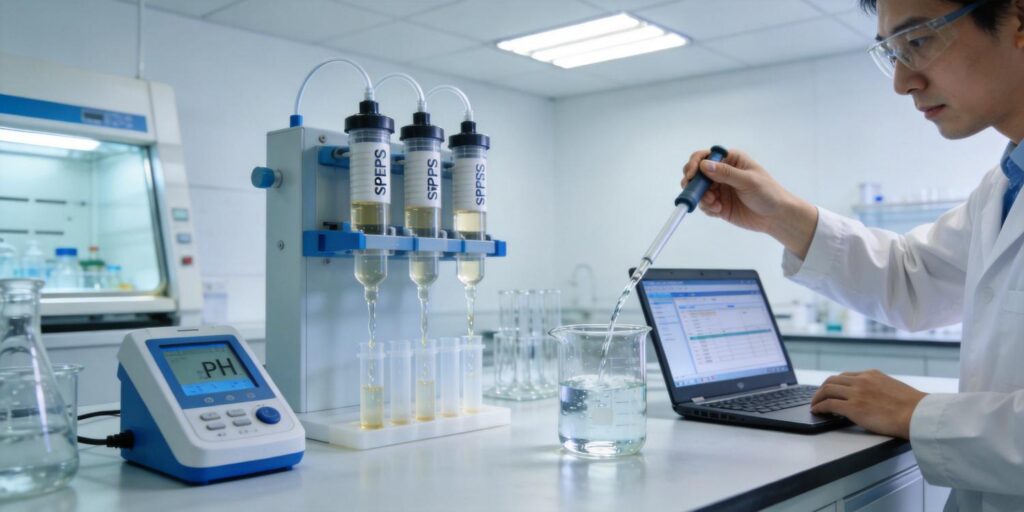
Proper conditioning of the SPE cartridge is critical to ensure reproducible retention and recovery. For PAH analysis using HLB cartridges, the conditioning step typically involves passing 5–10 mL of methanol followed by 5–10 mL of water or the loading solvent (e.g., 5% methanol in water). This activates the sorbent and creates a suitable environment for analyte retention. The soil extract, after solvent exchange into a water-miscible solvent (e.g., acetonitrile or methanol), is diluted with water to reduce the organic solvent content to <10% (v/v). This diluted extract is then loaded onto the conditioned cartridge at a flow rate of 1–2 mL/min. For soil samples with high organic content, using MCX SPE cartridges (mixed-mode cation exchange) may help retain interfering basic compounds. The loading capacity should be optimized to avoid breakthrough; typically, up to 500 mg of soil equivalent can be loaded on a 60 mg cartridge.
Washing Steps Removing Humic Substances
After loading, a washing step is employed to remove co-retained interferences, particularly humic and fulvic acids, which are common in soil extracts. These substances can cause ion suppression in mass spectrometry and column contamination in GC analysis. A wash solution of 5–10% methanol in water (e.g., 5 mL) is effective in eluting polar interferences while retaining PAHs. For more aggressive removal, a wash with 0.1 M hydrochloric acid (for basic interferences) or 0.1 M sodium hydroxide (for acidic interferences) can be applied if using mixed-mode sorbents like WCX SPE cartridges (weak cation exchange). However, for non-polar PAHs, a simple aqueous-methanol wash is usually sufficient. The wash volume should be kept to a minimum to avoid premature elution of target analytes.
Elution Using Non-Polar Solvents
PAHs are eluted from the SPE cartridge using a non-polar solvent such as hexane, DCM, or a mixture thereof. Typically, 5–10 mL of hexane or hexane:DCM (1:1, v/v) is passed through the cartridge at a flow rate of 1–2 mL/min. The eluate is collected and then concentrated under a gentle stream of nitrogen to a final volume of 1 mL or to dryness for reconstitution in a suitable injection solvent (e.g., isooctane). For more retained PAHs, such as those with high molecular weight (e.g., dibenzo[a,h]anthracene), elution with DCM may be more efficient. The 96-well SPE plate format can be used for high-throughput sample preparation, allowing simultaneous processing of multiple samples.
GC-MS Detection Parameters
Gas chromatography-mass spectrometry (GC-MS) is the standard technique for PAH analysis. The GC column is typically a 5% phenyl-95% dimethylpolysiloxane (e.g., HP-5MS, DB-5MS) with dimensions 30 m × 0.25 mm × 0.25 μm. The temperature program is optimized for PAH separation: initial temperature 60°C held for 1 min, ramped at 20°C/min to 150°C, then 5°C/min to 310°C, held for 5 min. Helium is used as carrier gas at a constant flow rate of 1.0 mL/min. Injection is performed in splitless mode at 280°C with an injection volume of 1 μL. The mass spectrometer is operated in electron ionization (EI) mode at 70 eV, with selected ion monitoring (SIM) for quantitation. For example, quantification ions for naphthalene (m/z 128), phenanthrene (m/z 178), and benzo[a]pyrene (m/z 252) are monitored. The transfer line temperature is set at 300°C and ion source at 230°C.
Method Performance Metrics
The SPE-GC-MS method for PAH analysis in soil should be validated in terms of linearity, limit of detection (LOD), limit of quantification (LOQ), precision, and accuracy. Typical linear calibration ranges are from 0.5 to 500 ng/mL with correlation coefficients >0.999. LODs for PAHs are usually below 0.1 μg/g soil, and LOQs around 0.3 μg/g. Recovery studies using spiked soil samples (e.g., at 10 and 100 μg/g) show recoveries between 85% and 115% with relative standard deviations (RSDs) less than 15%. The method is robust for a variety of soil types (sandy, loamy, clay), though matrix effects may necessitate matrix-matched calibration or internal standards (e.g., deuterated PAHs like d10-phenanthrene). The SPE cleanup significantly reduces background interferences, improving signal-to-noise ratios and ensuring reliable quantification. For laboratories following USEPA Method 8270, this SPE-based approach is fully compatible.