Types of Synthetic Dyes in Confectionery
Synthetic dyes are widely used in candy products to achieve vibrant, consistent colors. Common examples include Tartrazine (E102, Yellow 5), Sunset Yellow (E110, Yellow 6), Quinoline Yellow (E104), Azorubine (E122, Carmoisine), Ponceau 4R (E124, Red 4), Allura Red (E129, Red 40), Brilliant Blue (E133, Blue 1), and Indigotine (E132, Blue 2). These azo and triarylmethane dyes are favored for their stability and low cost. Regulatory limits vary by region; for instance, the EU sets maximum levels per dye per food category, while the FDA certifies batches for use in the US. Accurate quantitation is crucial to ensure compliance and consumer safety.
Matrix Challenges of Candy Samples
Candy samples present a complex matrix for dye analysis. High sugar content (sucrose, glucose, fructose) can cause viscosity issues, interfere with chromatographic separation, and suppress ionization in mass spectrometry. Fats, waxes, gelatin, and gums in chewy or gummy candies may co-extract and clog columns. Natural pigments from fruit concentrates, acidity regulators (citric acid), and preservatives (sorbates, benzoates) can also co-elute with target dyes. Efficient sample cleanup is essential to remove these interferences without losing the analytes of interest.
Sample Dissolution and Filtration
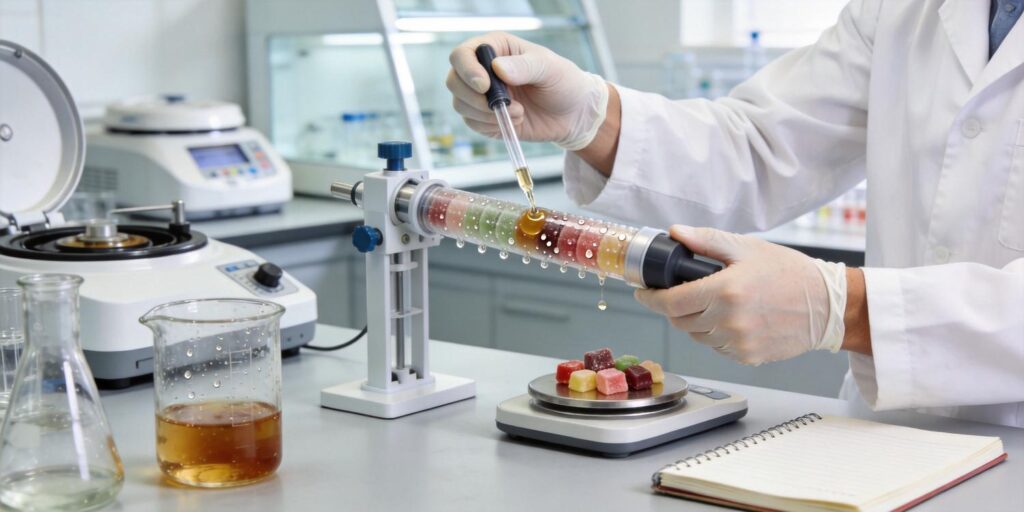
For solid candies, a representative sample is ground and dissolved in a suitable solvent. Water with a small amount of organic modifier (e.g., 5% methanol) is typically used to ensure complete dissolution while maintaining dye solubility. The solution is heated gently (e.g., 40 °C) under sonication to break down gelatin or gum structures. After cooling, the sample is centrifuged or filtered through a 0.45 μm membrane filter (e.g., PTFE or nylon) to remove particulate matter. For colored hard candies, dissolution in warm water followed by filtration is often sufficient. For chewy or chocolate-based products, a defatting step with hexane may be added prior to aqueous extraction.
SPE Sorbent Selection for Dye Compounds
For synthetic dyes, mixed-mode reversed-phase and ion-exchange sorbents are recommended. The MAX (Mixed-mode Anion Exchange) sorbent is ideal for anionic dyes (all common sulfonated azo dyes), offering both hydrophobic retention and strong anion exchange. Alternatively, WAX (Weak Anion Exchange) can be used for milder retention, while WCX (Weak Cation Exchange) suits cationic dyes. For broad-spectrum cleanup, HLB (Hydrophilic-Lipophilic Balance) cartridges provide good retention of neutral and ionizable dyes. The MCX (Mixed-mode Cation Exchange) is preferable for basic dyes. Selecting the right sorbent ensures high recovery and effective removal of sugars and additives.
Conditioning and Loading Protocol
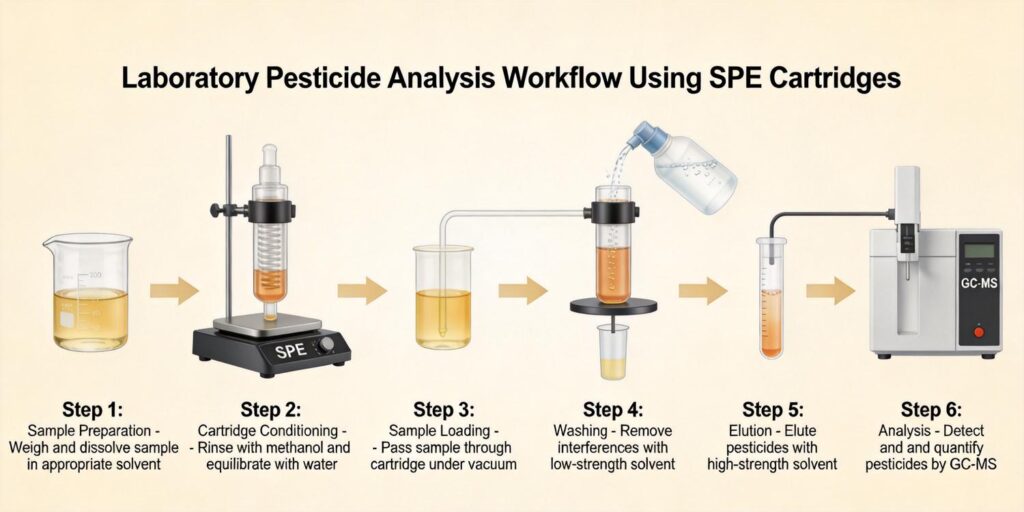
Condition the SPE cartridge with 3 mL of methanol followed by 3 mL of water (or buffer at loading pH). For MAX or WAX, the cartridge should be buffered to pH ~6–7 to deprotonate the sorbent. Load the filtered sample extract (typically 5–10 mL) at a low flow rate (1 mL/min) to maximize binding. For anionic dyes on MAX, the acidic sulfonate groups are retained via ion exchange. After loading, wash the cartridge with 2 mL of water to remove loosely bound sugars and polar interferences.
Washing Steps Removing Sugars and Additives
After loading, a washing step with 5% methanol in water (3 mL) helps elute residual sugars, organic acids, and non-retained compounds. For fatty matrices, a wash with hexane (2 mL) can remove lipids. A second wash with 0.1 M acetate buffer (pH 5) may further eliminate weakly acidic interferences without affecting dye retention on MAX. Ensure the wash solvent does not exceed 20% organic content to prevent premature dye elution. This step is critical to achieve a clean chromatogram for HPLC-DAD analysis.
Elution Conditions
Elute the retained dyes using a solvent that disrupts both hydrophobic and ionic interactions. For MAX cartridges, acidified methanol (e.g., 2% formic acid in methanol) is effective: 3 mL at 1 mL/min. The acidic modifier protonates the sulfonate groups, neutralizing the charge while methanol breaks hydrophobic interactions. For WAX or HLB, 0.1% ammonium hydroxide in methanol may be used. Collect the eluate in a glass tube, evaporate under nitrogen at 40 °C, and reconstitute in 1 mL of mobile phase (e.g., 0.1 M ammonium acetate at pH 4.5). Filter through a 0.22 μm syringe filter before injection.
HPLC-DAD Detection Workflow
Separate dyes on a reversed-phase C18 column (e.g., 250 × 4.6 mm, 5 μm) with gradient elution. Mobile phase A: 0.1 M ammonium acetate buffer (pH 4.5); mobile phase B: methanol/acetonitrile (50:50). Gradient: 0 min, 5% B; 5 min, 30% B; 15 min, 60% B; 20 min, 80% B; hold 2 min; re-equilibrate. Flow rate: 1 mL/min. Detection: DAD at 428 nm (yellow dyes), 520 nm (red dyes), and 620 nm (blue dyes). Quantitation via external calibration curves (0.5–50 μg/mL). Recovery should be 80–120% with RSD < 15%. The method can be expanded to LC-MS/MS for confirmation.
Food Safety Compliance Requirements
Regulations such as EU Regulation 1333/2008 and FDA 21 CFR Part 74 set maximum permitted levels for synthetic dyes in confectionery. For example, the EU allows up to 300 mg/kg of Sunset Yellow in candies, while the FDA limits for Yellow 5 and Yellow 6 are 300 mg/kg and 500 mg/kg, respectively. Accurate quantification is mandatory for export. Use certified reference standards and run spiked samples to verify method performance. For multi-residue analysis, 96-well SPE plates can streamline high-throughput screening. Regular participation in proficiency testing ensures compliance with ISO 17025. Implementing a robust SPE cleanup protocol as described will produce reliable, audit-ready data.