Regulatory Monitoring of Antibiotic Residues in Eggs
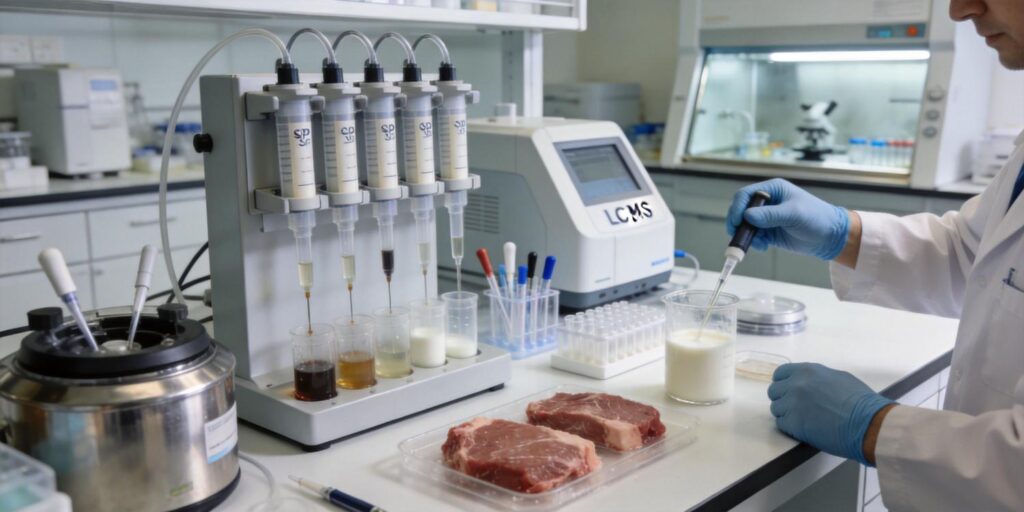
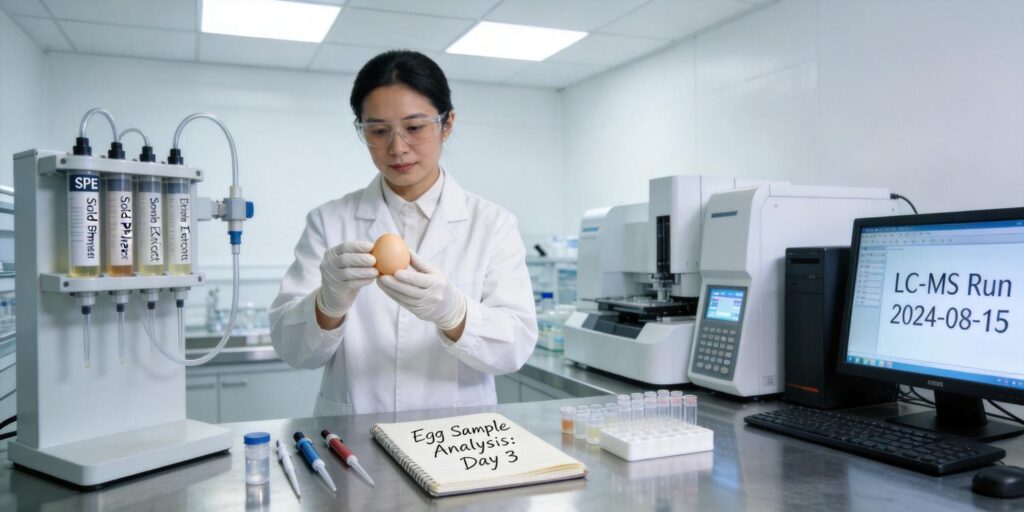
Eggs are a staple source of protein globally, and their safety is paramount. Regulatory agencies such as the U.S. FDA, European Commission, and Codex Alimentarius have established maximum residue limits (MRLs) for veterinary antibiotics in eggs. Common monitored antibiotics include tetracyclines, sulfonamides, fluoroquinolones, and macrolides, which are used in poultry farming to treat or prevent infections. Regular monitoring programs utilize liquid chromatography coupled with tandem mass spectrometry (LC-MS/MS) to ensure compliance. Solid-phase extraction (SPE) is the preferred sample preparation technique due to its ability to clean up complex matrices and concentrate analytes. High recoveries and low detection limits are essential, and method validation must follow guidelines such as SANTE/11312/2021 or FDA’s Bioanalytical Method Validation Guidance.
Egg Matrix Challenges: Lipids and Proteins
The egg matrix presents unique challenges for antibiotic extraction. Eggs are rich in proteins (approximately 12-14%) and lipids (around 10-12%), including phospholipids and triglycerides. These components can co-extract with target analytes, causing ion suppression or enhancement in LC-MS/MS, column fouling, and reduced sensitivity. Proteins can precipitate and clog SPE cartridges, while lipids may form emulsions during solvent extraction. To overcome these issues, sample preparation must include effective defatting and protein removal steps. Methods often employ acidified organic solvents for protein precipitation and liquid-liquid extraction (LLE) with non-polar solvents for lipid removal. However, integrating these steps with SPE requires careful optimization of the SPE protocol to ensure high recovery of polar and non-polar antibiotics.
Sample Homogenization and Extraction Solvent Selection
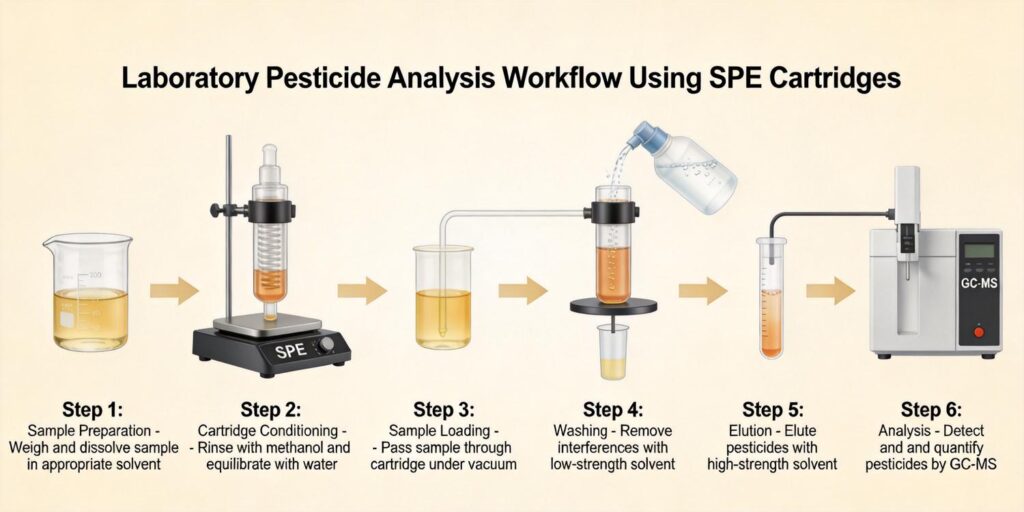
Initial sample preparation begins with homogenization of whole eggs (including yolk and albumen) using a blender or homogenizer. A representative sample (typically 1-5 g) is then weighed into a tube. For extraction, a mixture of acetonitrile (ACN) and water (e.g., 80:20, v/v) acidified with formic acid (0.1-1%) is commonly used, as it precipitates proteins and extracts a broad range of antibiotics. Some protocols use ethyl acetate or methanol for specific compound classes. After vigorous shaking and centrifugation, the supernatant is collected and diluted with water or buffer to reduce the organic content before SPE loading. This dilution step is critical to ensure proper retention on reversed-phase or mixed-mode sorbents.
SPE Cartridge Conditioning and Loading
Cartridge selection depends on the target antibiotics. Mixed-mode sorbents such as MCX (mixed-mode cation exchange) or MAX (mixed-mode anion exchange) are ideal for acidic/basic compounds, while HLB (hydrophilic-lipophilic balanced) is suitable for a wide polarity range. Conditioning typically involves 3-5 mL of methanol followed by 3-5 mL of water or buffer. The diluted extract is loaded onto the cartridge at a flow rate of 1-2 mL/min to ensure proper interaction. For mixed-mode cartridges, pH adjustment of the loading solution is crucial to maintain the desired ionization state of the analytes.
Washing Steps to Remove Fats and Phospholipids
After loading, a washing step is performed to remove interfering matrix components. A common wash solvent is 5% methanol in water (or 0.1% formic acid in water) for HLB cartridges, which elutes polar interferences while retaining analytes. For mixed-mode sorbents, a wash with 0.1 M HCl or 0.1 M NaOH (depending on sorbent type) can remove proteins and salts. A second wash with a non-polar solvent like hexane or cyclohexane is often used to remove lipids and phospholipids. This step significantly reduces matrix effects in LC-MS/MS. Care must be taken to avoid analyte loss; for example, hexane wash should be performed before any elution of the target compounds.
Elution Solvent Optimization
Elution is performed with a small volume (3-6 mL) of an appropriate solvent to recover the antibiotics. For HLB, methanol or acetonitrile is typically used. For MCX, 5% ammonium hydroxide in methanol is employed to neutralize the sorbent and elute basic compounds. For MAX, 5% formic acid in methanol is used for acidic analytes. The eluate is then evaporated to dryness under nitrogen and reconstituted in a mobile phase-compatible solvent (e.g., 10% methanol in water with 0.1% formic acid) for LC-MS/MS injection. Recovery rates should be above 70% for most antibiotics; optimization of elution volume and pH may be necessary for multi-class methods.
LC-MS/MS Detection Method
LC-MS/MS analysis is performed using a C18 reversed-phase column (e.g., 2.1 × 100 mm, 1.8 μm) with a mobile phase consisting of water (with 0.1% formic acid) and methanol or acetonitrile (with 0.1% formic acid). A gradient elution program is used to separate the antibiotics within 10-15 minutes. Mass spectrometry detection is carried out in positive electrospray ionization (ESI+) mode with multiple reaction monitoring (MRM) for quantification and confirmation. At least two MRM transitions per compound are monitored. Typical parameters include a capillary voltage of 3.5 kV, desolvation temperature of 350°C, and collision energy optimized for each analyte.
Recovery and Method Validation Parameters
Method validation follows guidelines such as SANTE/11312/2021. Linearity is evaluated over the range of 0.5-200 μg/kg with correlation coefficients >0.99. Recovery experiments are spiked at three concentration levels (e.g., 1, 10, and 50 μg/kg) in triplicate, yielding recoveries between 80-110% with RSD <20%. Limits of detection (LOD) and quantification (LOQ) are determined as signal-to-noise ratios of 3 and 10, respectively, typically achieving LODs below 0.5 μg/kg. Matrix effects are assessed by comparing post-extraction spiked samples with neat solutions. For QA/QC, solvent blanks, matrix blanks, and spiked samples are included in each batch. Our Poseidon Scientific HLB, MAX, MCX, WAX, and WCX SPE cartridges, as well as 96-well SPE plates, provide consistent performance for such validation studies, offering high batch-to-batch reproducibility and low lot-to-lot variability.