Technical Deep Dive

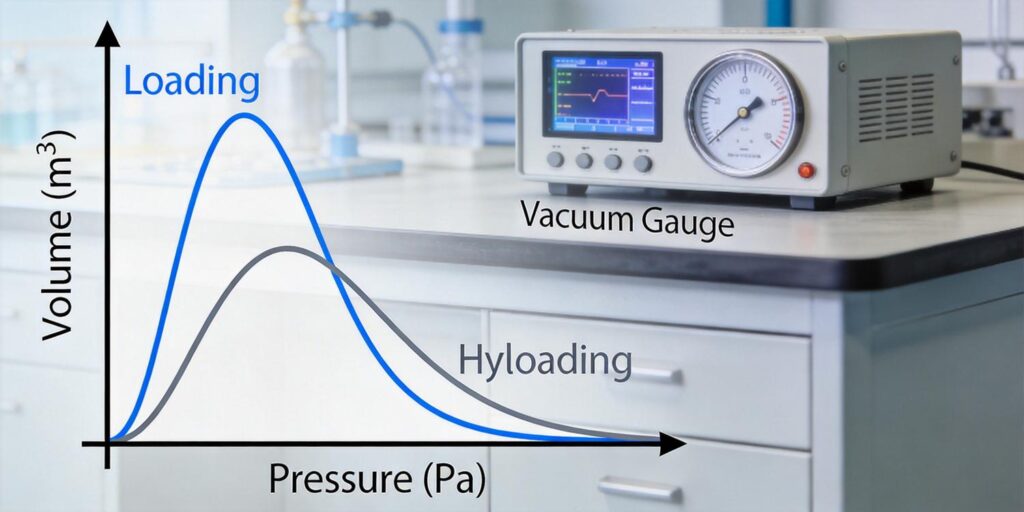
Vacuum gauge display on industrial coating chamber

Why Vacuum Gauge Repeatability Matters More Than Absolute Accuracy in Some Processes

In vacuum-dependent manufacturing and research, engineers often debate whether a gauge’s absolute accuracy or its repeatability deserves priority. For many production processes—continuous coating, heat treatment, or semiconductor wafer processing—repeatability consistently proves more valuable. A gauge that delivers the same reading today, tomorrow, and next week under identical chamber conditions enables tighter statistical process control, fewer […]

Why Vacuum Gauge Repeatability Matters More Than Absolute Accuracy in Some Processes Read More »

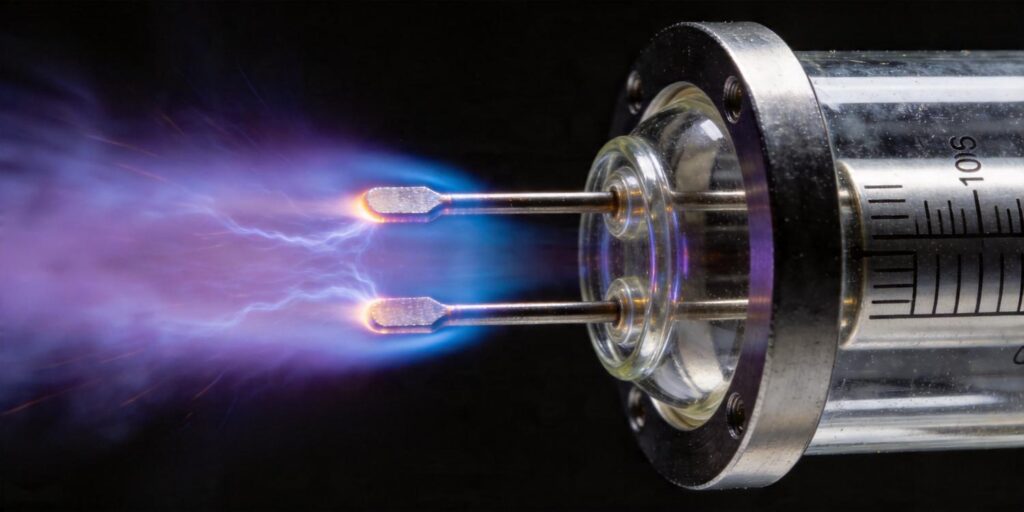
Vacuum gauge mounted near sputtering plasma chamber

Vacuum Gauge Sensitivity to Electromagnetic Fields in Sputtering Systems

In physical vapor deposition (PVD) and magnetron sputtering systems, accurate vacuum measurement is essential for process stability, film uniformity, and equipment protection. Yet the very plasma that enables deposition—driven by RF or pulsed-DC power supplies—generates intense electromagnetic interference (EMI) that can corrupt gauge signals. Engineers routinely observe noisy analog outputs, false pressure readings, delayed cold-cathode

Vacuum Gauge Sensitivity to Electromagnetic Fields in Sputtering Systems Read More »

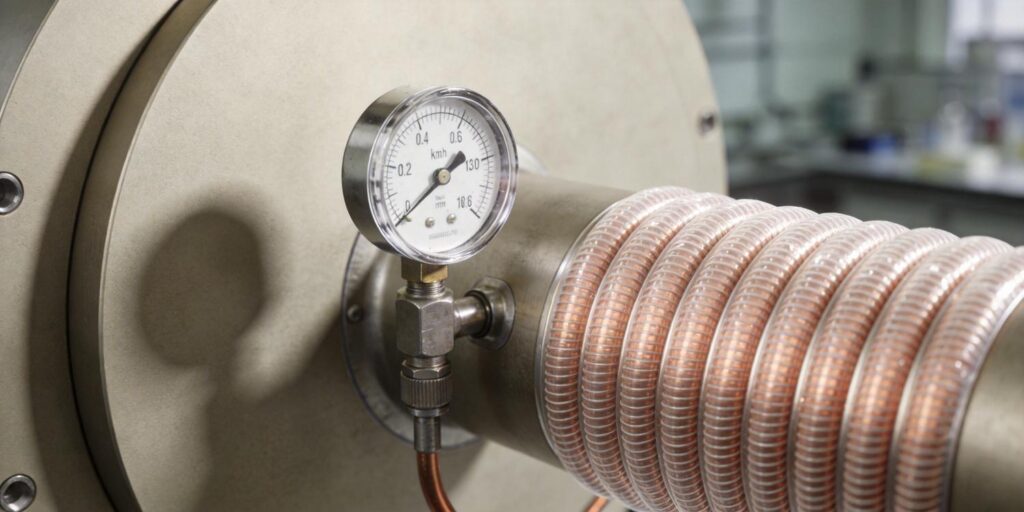
Vacuum gauge mounted on extended stainless steel pipeline

Understanding Gauge Conductance Limitations in Long Vacuum Lines

In vacuum systems, precise pressure measurement is essential for process control, equipment protection, and experimental repeatability. Yet one often-overlooked factor can introduce significant errors: the conductance of the tubing connecting a vacuum gauge to the chamber. When gauges such as the Poseidon Scientific VG-SP205 Pirani Vacuum Transmitter or VG-SM225 Cold Cathode Vacuum Gauge are mounted

Understanding Gauge Conductance Limitations in Long Vacuum Lines Read More »

Cold cathode vacuum gauge installed on industrial chamber

Cold Cathode Gauge Current Stability and Its Impact on Measurement Linearity

Explain Discharge Current Regulation Principle Cold-cathode gauges, such as Poseidon Scientific’s VG-SM225 Cold Cathode Vacuum Gauge, operate on the Penning discharge principle. A high negative voltage is applied to the cathode (initial startup at –2500 V, then regulated to –2000 V working voltage) while a permanent NdFeB magnet produces an axial field of approximately 100

Cold Cathode Gauge Current Stability and Its Impact on Measurement Linearity Read More »

Vacuum gauge mounted on plasma sputtering chamber

How Plasma Processes Influence Vacuum Gauge Readings

Plasma Density Effect on Ionization Gauges In plasma-enhanced processes such as reactive sputtering, PECVD, and plasma etching, the vacuum chamber contains a dense cloud of ions, electrons, and excited neutrals. This external plasma directly influences ionization-type vacuum gauges because their measurement principle already relies on electron–molecule collisions to generate a measurable ion current. The VG-SM225

How Plasma Processes Influence Vacuum Gauge Readings Read More »

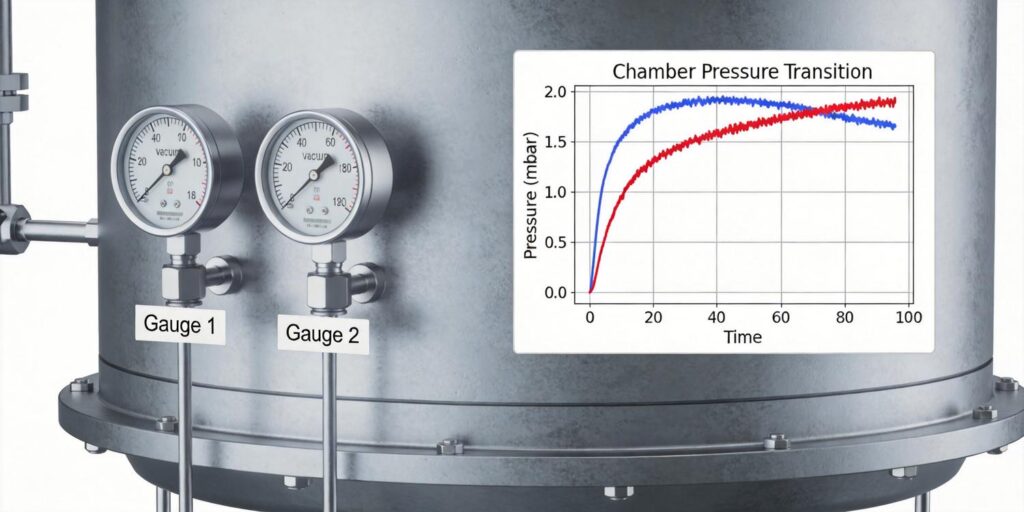
High vacuum chamber with installed vacuum gauge

How Outgassing Skews High Vacuum Measurements

Define Material Outgassing Outgassing is the spontaneous release of trapped or adsorbed gases from the surfaces and bulk of materials inside a vacuum chamber. These gases—primarily water vapor, hydrogen, carbon monoxide, and hydrocarbons—originate from atmospheric exposure, manufacturing residues, or dissolved species within metals, polymers, and ceramics. In high-vacuum systems the dominant source is physisorbed and

How Outgassing Skews High Vacuum Measurements Read More »

Pirani vacuum transmitter mounted on laboratory vacuum system

Pirani Gauge Accuracy Limits Below 1E-3 mbar

Thermal Conductivity Limit in Molecular Flow Pirani gauges measure pressure by sensing the heat loss from a heated filament (typically platinum) to the surrounding gas. At higher pressures, in the viscous-flow regime, thermal conductivity increases linearly with gas density, providing excellent sensitivity. As pressure drops into the transition region (roughly 10 Torr to 10⁻² Torr),

Pirani Gauge Accuracy Limits Below 1E-3 mbar Read More »

Cold cathode vacuum gauge installed on industrial vacuum chamber

Cold Cathode Gauge Overpressure Exposure: What Happens Above 1 mbar?

Plasma Discharge Behavior at High Pressure Cold cathode gauges rely on the Penning (magnetron) discharge to ionize gas molecules. A high negative voltage (–2000 V operating, –2500 V for startup) combined with a ~100 gauss magnetic field traps electrons in long spiral paths, creating an avalanche of ions whose current is proportional to pressure. This

Cold Cathode Gauge Overpressure Exposure: What Happens Above 1 mbar? Read More »

Ionization vacuum gauges mounted on industrial chamber

Cold Cathode vs Hot Cathode Gauges: Cost and Maintenance Comparison

Structural Differences Hot cathode and cold cathode ionization gauges both measure vacuum by ionizing gas molecules and collecting the resulting ion current, but their fundamental designs differ dramatically in how electrons are generated and how the discharge is sustained. A hot cathode gauge, often based on the Bayard-Alpert or triode geometry, relies on a thermionic

Cold Cathode vs Hot Cathode Gauges: Cost and Maintenance Comparison Read More »

Cold cathode vacuum gauge mounted on industrial vacuum system

How Contamination Affects Cold Cathode Plasma Stability

Plasma Discharge Principle in Cold Cathode Gauges Cold cathode ionization gauges, such as Poseidon Scientific’s VG-SM225, operate on the Penning discharge principle. A high-voltage electric field (typically –2000 V working, –2500 V startup) combined with an axial magnetic field (~100 gauss from NdFeB permanent magnets) traps electrons in cycloidal or spiral paths. These electrons collide

How Contamination Affects Cold Cathode Plasma Stability Read More »

Shopping Cart
Poseidon Scientific
Privacy Overview

This website uses cookies so that we can provide you with the best user experience possible. Cookie information is stored in your browser and performs functions such as recognising you when you return to our website and helping our team to understand which sections of the website you find most interesting and useful.