
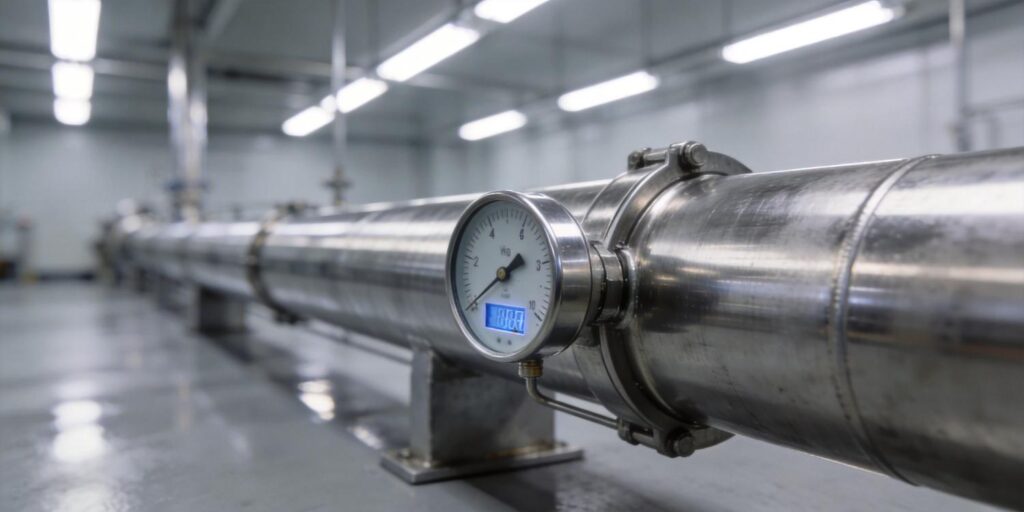
In vacuum systems, precise pressure measurement is essential for process control, equipment protection, and experimental repeatability. Yet one often-overlooked factor can introduce significant errors: the conductance of the tubing connecting a vacuum gauge to the chamber. When gauges such as the Poseidon Scientific VG-SP205 Pirani Vacuum Transmitter or VG-SM225 Cold Cathode Vacuum Gauge are mounted at the end of long vacuum lines, the pressure at the gauge may differ from the true chamber pressure due to limited gas flow through the pipe. Understanding conductance limitations helps engineers and procurement teams select optimal installation practices and avoid costly measurement inaccuracies.
This article examines the physics of conductance, its dependence on geometry and flow regime, practical calculation examples, and proven strategies for reliable gauge placement. The principles apply directly to real-world applications of thermal-conductivity (Pirani) and cold-cathode ionization gauges in analytical instruments, vacuum furnaces, and coating systems.
Defining Conductance Mathematically
Conductance \(C\) quantifies a vacuum component’s ability to transport gas. It is defined by the relation
\[ C = \frac{Q}{P_a – P_s} \]
where \(Q\) is the gas throughput (in Pa·L/s or Torr·L/s), \(P_a\) is the upstream pressure, and \(P_s\) is the downstream pressure. The units of \(C\) are typically L/s (liter per second). Conductance is analogous to electrical conductance, with pressure difference playing the role of voltage and throughput the role of current.
For components in series—such as a long tube plus a flange—the reciprocal conductances add:
\[ \frac{1}{C_n} = \frac{1}{C_1} + \frac{1}{C_2} + \cdots \]
This series rule is critical when evaluating the net conductance between a chamber and a remotely mounted gauge. Low net \(C\) creates a measurable pressure drop whenever any net gas load (outgassing, leaks, or gauge pumping) exists.
Pipe Diameter and Length Influence
In the molecular-flow regime typical of high-vacuum operation, conductance scales strongly with geometry. For a long cylindrical tube the molecular-flow conductance for air at 20 °C is
\[ C_m \approx 12.1 \frac{d^3}{L} \quad (\text{L/s, } d \text{ and } L \text{ in cm}) \]
Diameter \(d\) appears cubed, while length \(L\) appears linearly in the denominator. Doubling the diameter multiplies conductance by eight; doubling the length halves it. A 10 mm diameter, 1 m long tube yields only ~0.12 L/s—orders of magnitude below the effective pumping speed of most turbomolecular or diffusion pumps. In contrast, a 25 mm (KF25) tube of the same length provides ~1.9 L/s, dramatically reducing the pressure gradient.
Short, wide tubing (or direct chamber mounting) maximizes conductance and keeps the gauge reading representative of the process volume. Narrow or extended lines quickly become the dominant impedance in the system.
Viscous versus Molecular Flow Effect
The flow regime—and therefore the conductance dependence—shifts with pressure and the Knudsen number \(Kn = \lambda / d\), where \(\lambda\) is the mean free path.
- Molecular flow (\(Kn > 1\), typical below ~10⁻³ Torr): Molecules travel wall-to-wall without colliding with one another. Conductance is independent of pressure and proportional to \(d^3/L\). This regime dominates the operating range of the VG-SM225 Cold Cathode Gauge (10⁻³ to 10⁻⁷ Torr).
- Viscous flow (\(Kn < 0.01\), above ~1 Torr): Gas behaves as a continuum. Conductance follows the Poiseuille law
\[ C_v = \frac{\pi d^4 \bar{P}}{128 \eta L} \]
where \(\bar{P}\) is average pressure and \(\eta\) is dynamic viscosity. Here \(C\) increases linearly with pressure and with \(d^4\), making diameter even more dominant. The VG-SP205 Pirani Vacuum Transmitter operates across both regimes (atmosphere to 10⁻³ Torr), so its readings can be affected differently depending on whether the connecting line is in viscous or transition flow.
In the transitional region (\(0.01 < Kn < 1\)) conductance passes through a shallow minimum, then rises again toward the viscous value. Engineers must therefore evaluate the expected operating pressure before choosing tube dimensions.
Example Calculation Scenario
Consider a 500 mm long, 16 mm diameter (KF16) tube connecting a process chamber to a remote gauge at 10⁻⁵ Torr (molecular regime). For air at 20 °C:
\[ C_m \approx 12.1 \times \frac{1.6^3}{50} = 0.50 \, \text{L/s} \]
Suppose the chamber experiences a small outgassing load of 10⁻⁶ Torr·L/s (typical for stainless steel after mild bake-out). The pressure drop across the tube is
\[ \Delta P = \frac{Q}{C_m} = \frac{10^{-6}}{0.50} = 2 \times 10^{-6} \, \text{Torr} \]
The gauge therefore reads ~20 % lower than the true chamber pressure. Switching to a 25 mm (KF25) tube of the same length raises \(C_m\) to ~1.9 L/s, reducing \(\Delta P\) to < 5 %—well within the accuracy needs of most Pirani or cold-cathode applications. At higher pressures (viscous regime) the same KF16 line would show even larger relative error because \(C_v\) drops as pressure falls.
These numbers illustrate why the compact design of Poseidon gauges, which mount directly via standard KF flanges, minimizes such errors in space-constrained instruments like mass spectrometers.
Placement Optimization Strategy
To keep gauge readings faithful to chamber conditions:
- Mount the gauge directly on the chamber wall whenever possible; the Poseidon VG-SP205 and VG-SM225 are engineered with minimal envelope size precisely for this purpose.
- Use the shortest possible tubing; every additional 100 mm halves conductance in the molecular regime.
- Select the largest practical flange (KF25 preferred over KF16) and avoid reducers.
- Minimize bends and elbows; each 90° elbow adds an effective length of ~1.5–2 diameters.
- Locate the gauge upstream of any restrictive elements (valves, traps) when monitoring process pressure.
- For differential measurements (foreline vs. chamber), ensure identical tube geometries on both gauges.
In practice, the difference between a direct-mount reading and a 1 m remote line can exceed one order of magnitude at 10⁻⁶ Torr if outgassing is present.
Engineering Checklist
- Calculate net conductance from chamber to gauge port using series addition of tube, flange, and elbow values.
- Verify that \(C_{\text{net}} \geq 10 \times S_{\text{gauge}}\) (where \(S_{\text{gauge}}\) is the small pumping speed of the gauge itself) to keep \(\Delta P < 10\%\).
- Confirm operating pressure regime and choose diameter accordingly (molecular → emphasize \(d^3\); viscous → emphasize \(d^4\)).
- Specify tube material and surface finish (electropolished 316L stainless preferred) to minimize outgassing contribution to \(Q\).
- Document tube length and diameter on the system P&ID for future troubleshooting.
- Cross-check gauge readings against a second gauge mounted directly on the chamber during commissioning.
- For custom protocols or OEM integration, request Poseidon’s communication-protocol customization service—available even for small quantities.
CTA
When conductance limitations threaten measurement accuracy, the right gauge placement and tube design make all the difference. Poseidon Scientific’s VG-SP205 Pirani Vacuum Transmitter and VG-SM225 Cold Cathode Vacuum Gauge combine compact footprints, robust KF flanges, and optional digital protocols to simplify optimal installations.
Explore the full specifications:
VG-SP205 Pirani Vacuum Transmitter
VG-SM225 Cold Cathode Vacuum Gauge
Need help calculating conductance for your specific line layout or customizing a protocol for your instrument? Contact our applications team today—we routinely support engineers and procurement specialists in achieving reliable vacuum measurements across scientific and industrial applications.


