Ionization Principles for Analytes and Sorbent Groups
Understanding ionization principles is fundamental to successful cation exchange solid phase extraction (SPE). The acid dissociation constant (pKa) represents the pH at which an analyte is 50% ionized, serving as the equilibrium point between protonated and deprotonated forms. For basic compounds (amines, alkaloids, pharmaceuticals), ionization occurs when the pH is below their pKa, resulting in positively charged species that can interact with negatively charged cation exchange sorbents.
Cation exchange sorbents feature negatively charged functional groups such as benzenesulfonic acid (strong cation exchange) or carboxylic acid (weak cation exchange). These groups remain ionized across most pH ranges, with strong cation exchangers maintaining their charge regardless of pH, while weak cation exchangers may lose their charge at higher pH values. The electrostatic interaction between the positively charged analyte and negatively charged sorbent forms the basis of retention in cation exchange SPE.
According to established SPE literature, to achieve approximately 99% ionization of basic compounds, the sample pH should be at least 2 full pH units below the analyte’s pKa. This ensures maximum protonation and optimal retention on cation exchange phases. The relationship between pH and ionization state is critical for method development, as it directly impacts recovery and selectivity.
pH Effect on Strong vs Weak Cation Exchange Phases
The distinction between strong and weak cation exchange phases significantly influences pH optimization strategies. Strong cation exchange (SCX) phases, typically featuring sulfonic acid groups (benzenesulfonic or propylsulfonic acid), maintain their negative charge across the entire pH range (pH 1-14). This characteristic provides consistent retention capacity regardless of sample pH, making SCX phases particularly suitable for applications requiring robust performance across varying pH conditions.
Weak cation exchange (WCX) phases, commonly containing carboxylic acid groups, exhibit pH-dependent ionization. These phases lose their negative charge at higher pH values (typically above pH 5-6), which affects their retention capacity. This pH sensitivity can be leveraged for selective elution strategies but requires careful pH control during method development.
For SCX phases, the primary consideration is maintaining the analyte in its protonated form, as the sorbent remains charged throughout the extraction process. With WCX phases, both analyte and sorbent ionization states must be considered simultaneously. The sorbent must remain ionized (negatively charged) while the analyte is protonated (positively charged) for effective retention. This dual requirement makes pH optimization more critical for WCX applications.
Calculating Analyte pKa and Selecting Sample pH
Determining the appropriate sample pH begins with identifying the analyte’s pKa value. For basic compounds with amine functional groups, the pKa typically ranges from 7 to 11, though some pharmaceutical compounds may have pKa values outside this range. Comprehensive pKa reference tables are available in SPE literature, with values for hundreds of pharmaceutical compounds documented for method development purposes.
The sample pH should be adjusted to at least 2 pH units below the analyte’s pKa to ensure >99% protonation. For example, if extracting a basic drug with pKa = 9.5, the sample pH should be adjusted to ≤7.5. This margin provides a safety buffer against minor pH variations during sample preparation and loading.
When dealing with compounds having multiple pKa values, use the most extreme value relevant to the functional group involved in cation exchange. For basic compounds, this typically means using the highest pKa value to determine the minimum pH required for protonation. Buffer selection is crucial for maintaining consistent pH during sample loading; phosphate buffers (pH range 6.6-7.8) and acetate buffers (pH 4.2-5.4) are commonly used depending on the required pH range.
Loading Conditions Ensuring Analyte Protonation
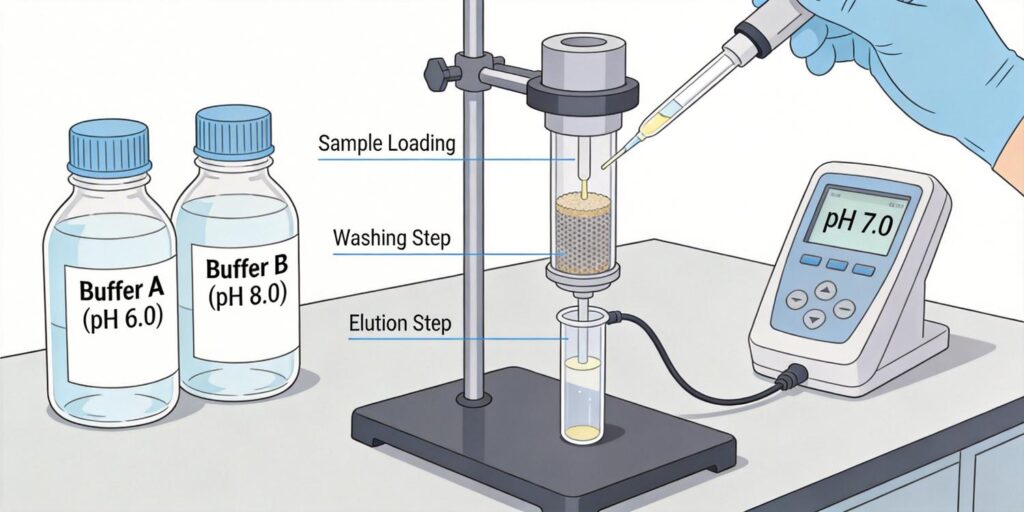
Proper sample loading conditions are essential for maximizing retention efficiency on cation exchange phases. The sample matrix should be prepared in an aqueous solution with appropriate pH adjustment using buffers that maintain stability throughout the loading process. Typical loading volumes range from 1-10 mL depending on sorbent mass (100-1000 mg), with flow rates controlled at approximately 1 mL/min to ensure adequate interaction time between analytes and sorbent.
For cation exchange applications, the sample should be loaded under conditions where both the analyte and sorbent are appropriately charged. With SCX phases, this means ensuring the analyte is protonated (pH at least 2 units below pKa). With WCX phases, additional consideration must be given to maintaining the sorbent in its ionized state, typically requiring pH values above 4-5 for carboxylic acid groups.
Sample pretreatment often includes dilution with buffer solutions to maintain pH consistency and reduce matrix effects. For biological samples like plasma or urine, typical dilution ratios range from 1:1 to 1:4 with appropriate buffer solutions. Particulate removal through centrifugation or filtration may be necessary to prevent column clogging and ensure consistent flow rates.
Wash Solvent pH Design
Wash step optimization is critical for removing interferences while retaining target analytes. For cation exchange SPE, wash solvents should maintain conditions that preserve the ionic interaction between protonated analytes and charged sorbents. Typically, wash solutions consist of aqueous buffers or water with pH adjusted to remain at least 1-2 pH units below the analyte’s pKa.
Organic solvents can be incorporated into wash solutions to remove hydrophobic interferences, but the organic content must be balanced to avoid disrupting ionic interactions. Common wash strategies include:
- Water or aqueous buffer washes to remove polar interferences
- Low-percentage methanol or acetonitrile washes (5-20%) to remove moderately hydrophobic compounds
- pH-adjusted organic-aqueous mixtures for selective removal of specific interference classes
The wash pH should be carefully controlled to prevent premature elution of target analytes. For compounds with pKa values above 9 (such as morphine or benzoylecgonine), even slight pH increases during washing can lead to significant losses. Maintaining wash solutions at pH values 2-3 units below the analyte pKa provides a safety margin against accidental neutralization.
Elution Strategies Based on Neutralization
Elution from cation exchange phases typically involves disrupting the ionic interaction through pH adjustment. For basic compounds, this means raising the pH above the analyte’s pKa to neutralize the positive charge. The elution solvent should have a pH at least 2 units above the analyte pKa to ensure complete deprotonation and release from the sorbent.
Common elution solvents for cation exchange include:
- Ammoniated organic solvents (2-5% ammonium hydroxide in methanol, ethyl acetate, or methylene chloride/isopropanol mixtures)
- High-pH aqueous-organic mixtures
- Solvents containing competing ions with higher affinity for the sorbent
Ammonium hydroxide is frequently used for elution but requires careful handling as it can lose potency when exposed to air. Fresh preparation of ammoniated elution solvents is recommended, and small bottles of concentrated ammonium hydroxide should be purchased to ensure consistent pH strength. When preparing mixed solvents like methylene chloride/isopropanol/ammonium hydroxide, add ammonium hydroxide to isopropanol first, then mix with methylene chloride to prevent phase separation.
Elution volume optimization is crucial for maximizing recovery while minimizing solvent use. Typical elution volumes range from 0.5-8.0 mL depending on sorbent mass, with slower flow rates (gravity flow preferred) allowing complete transfer of analytes from stationary to mobile phase.
Case Examples with Pharmaceutical Compounds
Example 1: Basic Drug Extraction with SCX Phase
For extraction of basic pharmaceuticals with pKa values around 9-10 (such as tricyclic antidepressants or beta-blockers), sample pH is adjusted to 6-7 using phosphate buffer. The SCX phase (benzenesulfonic acid) provides consistent retention regardless of minor pH fluctuations. Wash steps employ pH-adjusted water or low-percentage methanol. Elution uses ammoniated methanol (2-5% NH4OH) with pH >11, ensuring complete neutralization of basic compounds.
Example 2: Mixed-Mode Extraction with WCX Phase
For compounds like ibuprofen (pKa = 5.9) extracted using mixed-mode columns, pH optimization demonstrates how small adjustments impact recovery. Lowering sample pH from 6.0 to 5.0 increases ibuprofen recovery on hydrophobic phases by reducing ionization, while basic drugs remain unaffected. This highlights the importance of understanding both hydrophobic and ionic interactions in mixed-mode applications.
Example 3: High pKa Compound Extraction
Compounds with pKa values above 9 (morphine, benzoylecgonine) present particular challenges. These require careful pH control throughout the extraction process, as even wash solutions with pH 8-9 can cause significant losses. Elution solvents must have sufficiently high pH (≥11) to effectively neutralize these strongly basic compounds.
Troubleshooting pH-Related Losses
pH-related issues account for approximately 90% of problems encountered in cation exchange SPE applications. Common troubleshooting scenarios include:
Low Recovery During Loading
Symptoms: Analyte appears in flow-through or early wash fractions.
Causes: Sample pH too high (above analyte pKa), insufficient buffer capacity, or sorbent not properly conditioned.
Solutions: Verify sample pH is at least 2 units below analyte pKa, increase buffer concentration, ensure proper sorbent conditioning with appropriate pH buffer.
Poor Retention During Washing
Symptoms: Analyte elutes during wash steps.
Causes: Wash solvent pH too high, excessive organic content in wash, or insufficient ionic strength.
Solutions: Lower wash solvent pH, reduce organic percentage, add appropriate salts to maintain ionic strength.
Incomplete Elution
Symptoms: Low recovery despite proper loading and washing.
Causes: Elution solvent pH insufficiently high, expired ammonium hydroxide, or inadequate elution volume.
Solutions: Verify elution solvent pH is at least 2 units above analyte pKa, use fresh ammonium hydroxide, increase elution volume or use multiple elution steps.
Inconsistent Results Between Batches
Symptoms: Variable recovery when repeating methods.
Causes: pH meter calibration issues, buffer preparation variations, or environmental temperature effects on pKa.
Solutions: Regularly calibrate pH meters, prepare buffers consistently, account for temperature effects on ionization constants.
Matrix Effects on pH
Symptoms: Methods work with standards but fail with real samples.
Causes: Sample matrix components affecting local pH at sorbent surface.
Solutions: Increase sample dilution with buffer, use stronger buffers with higher capacity, or incorporate additional cleanup steps.
Proper documentation of pH values at each step, including meter calibration records and buffer preparation details, facilitates troubleshooting and method transfer. When developing cation exchange SPE methods, systematically varying pH in 0.5-1.0 unit increments while monitoring recovery at each step provides valuable optimization data and establishes robust operating ranges.
For comprehensive SPE solutions including mixed-mode cation exchange cartridges and weak cation exchange phases, visit Poseidon Scientific’s product pages. Our 96-well SPE plates offer high-throughput solutions for pharmaceutical applications requiring precise pH control.