
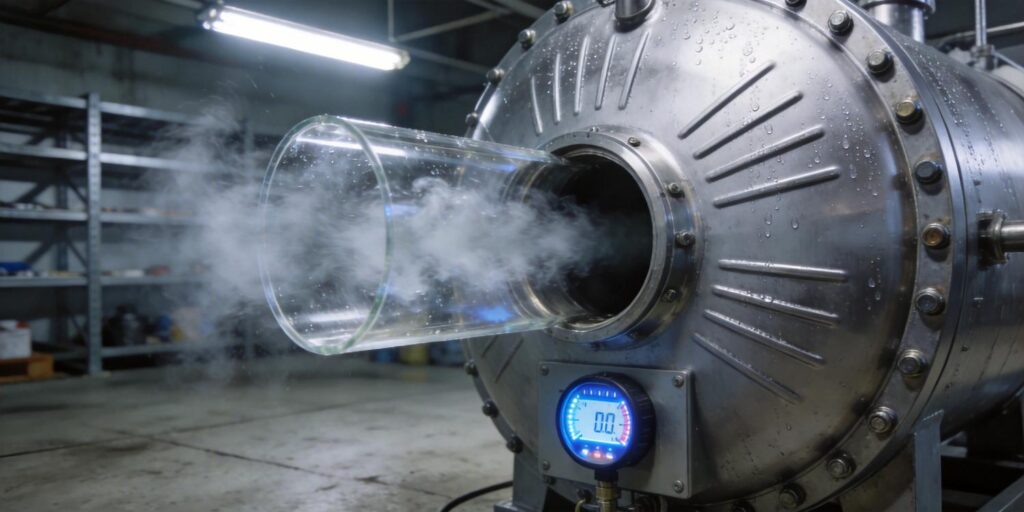
Sudden venting—dropping a vacuum chamber from high vacuum to atmosphere in seconds—remains one of the most common causes of premature vacuum gauge failure. Engineers and maintenance teams report filament burnout in Pirani transmitters, erratic readings or permanent electrode damage in cold-cathode gauges, and occasional electronics faults after unplanned fast vents. These failures are not random; they stem from well-understood physical mechanisms involving rapid gas dynamics, thermal transients, plasma behavior, and electrical stresses. Understanding the root causes allows system designers and end users to implement simple, cost-effective protections that extend gauge life from months to years.
This analysis focuses on the two most widely deployed low-cost gauges in analytical and industrial vacuum systems: the Poseidon Scientific VG-SP205 Pirani Vacuum Transmitter (atmosphere to 10⁻³ Torr) and the VG-SM225 Cold Cathode Vacuum Gauge (10⁻³ to 10⁻⁷ Torr). Both are engineered for durability and compact installation, yet even robust designs require proper venting protocols to avoid damage.
Rapid Pressure Shock Impact
When a chamber vents rapidly, the pressure rise rate (dP/dt) can exceed 100 Torr/s. This creates a high-velocity gas front that impinges directly on the gauge sensor. In a typical KF-flange installation, the gauge body experiences a transient pressure gradient while the chamber bulk pressure lags. The resulting momentum transfer can mechanically stress internal components—particularly fine wires or electrode gaps.
For both Pirani and cold-cathode sensors, the immediate effect is a mismatch between the gauge’s calibrated pressure-volume relationship and the actual local density. More critically, the sudden influx of atmospheric molecules triggers secondary effects discussed below. In practice, gauges mounted at the end of long lines suffer amplified shock because the connecting tube acts as a delay line, concentrating the pressure wave at the sensor port.
Thermal Shock in Pirani Filament
The VG-SP205 uses a platinum filament maintained at constant temperature via a Wheatstone-bridge power-feedback circuit. At high vacuum the filament operates near 150–200 °C; the power required to hold this temperature is low. When cold atmospheric gas rushes in, convective cooling increases dramatically within milliseconds. The control loop responds by increasing heater current to restore temperature.
If the vent is fast enough, two failure modes appear:
- Overshoot burn-out: The feedback loop temporarily supplies excess power before equilibrium is restored, driving filament temperature beyond the platinum oxidation threshold (~400 °C). Even though platinum is chemically stable, repeated thermal cycling fatigues the wire, leading to eventual open-circuit failure.
- Mechanical sag and fracture: Rapid cooling contracts the filament while the supports remain hot, inducing differential expansion stress. Over multiple vents this micro-strain accumulates until the 20–30 mm platinum wire (≈10 μm diameter) breaks.
Factory data and field returns show that Pirani filaments rated for 3–5 years in controlled environments drop to <12 months when subjected to repeated sudden vents. The VG-SP205’s temperature-compensation algorithm mitigates steady-state drift but cannot fully compensate for millisecond-scale transients.
Plasma Instability in Cold Cathode
The VG-SM225 operates on the Penning-discharge principle: electrons spiral in crossed E×B fields, ionizing residual gas and producing a measurable ion current. At pressures above 10⁻³ Torr the mean free path collapses, collision frequency rises sharply, and the discharge transitions from glow to abnormal or arc mode.
During sudden venting the pressure crosses the 10⁻³ Torr threshold in <1 s. The gauge’s internal protection circuit—software-driven high-voltage shutdown—requires ~50–100 ms to respond. In that window the discharge current can spike by orders of magnitude, delivering intense ion bombardment to the stainless-steel electrodes. The result is rapid carbon deposition, surface oxidation, and localized heating that erodes the “之”字形 cathode plates. Once contaminated, startup time at high vacuum lengthens from minutes to hours or becomes impossible.
Repeated plasma instability also shifts the current-pressure curve permanently, introducing offsets of 0.5–1 decade. The compact positive-magnetron geometry of the VG-SM225 (≈100 G NdFeB magnet) actually concentrates discharge energy more tightly than larger inverted-magnetron designs, making it more sensitive to fast pressure transients.
Electrical Surge Risk
High-voltage transients compound the physical damage. The VG-SM225 cathode supply switches between –2500 V (startup) and –2000 V (run). A sudden pressure surge can cause momentary arc-over inside the gauge tube, collapsing the supply voltage and inducing inductive kick-back into the electronics. Without proper clamping, this can damage the high-voltage MOSFETs or the RS232 interface circuitry.
Pirani transmitters are lower voltage (typically 5–12 V) but still vulnerable: rapid filament current surges stress the bridge op-amps and can corrupt analog-output calibration. In systems using shared power rails or long unshielded cables, the common-mode surge couples into adjacent instruments. Poseidon gauges incorporate internal TVS diodes and soft-start firmware, yet these protections assume controlled venting—not instantaneous atmosphere exposure.
Safe Venting Protocol
Industry-standard practice limits pressure rise to 1–5 Torr/s for gauges rated to 10⁻⁷ Torr. Implement the following sequence:
- Close all process valves and isolate the chamber.
- Switch off high-voltage supplies on all cold-cathode gauges (manual or interlocked).
- Open a calibrated vent valve equipped with a 0.5–1 mm orifice or needle valve; monitor chamber pressure with a secondary roughing gauge.
- Do not exceed 2 Torr/s until the chamber reaches 1 Torr, then allow free venting.
- Re-energize gauges only after pressure stabilizes above 10 Torr and the system has equilibrated for ≥30 s.
The VG-SM225’s built-in LED indicator (flashing when high voltage is disabled) provides immediate visual confirmation of safe state. The VG-SP205 requires no shutdown but benefits from the same slow vent to protect the filament.
Preventive System Design
Long-term protection integrates hardware and software safeguards:
- Interlocks: PLC or embedded firmware that disables gauge high voltage whenever chamber pressure > 5×10⁻⁴ Torr (use a fast-response capacitance manometer as master sensor).
- Orifice-protected vent ports: Dedicated ¼-inch vent line with sintered-metal diffuser; limits maximum dP/dt to <1 Torr/s regardless of operator error.
- Redundant monitoring: Install a second gauge (e.g., VG-SP205) on the chamber wall for cross-check; compare readings in real time.
- Remote mounting mitigation: Keep gauge tubing ≤150 mm and ≥KF25 diameter; longer lines amplify pressure-wave effects.
- Custom protocol integration: Poseidon’s RS232 interface supports user-defined shutdown commands; 5–10 piece orders can embed vent-interlock logic directly in the transmitter firmware.
These measures add negligible cost yet routinely extend gauge lifetime by 3–5× in production environments such as mass-spectrometer OEMs and vacuum heat-treatment furnaces.
CTA
Protecting vacuum gauges from venting damage is straightforward once the physics is understood. The Poseidon VG-SP205 Pirani Vacuum Transmitter and VG-SM225 Cold Cathode Vacuum Gauge combine compact size, built-in protections, and optional digital customization to simplify safe system design.
Review detailed specifications and user manuals:
VG-SP205 Pirani Vacuum Transmitter
VG-SM225 Cold Cathode Vacuum Gauge
Need assistance calculating safe vent orifice size for your chamber volume, implementing interlocks, or customizing communication protocols? Contact our applications engineering team—we support both prototype and production-scale vacuum systems worldwide.


