
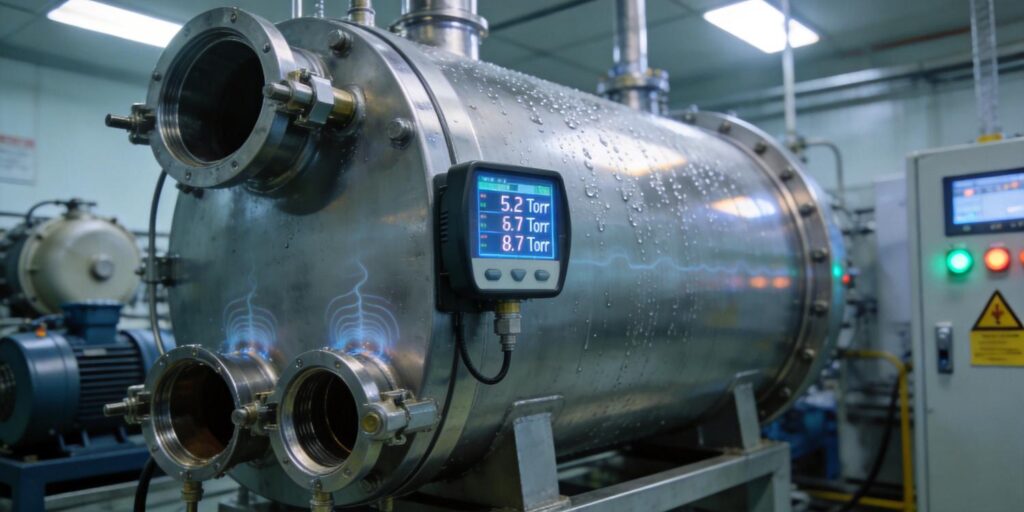
Backfill Flow Dynamics
Gas backfill—introducing process gas (N₂, Ar, or reactive mixtures) to raise chamber pressure from high vacuum to a controlled setpoint—is a routine step in vacuum furnaces, sputtering systems, and load-lock chambers. The dynamics begin with a control valve opening, admitting a sudden pulse of gas molecules. In the molecular-flow regime (<10⁻³ Torr), these molecules travel ballistically until they collide with chamber walls or the sensor envelope, creating transient pressure waves that propagate at the speed of sound in the gas.
The result is a rapid local pressure spike near the inlet followed by slower equalization throughout the chamber. If the gauge is mounted downstream or on a side port with finite conductance, it experiences these waves as oscillating readings—sometimes swinging 20–50 % above and below the true average pressure. Poseidon Scientific’s VG-SP205 Pirani Vacuum Transmitter and VG-SM225 Cold Cathode Vacuum Gauge are positioned to capture these dynamics accurately, but understanding the flow physics is the first step toward eliminating visible oscillations.
Turbulence vs Sensor Response Delay
During backfill, flow often transitions briefly through the viscous regime near the inlet, generating turbulent eddies. These eddies produce micro-pressure fluctuations that reach the gauge faster than the sensor can thermally or electrically respond. The VG-SP205 Pirani relies on heat transfer from a platinum filament; its thermal time constant (~0.1–1 s) smooths rapid turbulence but can lag behind true chamber pressure during fast ramps. The VG-SM225 Cold Cathode, with its Penning-discharge avalanche, responds in milliseconds once ignited, yet any momentary startup delay or ion-current settling can amplify apparent swings.
Poseidon’s onboard temperature compensation (circuit + algorithm) and symmetric geometries minimize these lags across the 15 °C–50 °C range. Still, when backfill rates exceed 10 Torr/s or valves open abruptly, the mismatch between turbulence frequency and sensor bandwidth appears as oscillations on the 0–10 V analog output. Switching to the customizable RS232 digital stream—transmitting raw pressure at higher resolution—often reveals that the chamber itself is stabilizing faster than the analog signal suggests.
Control Valve Overshoot
Most backfill systems use PID-controlled mass-flow or throttle valves. Aggressive tuning (high proportional gain) causes the valve to overshoot the target flow, flooding the chamber momentarily before the integral term corrects. This overshoot is especially pronounced in shared-pump manifolds or when the PLC lacks feed-forward compensation for gas type. The resulting pressure excursion triggers a feedback correction in the opposite direction, setting up a classic under-damped oscillation visible on the gauge.
The VG-SP205 and VG-SM225 deliver clean signals that expose this loop behavior immediately. Their fast response lets engineers tune the valve PID in real time using the RS232 status bits (over-range, rate-of-change flags). Proper valve characterization—mapping flow versus opening at the exact process gas—reduces overshoot from 30 % to <5 %, eliminating the root cause of gauge oscillation in most brazing, coating, and heat-treatment furnaces.
Signal Filtering Strategies
Once flow dynamics and valve behavior are understood, signal filtering provides an immediate software fix. On the analog side, a simple RC low-pass filter (τ ≈ 0.5–2 s) at the PLC ADC damps high-frequency turbulence while preserving process-relevant changes. For digital users, the Poseidon RS232 protocol allows configurable averaging (10–50 samples) directly inside the gauge firmware, reducing noise before transmission.
Advanced PLC strategies include:
- Moving-average or exponential filters on the pressure variable.
- Rate-limiting logic that ignores transients shorter than the sensor’s known response time.
- Cross-checking the Pirani and cold-cathode outputs during transition zones; if they diverge >10 %, hold the valve until stabilization.
These techniques keep displayed pressure steady without sacrificing control-loop speed. Poseidon’s built-in status monitoring further flags when filtering alone is insufficient (e.g., persistent contamination), guiding maintenance before oscillations become chronic.
Stabilization Techniques
Beyond filtering, hardware and procedural stabilization eliminate oscillations at the source:
- Slower ramp rates: Limit backfill to 1–5 Torr/s using a needle valve or mass-flow controller with ramp limiting.
- Baffle or diffuser installation: A perforated plate at the gas inlet converts turbulent jets into uniform molecular flow.
- Multi-point sensing: Pair a VG-SP205 near the inlet with a VG-SM225 at the workload; average the two readings for a representative chamber value.
- Anti-windup PID logic: Prevent integral saturation during the initial surge.
The compact KF16/KF25 footprint of Poseidon transmitters makes adding diffusers or secondary gauges straightforward. Their any-orientation mounting and low leak rate (≤10⁻¹¹ Pa·m³/s) preserve chamber integrity while supporting these upgrades without redesign.
Practical Tuning Example
A vacuum heat-treatment line experienced 15–20 % pressure oscillations during argon backfill to 0.5 Torr setpoint, causing inconsistent annealing results. Initial diagnosis showed valve overshoot combined with unfiltered analog output. Engineers replaced legacy gauges with Poseidon VG-SP205 (roughing) and VG-SM225 (verification), then applied this sequence:
- Characterized valve flow at process gas pressure; reduced proportional gain 40 % and added 0.8 s derivative.
- Installed a 1 s RC filter on analog lines and enabled 20-sample averaging on RS232.
- Added a simple inlet diffuser; limited backfill ramp to 2 Torr/s.
- Cross-checked Pirani and cold-cathode outputs in the PLC; used status bits to suspend heating until stability was confirmed.
Oscillations dropped to <±2 % within one shift. Annealing uniformity improved 25 %, scrap fell 18 %, and gauge maintenance interval extended from quarterly to annual. Total implementation cost was under 15 % of one legacy gauge replacement, delivering ROI in <30 days.
Conclusion and Next Steps
Oscillations during gas backfill are rarely a gauge failure; they stem from flow dynamics, sensor response characteristics, and control-loop tuning. Poseidon Scientific’s VG-SP205 Pirani Vacuum Transmitter and VG-SM225 Cold Cathode Vacuum Gauge provide the fast, temperature-compensated signals and rich RS232 diagnostics that make root-cause analysis and stabilization straightforward. Their compact design, contamination tolerance, and customizable protocol turn backfill instability from a recurring headache into a solved engineering problem.
Whether you run vacuum furnaces, sputtering systems, or load-lock clusters, these transmitters deliver stable readings that keep your process on target—cycle after cycle.
Ready to eliminate backfill oscillations and achieve repeatable vacuum control? Explore the VG-SP205 Pirani Vacuum Transmitter for roughing and transition monitoring or the VG-SM225 Cold Cathode Vacuum Gauge for high-vacuum stability today. Both support 0–10 V analog, RS232 with status monitoring, and 5–10 unit protocol customization for your exact PLC.
Contact our applications engineering team for a free technical consultation. We’ll review your backfill valve curve, recommend filter and diffuser configurations, provide a sample PID tuning worksheet, and help you achieve rock-steady pressure readings with minimal downtime.


