Industry Applications

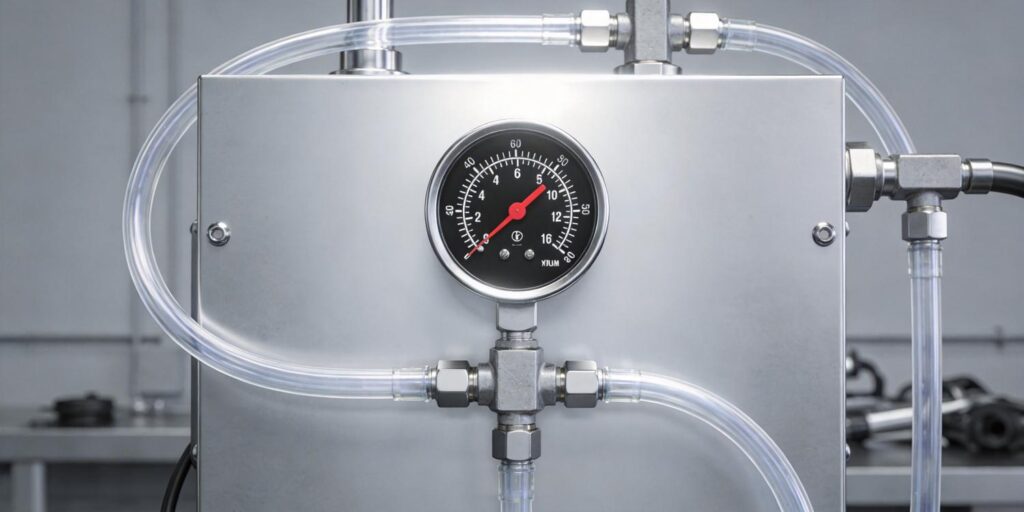
Cold cathode vacuum gauge mounted on mass spectrometer system

Vacuum Monitoring in Research Mass Spectrometry Systems

The Critical Ultra-High Vacuum Region in Research Mass Spectrometry Systems Research mass spectrometry (MS) demands precise control of gas density to ensure accurate ion trajectories, minimal scattering, and high signal-to-noise ratios. In quadrupole, time-of-flight, or sector-field analyzers, the mean free path of ions must exceed the instrument path length—typically requiring pressures below 10−6 Torr in […]

Vacuum Monitoring in Research Mass Spectrometry Systems Read More »

Pirani vacuum transmitter installed on roughing line

Monitoring Rough Vacuum Stage to Protect High Vacuum Pumps

In multi-stage vacuum systems, the roughing phase is the critical first step that bridges atmosphere to high-vacuum operation. Without reliable monitoring and automated crossover, high-value turbomolecular or cryopumps can suffer catastrophic overload—leading to rotor damage, excessive heat buildup, or premature bearing failure. The Poseidon Scientific VG-SP205 Pirani Vacuum Transmitter is purpose-built for this exact role:

Monitoring Rough Vacuum Stage to Protect High Vacuum Pumps Read More »

Vacuum gauge mounted on industrial brazing furnace pipeline

Vacuum Gauge Selection for Vacuum Brazing Furnaces

Vacuum Brazing Pressure Profile Vacuum brazing joins base metals using filler alloys that melt at temperatures between 450 °C and 1200 °C without flux. The process profile follows a precise vacuum curve: initial pump-down to remove air and moisture, followed by a controlled heat ramp under stable high vacuum, and finally a controlled cool-down before

Vacuum Gauge Selection for Vacuum Brazing Furnaces Read More »

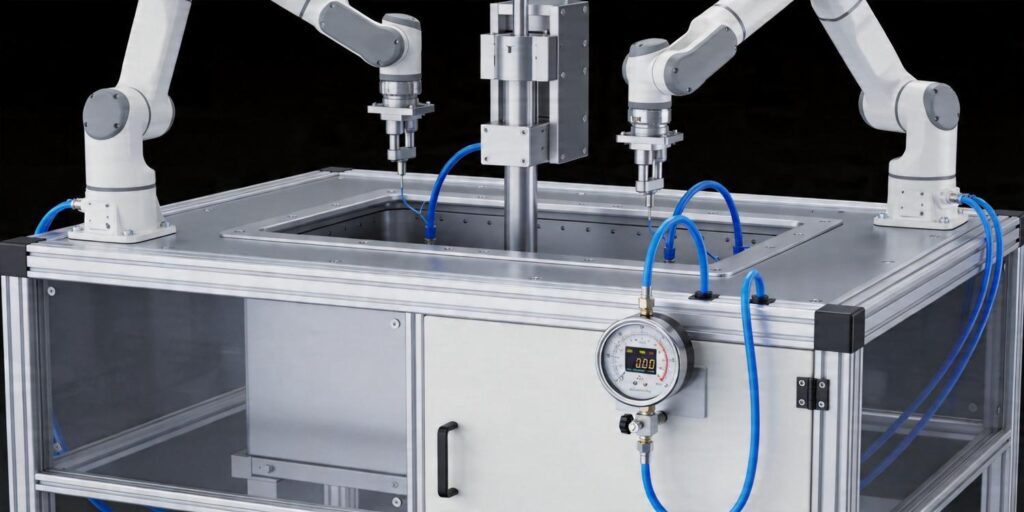
Vacuum gauge installed on industrial metal 3D printer chamber

Vacuum Monitoring in Additive Manufacturing Systems

Vacuum-Assisted Metal Printing Requirements Additive manufacturing of metal parts—particularly electron-beam melting (EBM) and vacuum-assisted laser powder-bed fusion—relies on controlled vacuum environments to eliminate oxidation, improve melt-pool stability, and ensure defect-free microstructures. Build chambers must reach and hold pressures low enough to prevent oxygen and nitrogen pickup while still allowing efficient powder spreading and electron or

Vacuum Monitoring in Additive Manufacturing Systems Read More »

Cold cathode vacuum gauge on electron beam vacuum chamber

High Vacuum Measurement in Electron Beam Systems

Required Pressure Levels (10⁻⁵ mbar Region) Electron beam systems—scanning electron microscopes (SEM), electron-beam lithography tools, e-beam welding machines, and high-resolution analytical instruments—operate in the high-vacuum regime to ensure electrons travel in straight-line paths without scattering. At pressures above ~10⁻³ mbar (~7.5×10⁻⁴ Torr), the mean free path of residual gas molecules drops below chamber dimensions, causing

High Vacuum Measurement in Electron Beam Systems Read More »

Vacuum gauge installed on battery production vacuum system

Selecting Vacuum Gauges for Battery Manufacturing Dry Rooms

Dry Room Vacuum Requirements Lithium-ion battery manufacturing demands ultra-dry environments to prevent moisture from reacting with lithium salts, electrolytes, or electrode materials. Dry rooms typically maintain dew points of −40 °C to −60 °C at atmospheric pressure, but the critical vacuum step occurs inside integrated drying ovens or airlock chambers. These ovens remove residual solvents

Selecting Vacuum Gauges for Battery Manufacturing Dry Rooms Read More »

Vacuum gauge mounted on industrial high temperature furnace pipeline

Vacuum Gauge Selection for Industrial Furnaces Above 800°C

Remote Mounting Requirement Industrial vacuum furnaces operating above 800 °C—such as vacuum annealing, tempering, or brazing systems—present a fundamental challenge for pressure measurement: the process chamber itself exceeds the safe operating temperature of any electronic vacuum gauge. Poseidon Scientific’s VG-SP205 Pirani Vacuum Transmitter and VG-SM225 Cold Cathode Vacuum Gauge are both rated for 15–50 °C

Vacuum Gauge Selection for Industrial Furnaces Above 800°C Read More »

Vacuum gauge installed on PVD coating chamber wall

Vacuum Monitoring in PVD Coating: Where to Place Gauges for Best Film Quality

Pump-down Stage Monitoring Physical vapor deposition (PVD) coating quality starts with a clean, reproducible base vacuum. Residual gases—water vapor, oxygen, or hydrocarbons—can react with sputtered material and degrade film adhesion, stoichiometry, or optical properties. The pump-down phase therefore requires continuous, accurate monitoring from atmosphere down to at least 10−6 Torr. The Poseidon Scientific VG-SP205 Pirani

Vacuum Monitoring in PVD Coating: Where to Place Gauges for Best Film Quality Read More »

Vacuum gauges installed on semiconductor load lock chamber

Choosing Vacuum Gauges for Semiconductor Load Locks

Load Lock Vacuum Cycle Stages In semiconductor fabrication, load locks serve as critical airlocks between the cleanroom atmosphere and the ultrahigh-vacuum process chambers used for etching, deposition, and lithography. A typical load-lock cycle follows a repeatable sequence that protects wafer integrity while maximizing tool throughput. Stage 1 begins with the outer door open at atmospheric

Choosing Vacuum Gauges for Semiconductor Load Locks Read More »

Vacuum gauges installed on thin film deposition chamber

Monitoring Vacuum in Thin Film Deposition Systems

Deposition Stages: Where Vacuum Monitoring Drives Film Quality Thin-film deposition—whether by physical vapor deposition (PVD), sputtering, evaporation, or chemical vapor deposition (CVD)—is a sequence of precisely timed vacuum phases. Each stage imposes different pressure demands, and real-time monitoring determines film adhesion, density, stoichiometry, and defect density. Engineers and procurement teams in semiconductor, optics, and display

Monitoring Vacuum in Thin Film Deposition Systems Read More »

Shopping Cart
Poseidon Scientific
Privacy Overview

This website uses cookies so that we can provide you with the best user experience possible. Cookie information is stored in your browser and performs functions such as recognising you when you return to our website and helping our team to understand which sections of the website you find most interesting and useful.