Vacuum Use in Brake System Testing
Automotive brake system testing relies heavily on vacuum technology to validate critical safety components such as brake boosters, vacuum pumps, hoses, and valves. Modern vehicle brake systems use engine or electric vacuum to amplify pedal force through a booster assembly. During design validation, production qualification, and end-of-line testing, manufacturers simulate real-world vacuum levels to confirm boost performance, response time, and leak-free operation. Typical test pressures range from atmosphere down to approximately 10−3 Torr, making precise vacuum measurement essential for compliance with FMVSS, ECE R13, and IATF 16949 standards.
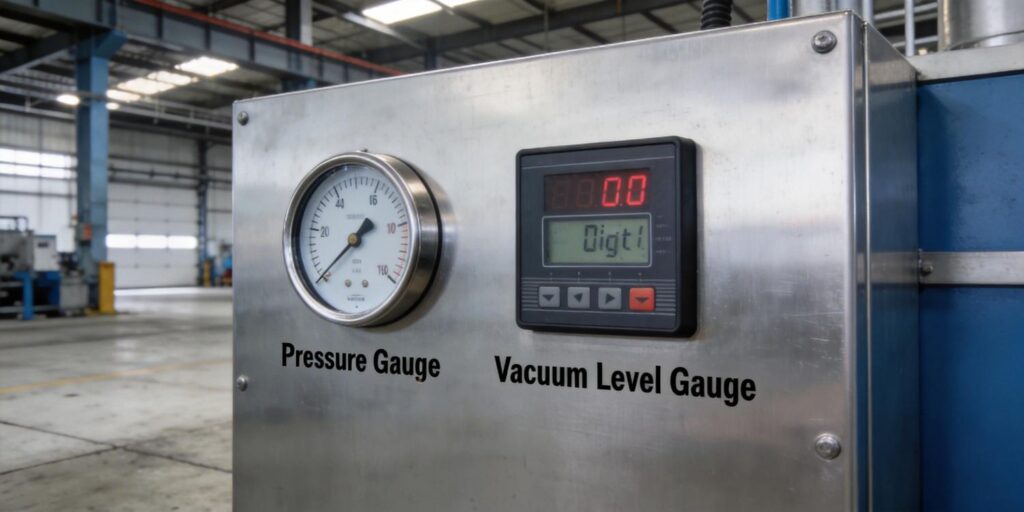
In these applications, vacuum gauges serve as the primary feedback devices for automated test benches. They ensure that components meet strict leak-rate specifications (often <0.5 mbar·L/s) and maintain consistent pressure during cyclic loading. Poseidon Scientific’s VG-SP205 Pirani Vacuum Transmitter was developed specifically for these rough-vacuum demands, delivering reliable, compact monitoring that integrates directly into high-throughput automotive test cells.
Leak Integrity Verification
Leak integrity testing is a core requirement in brake component manufacturing. Vacuum decay methods or pressure-rise techniques are used to detect micro-leaks in booster diaphragms, check valves, and hose assemblies. The test chamber is evacuated to a target vacuum level, isolated, and monitored for any pressure rise over a defined hold period—typically 10–60 seconds.
The VG-SP205 Pirani Vacuum Transmitter excels here because its thermal conductivity principle provides fast response to small pressure changes in the atmosphere-to-10−3 Torr range. Platinum filament construction ensures stability even when exposed to trace moisture or hydrocarbons common in automotive environments. Its 0–10 V analog output (effective 2–8 V) and RS232 digital interface allow real-time data logging at 1 Hz or faster, enabling statistical process control (SPC) charts that flag out-of-spec parts before they reach the assembly line.
Unlike capacitance manometers that can be cost-prohibitive for multi-station test benches, the VG-SP205 offers equivalent performance at a fraction of the price while maintaining the compact KF16/KF25 flange footprint that fits easily inside test fixtures.
Pressure Cycling Monitoring
Brake boosters and vacuum pumps undergo rigorous pressure cycling tests—often 100,000 to 1,000,000 cycles—to simulate vehicle lifetime durability. Each cycle involves rapid pump-down, hold, and vent sequences that stress seals and diaphragms. Continuous vacuum monitoring during these cycles verifies that the component maintains specified boost ratios and does not develop progressive leaks.
The VG-SP205’s response time of <1 second across its operating range makes it ideal for capturing transient pressure events. Temperature compensation circuitry (15–50 °C) prevents drift during long test runs in climate-controlled test chambers. For applications requiring even lower pressures during advanced EV brake-by-wire validation, the VG-SM225 Cold Cathode Vacuum Gauge can be paired as a secondary sensor, providing seamless coverage down to 10−7 Torr without changing test-bench wiring.
Both transmitters feature built-in protection logic that prevents sensor damage during unexpected pressure spikes, a common occurrence when test parts fail catastrophically.
Pirani Suitability for Automotive Component Testing
The thermal conductivity principle of Pirani gauges aligns perfectly with the pressure regimes used in brake system testing. The VG-SP205 measures from atmosphere to 10−3 Torr with highest accuracy in the 10–10−2 Torr linear region where most leak and cycle tests occur. Its platinum filament offers superior resistance to oxidation and contamination compared with tungsten alternatives, delivering 3–5 year service life in clean test environments.
Key advantages for automotive users include:
- Compact size: Minimal intrusion into test fixtures, enabling higher station density.
- Maintenance-free operation: No filament replacement or frequent cleaning required.
- Cost effectiveness: Self-developed design keeps unit pricing at roughly half that of imported equivalents while meeting automotive traceability requirements.
For ultra-high-vacuum validation of next-generation vacuum pumps or EV brake components, the VG-SM225 Cold Cathode complements the Pirani with its Penning discharge technology, offering the same RJ45 connectivity and customizable protocols.
Integration into Test Bench PLC
Modern automotive test benches use PLC platforms such as Siemens S7, Allen-Bradley CompactLogix, or Mitsubishi MELSEC for closed-loop control and data acquisition. Poseidon transmitters support both 0–10 V analog and RS232 digital outputs, allowing direct connection without additional signal conditioners.
Integration steps are straightforward:
- Mount the gauge on the test chamber via standard KF flange.
- Connect via RJ45 (or field-convertible DB9/DB15) to the PLC serial port or analog input module.
- Load the factory-supplied scaling table or polynomial into the PLC function block.
- Configure the customizable RS232 protocol (available at 5–10 unit volumes) to transmit pressure already scaled in mbar, Torr, or Pa.
- Map the gauge status bits (including high-voltage enable and fault flags) to PLC interlocks for automatic abort on sensor failure.
The VG-SP205’s low power draw and built-in temperature compensation simplify qualification under automotive environmental standards (e.g., temperature cycling from –40 °C to +85 °C). Digital output also provides runtime hours and event logs, supporting predictive maintenance and audit-ready traceability.
Documentation Requirements
Automotive OEMs and Tier-1 suppliers demand full traceability under IATF 16949 and PPAP requirements. Poseidon supplies each VG-SP205 and VG-SM225 with:
- Individual calibration certificate traceable to NIST standards.
- Material and process certificates for wetted parts (stainless steel, PEEK, Viton).
- RoHS/REACH compliance declaration.
- Functional test report including voltage-to-pressure curve data.
- Custom PPAP documentation package (control plan, FMEA, MSA study) available on request.
Digital output includes embedded serial number and firmware version for automated data logging, simplifying gage R&R studies and long-term stability tracking required for annual re-validation.
Case Example: Major Brake Supplier Reduces Test Cycle Time
A Tier-1 automotive brake supplier in the Midwest United States was experiencing frequent downtime and inconsistent leak-test results with aging imported Pirani gauges. Test benches required weekly recalibration, and bulky controller boxes limited station density.
After evaluating Poseidon’s VG-SP205 Pirani Vacuum Transmitter, the company standardized on 48 units across vacuum booster and hose test stations. The compact design allowed 20 % more test fixtures per bench. Custom RS232 protocol integration with their Siemens PLC eliminated analog noise issues and reduced cycle time by 18 seconds per part. Leak detection sensitivity improved, cutting false rejects by 12 %.
Over 18 months, the supplier reported zero gauge-related failures, a 35 % reduction in vacuum instrumentation spend, and full IATF 16949 compliance with Poseidon’s calibration documentation. The cleanable VG-SM225 Cold Cathode was later added for advanced vacuum pump durability testing, extending the same cost and integration benefits to high-vacuum validation.
Optimize Your Automotive Test Bench Reliability
Vacuum measurement is a critical but often overlooked contributor to brake system quality and throughput. Poseidon Scientific’s VG-SP205 Pirani Vacuum Transmitter and VG-SM225 Cold Cathode Vacuum Gauge combine automotive-grade robustness, seamless PLC integration, and low total cost of ownership—delivering the performance Tier-1 suppliers and OEMs require without the premium pricing of legacy instrumentation.
Whether you are updating existing test cells or designing new EV brake validation lines, our applications engineers understand the exact pressure ranges, cycle profiles, and documentation demands of automotive component testing.
Learn more about the VG-SP205 Pirani Vacuum Transmitter | Discover the VG-SM225 Cold Cathode Vacuum Gauge
Contact our automotive vacuum specialists today for a no-obligation test-bench audit and quotation. Share your component type, target leak rate, PLC platform, and annual test volume, and we will deliver a complete integration proposal—including custom protocol, PPAP documentation, and on-site support—within 24 hours. Reliable vacuum control starts with the right gauge—let Poseidon help you accelerate your brake system testing program.