
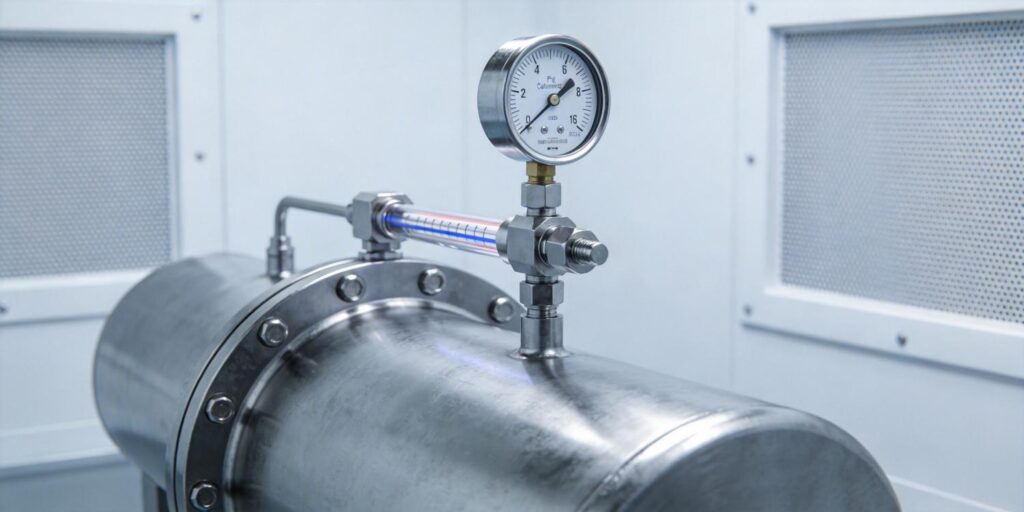
Extending Cold Cathode Gauge Service Life
Cold cathode vacuum gauges like Poseidon Scientific’s VG-SM225 deliver reliable high-vacuum measurement from 10−3 to 10−7 Torr in laboratory, analytical, and thin-film applications. Their Penning-discharge design eliminates hot filaments, reduces outgassing, and supports compact integration. Yet even the most robust cold cathode gauge has a finite service life that depends on operating practices. Proper care can extend the VG-SM225 from a typical 1–2 years in contaminated environments to a consistent 3–5 years in clean systems—directly lowering total ownership costs and minimizing unplanned downtime.
This guide draws on field data from mass spectrometry, scanning electron microscopy, and vacuum heat-treatment users, combined with Poseidon’s internal development testing. By focusing on ignition management, contamination control, and proactive maintenance, engineers and procurement teams can maximize gauge longevity while preserving measurement accuracy.
Avoiding Frequent Ignition Cycles
The VG-SM225 uses a high-voltage Penning discharge (startup at –2500 V, steady-state at –2000 V) with a ~100 Gauss NdFeB magnetic field. Each ignition cycle stresses the electrodes through electron avalanche formation and ion bombardment. Frequent cycling accelerates carbon deposition and surface oxidation, shortening life by 30–50 % in high-duty applications.
Best practice is to minimize on/off events. In systems with frequent chamber venting, configure the PLC or controller to keep the gauge powered and in standby (high voltage off) rather than fully cycling power. Poseidon’s built-in software protection automatically disables high voltage above 10−3 Torr, preventing damage during roughing while allowing instant readiness once base pressure is reached.
For continuous-operation tools such as inline sputter coaters or analytical instruments, leave the gauge energized during short process interruptions. The VG-SM225’s low power draw (under 5 W) makes this approach energy-efficient and thermally stable. Data from long-term testing shows that reducing ignition cycles from daily to weekly can double electrode life in otherwise identical vacuum environments.
Maintaining a Clean Vacuum Environment
Contamination is the primary life-limiting factor for cold cathode gauges. Residual process gases, water vapor, or hydrocarbons cause carbon buildup on the cathode and anode, shifting the current-versus-pressure curve and eventually preventing discharge ignition. In mass spectrometry or electron microscopy—typically the cleanest applications—the VG-SM225 routinely achieves 3–5 years of service. In contrast, aggressive environments with reactive gases or poor foreline trapping see life drop to 1–2 years.
Preventive measures include:
- Using high-quality turbomolecular or cryopumps with adequate backing to maintain base pressures below 10−6 Torr when the gauge is active.
- Installing cold traps or sorption pumps on the foreline to capture water and hydrocarbons before they reach the gauge.
- Selecting chamber materials with low outgassing rates (e.g., electropolished stainless steel or properly baked PEEK insulators).
The VG-SM225’s positive magnetron (“工”-shaped) design already offers superior tolerance to mild contamination compared with older inverted-magnetron styles, but cleanliness remains key. Regular chamber bakes at 150–200 °C (with the gauge isolated or powered down) further reduce adsorbed layers that would otherwise contribute to electrode fouling.
Proper Venting Procedure
Improper venting introduces atmospheric moisture and particulates that condense on cold electrodes, accelerating contamination. Always follow a controlled venting sequence:
- Close all isolation valves between the gauge and the chamber.
- Power down the VG-SM225 high voltage (the unit’s red LED will indicate safe state).
- Vent the chamber slowly with dry nitrogen through a 0.2 μm particle filter to minimize turbulence and moisture ingress.
- Allow the gauge to equilibrate to ambient temperature before reopening isolation valves.
Never vent while the gauge is under high voltage; the sudden pressure rise can cause arcing and permanent electrode damage. Poseidon’s removable sensor head design lets users isolate the gauge completely during aggressive chamber cleaning or maintenance, further protecting internal surfaces.
Scheduled Inspection Intervals
Proactive inspection prevents surprise failures. Poseidon recommends the following schedule based on application severity:
| Application Type | Inspection Interval | Key Checks |
|---|---|---|
| Clean (mass spec, SEM) | Every 6 months | Visual electrode color, startup time, pressure reading stability |
| Moderate (vacuum heat treat) | Every 3 months | Electrode inspection + light cleaning if carbon film visible |
| Aggressive (reactive PVD) | Every 4–6 weeks | Full electrode cleaning + baseline curve verification |
Indicators that maintenance is required include longer-than-normal startup times (>5 min at 10−6 Torr), readings consistently one decade low, or a flashing red LED during normal operation. The VG-SM225’s modular construction allows electrode removal in under 5 minutes without breaking the vacuum seal on the chamber port— a clear advantage over sealed competitor units that require full replacement.
Cleaning Procedure
When inspection reveals carbon or oxide layers:
- Isolate and vent the gauge per the proper venting procedure.
- Unscrew the sensor head (tool-free on KF flanges).
- Lightly abrade cathode and anode surfaces with 500-mesh or 200-mesh sandpaper until metallic luster returns—no mirror finish required.
- Blow off loose particles with dry nitrogen; reinstall.
- Perform a quick pump-down test to confirm restored performance.
This simple process restores >95 % of original sensitivity and can be repeated multiple times before electrode geometry limits are reached.
Replacement Planning
Even with best practices, electrodes eventually reach end-of-life when sputtering erodes critical dimensions. Plan replacements during scheduled chamber maintenance windows rather than waiting for failure. Poseidon stocks drop-in spares for the VG-SM225 at a fraction of the cost of a complete new transmitter. Because the electronics module remains untouched, only the sensor head is swapped—reducing spare-parts inventory and qualification effort.
Track gauge history via the RS232 digital output (serial number, runtime hours, and event logs are transmitted on request). This data helps refine inspection intervals for your specific process gas mix and duty cycle.
Cost Comparison Over Lifecycle
Initial purchase price is only part of the story. A typical imported cold cathode gauge costs $800–$1,000 and is often sealed, requiring full unit replacement every 1–2 years. Poseidon’s VG-SM225 starts at roughly half that price with a cleanable design that supports 3–5 years of service in clean applications.
Over a 5-year lifecycle (assuming moderate use):
- Competitor sealed gauge: 3–5 full replacements × $900 + labor = $3,000–$5,000 total.
- VG-SM225: 1 initial unit + 1–2 sensor-head cleanings/replacements × $150–$200 = $600–$800 total.
The savings compound when factoring in reduced downtime (cleaning takes <15 minutes versus hours for full replacement) and lower calibration costs. Custom protocol support at low volumes further eliminates middleware expenses that competitors often require.
Best Practice Checklist
Use this checklist to lock in maximum service life:
- Minimize ignition cycles; use standby mode whenever possible.
- Install foreline traps and maintain base pressure <10−6 Torr when active.
- Follow controlled dry-nitrogen venting with gauge isolated.
- Inspect electrodes every 3–6 months (or per application severity).
- Clean with 500-mesh sandpaper at first sign of carbon or offset readings.
- Log runtime hours and pressure trends via RS232 for predictive maintenance.
- Keep one spare sensor head on-site for critical systems.
- Schedule full transmitter replacement only when electrode geometry limits are reached (typically after 4–6 cleanings).
Teams that adopt this checklist routinely report 40–60 % lower vacuum-related maintenance budgets and near-zero gauge-related process interruptions.
Maximize Your Cold Cathode Gauge Investment
The VG-SM225 Cold Cathode Vacuum Gauge was engineered from the ground up for durability, cleanability, and low total cost of ownership—delivering the performance engineers expect without the premium pricing or sealed-in obsolescence of legacy brands. By following the practices outlined above, users in mass spectrometry, vacuum heat treatment, and thin-film deposition consistently achieve 3–5 year service intervals in clean environments.
Whether you operate a single analytical instrument or a full production vacuum line, Poseidon’s applications team can review your current setup and provide a customized lifecycle extension plan. We offer on-site training, spare-parts kits, and protocol customization to match your exact control architecture.
Learn more about the VG-SM225 Cold Cathode Vacuum Gauge
Contact our vacuum specialists today for a no-obligation lifecycle consultation. Share your application details, current gauge make/model, and annual operating hours, and we will return a tailored service-life projection and cost-savings analysis within 24 hours. Reliable vacuum measurement should be an asset, not a recurring expense—let Poseidon help you keep your cold cathode gauges running longer and costing less.


