1. Forensic Toxicology Sample Matrices
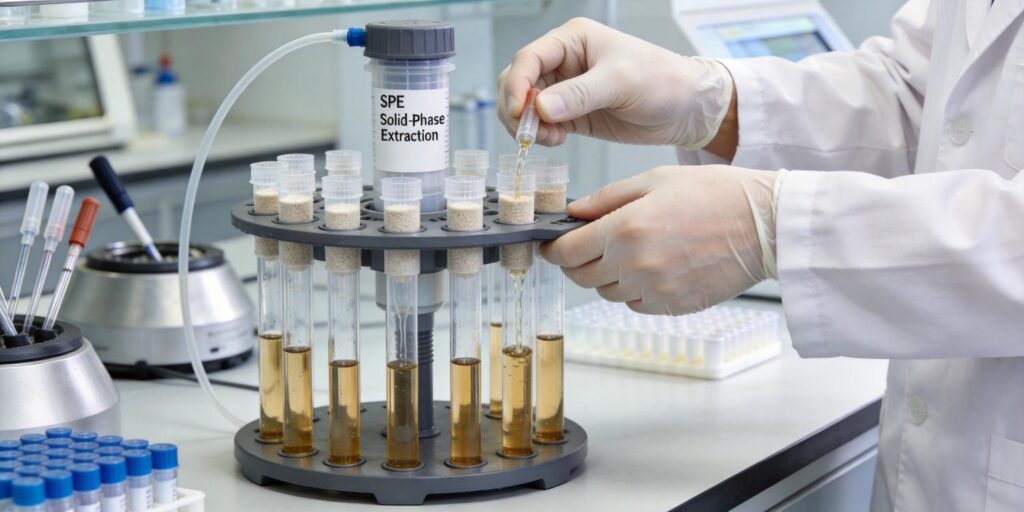
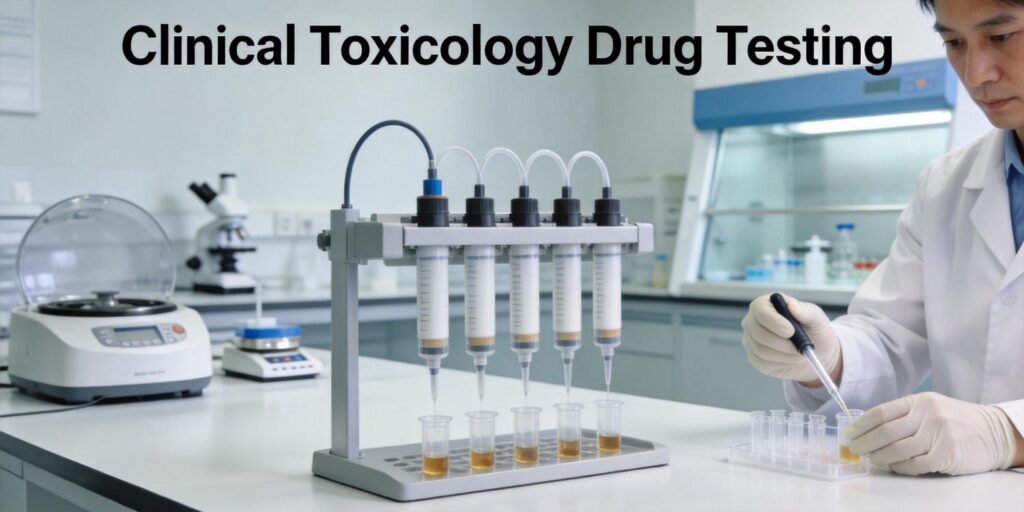
Forensic toxicology samples often include whole blood, urine, oral fluid, hair, and tissue homogenates. These biological matrices are complex, containing proteins, lipids, salts, and endogenous compounds that can interfere with drug analysis. The diversity of matrices poses a challenge for selective isolation of target analytes. Solid-phase extraction (SPE) is the method of choice to clean up these samples, concentrating the drugs of interest while removing matrix components that could suppress ionization or clog chromatographic columns.
2. Characteristics of Basic Drugs
Basic drugs (pKa typically 8–10) such as amphetamines, opiates, benzodiazepines, and tricyclic antidepressants are ionized at low pH and neutral at higher pH. This amphoteric behavior allows manipulation of their charge state to control retention and elution on ion-exchange sorbents. They are often present at trace levels (ng/mL to µg/mL) and can degrade under harsh conditions, so gentle, selective methods are required.
3. MCX SPE Retention Mechanism
The Poseidon MCX SPE cartridge features a mixed-mode sorbent with both reversed-phase (C18-like) and strong cation-exchange (sulfonic acid) functionality. At low pH (<3), basic drugs are protonated and positively charged, binding strongly to the sulfonate groups via ionic interactions. The reversed-phase component also retains nonpolar matrix components. This dual retention provides high selectivity for basic compounds even in complex forensic samples.
4. Sample Preparation and Acidification
Forensic samples (e.g., 0.5–1 mL plasma or urine) are first diluted with 2–3 volumes of 2% phosphoric acid or 0.1 M HCl to lower pH below 3, ensuring the basic drugs are fully ionized. For urine, an enzymatic hydrolysis step (e.g., β-glucuronidase) may be needed to cleave glucuronide conjugates, followed by acidification. Proteins are often precipitated with acetonitrile or methanol; a clean supernatant is then applied to the conditioned MCX cartridge.
5. Washing Protocols
After loading the acidified sample, the MCX cartridge is washed to remove interfering compounds. A typical wash uses 0.1 M HCl (1 mL) to maintain acidic conditions and remove neutral and acidic interferences. A second wash with methanol (1 mL) removes hydrophobic matrix components without eluting the protonated basic drugs. This two-step wash significantly reduces background noise in subsequent analysis.
6. Elution with Basic Solvent Mixture
To elute the retained basic drugs, the sorbent pH is raised to neutralize the sulfonic acid groups and deprotonate the analytes. A common eluent is 5% ammonium hydroxide in methanol (v/v), which breaks the ionic bonds. Elution volumes of 1–2 mL are typically sufficient. The eluate is then evaporated under nitrogen and reconstituted in a suitable solvent for GC-MS or LC-MS analysis.
7. GC-MS or LC-MS Analysis
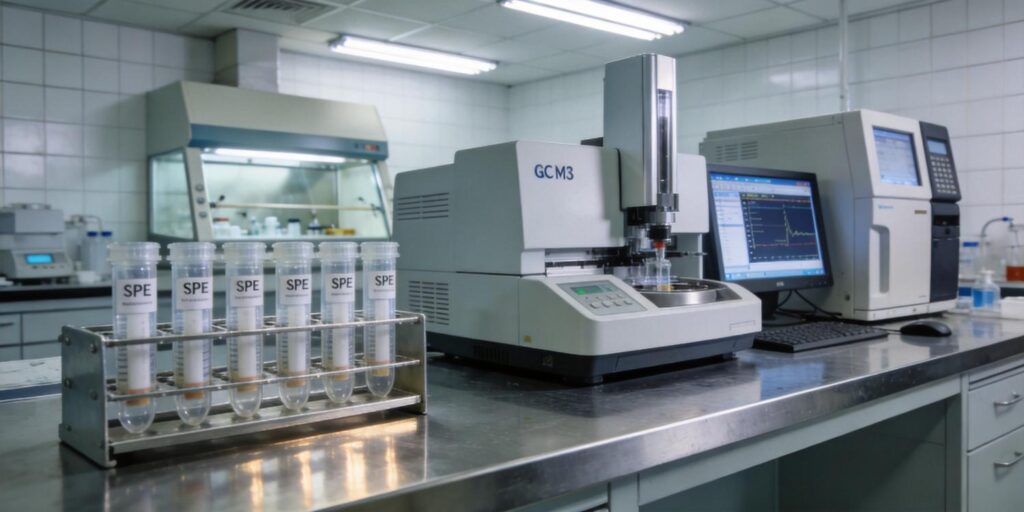
Basic drugs are well-suited for both GC-MS (after derivatization for polar groups) and LC-MS/MS. For GC-MS, derivatization with MSTFA or BSTFA improves volatility and peak shape. LC-MS/MS using electrospray ionization in positive mode offers high sensitivity and specificity. The clean extracts from the MCX method minimize matrix effects, allowing reliable quantification even at low concentrations.
8. Forensic Validation Requirements
Forensic methods must meet rigorous validation criteria per guidelines such as SWGTOX or ANSI/ASB standards. Key parameters include: (a) selectivity – demonstrating no interference from matrix or common drugs; (b) linearity – calibration curves with R² > 0.99; (c) accuracy and precision – within ±15% (20% at LLOQ); (d) recovery – >80% with low variability; (e) carryover – less than 20% of LLOQ; and (f) stability – bench-top, freeze-thaw, and autosampler stability. The MCX method described meets these requirements, providing a robust and defensible protocol for forensic toxicology.
For high-throughput needs, consider the 96-well SPE plate format, which enables parallel processing of multiple samples with the same mixed-mode chemistry.
References: Huestis, M. A., & Smith, M. L. (2018). Modern forensic toxicology. Journal of Analytical Toxicology, 42(1), 1-5. Poseidon Scientific product documentation.