Understanding Organic Pollutants in Marine Ecosystems
Marine ecosystems are increasingly threatened by a wide range of organic pollutants originating from land-based and maritime activities. Key sources include agricultural runoff carrying pesticides and herbicides, industrial discharges containing polychlorinated biphenyls (PCBs) and polycyclic aromatic hydrocarbons (PAHs), oil spills, and domestic wastewater introducing pharmaceuticals and personal care products. These hydrophobic compounds tend to partition into sediments and biota, but dissolved and colloidal fractions in seawater still pose significant ecological risks. Monitoring these trace contaminants requires robust extraction techniques to overcome the challenging matrix of high salt content, dissolved organic matter, and low analyte concentrations (parts per trillion).
Seawater Sample Collection and Filtration
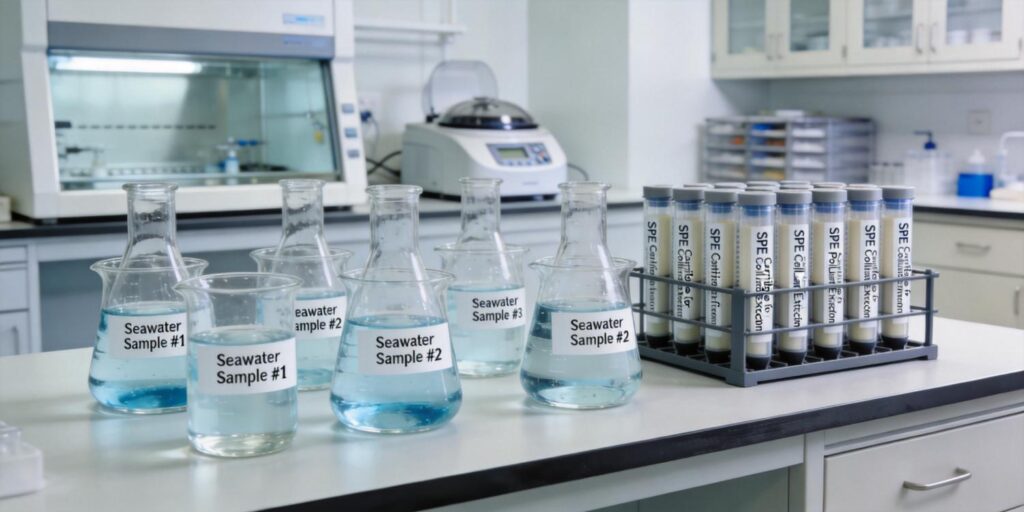
Representative sampling begins with careful collection using pre-cleaned Niskin bottles or peristaltic pumps to avoid contamination. Samples should be field-filtered immediately through 0.7 µm glass fiber filters to remove suspended particulate matter, which would otherwise clog SPE cartridges and compromise recovery. The filtrate, containing the dissolved organic pollutant fraction, is preserved by acidification to pH 2-3 using HCl or H₂SO₄ to suppress microbial degradation and stabilize certain analytes. Samples should be stored in amber glass bottles at 4°C and extracted within 48 hours to minimize losses.
Selecting the Optimal SPE Sorbent for Hydrophobic Pollutants
For non-polar to moderately polar organic pollutants, reversed-phase sorbents are the standard choice. HLB SPE cartridges offer a hydrophilic-lipophilic balance polymer, providing high retention for a broad polarity range, including PAHs, PCBs, and pesticides. Alternatively, MAX SPE cartridges (mixed-mode anion exchange) can be beneficial when selective removal of acidic interferences is needed. For highly hydrophobic compounds, WCX SPE cartridges (weak cation exchange) or C18-bonded silica may be used, understanding that polymer-based sorbents often outperform silica in salt-rich matrices due to greater pH stability and resistance to channeling.
Conditioning Cartridges for Saltwater Matrices
Proper conditioning is critical when processing seawater. Begin with 3-5 mL of methanol to wet the sorbent surface, followed by 3-5 mL of deionized water to remove excess solvent. For saltwater samples, an additional conditioning step with 3 mL of a buffer solution at the sample pH (typically pH 2-3) helps equilibrate the sorbent. This step prevents premature salt precipitation and ensures reproducible interactions between the pollutant and the stationary phase. Using 96-well SPE plates can streamline conditioning when processing many samples simultaneously, but each well must be conditioned individually to avoid cross-contamination.
Loading Large-Volume Seawater Samples
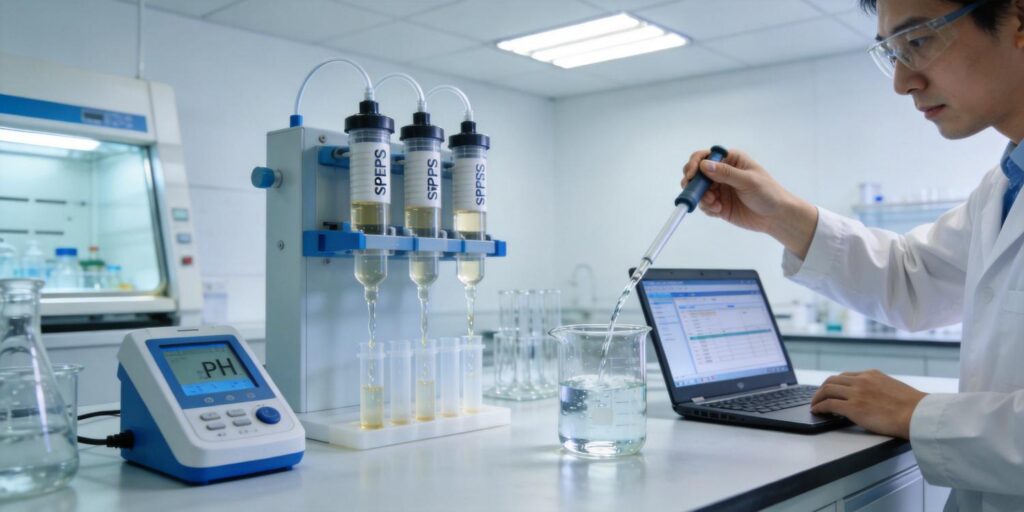
Seawater sample volumes typically range from 500 mL to 4 L, depending on the detection limit requirements. Peristaltic pumps provide precise flow control (5-15 mL/min) necessary to maintain retention while preventing sorbent saturation. For volumes exceeding 1 L, an SPE disk or large-volume cartridge (e.g., 12 mL reservoir with 1 g sorbent) is recommended. It is essential to monitor backpressure; if flow decreases significantly, the cartridge may be clogged by residual particulate matter or dissolved organic matter. In such cases, sample pre-filtration through a 0.45 µm filter or a preliminary cleanup step can alleviate the issue.
Washing Steps to Remove Salts and Matrix Interferences
After loading, the cartridge contains retained analytes along with salts and polar co-extractives. A wash with 5-10 mL of deionized water removes sodium chloride and other inorganic salts. For more rigorous cleanup, a wash with 5% methanol in water (v/v) can eliminate moderately polar interferences without eluting target hydrophobic pollutants. To remove humic acids and other natural organic matter, a wash with 2% formic acid in water (for acidic conditions) or 2% ammonium hydroxide (for basic conditions) may be applied judiciously, keeping the pH compatible with the sorbent’s retention mechanism.
Elution of Concentrated Pollutants for Analysis
Elution with a suitable solvent is the final step before analysis. Typically, 3-5 mL of ethyl acetate, dichloromethane, or acetonitrile is used for non-polar analytes. For best recovery, divide the elution into two aliquots and combine them. The eluate is then concentrated under a gentle nitrogen stream to 200-500 µL, and the solvent is exchanged to match the LC-MS mobile phase, usually methanol or acetonitrile. Care must be taken to avoid complete dryness, which may cause analyte losses, especially for volatile compounds.
Environmental Monitoring by LC-MS
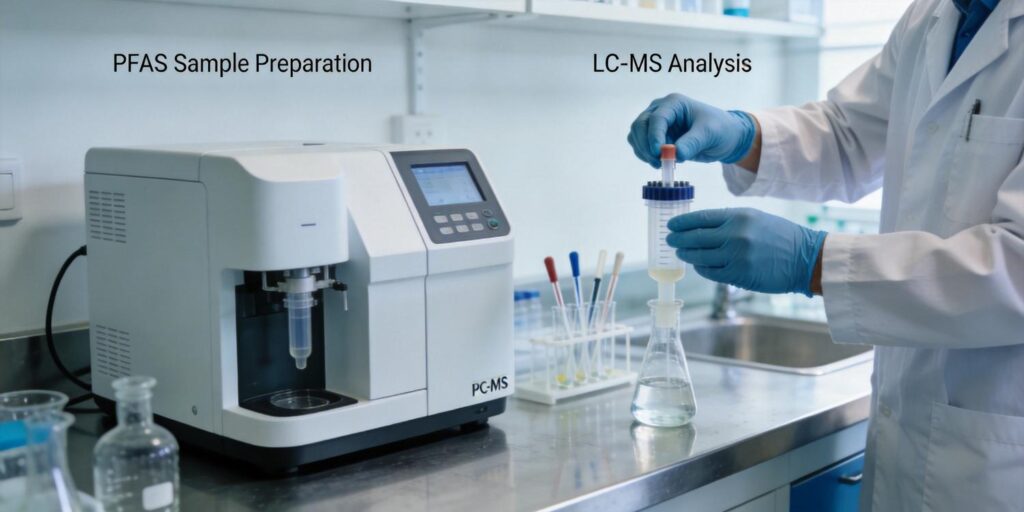
Liquid chromatography coupled with mass spectrometry (LC-MS/MS) offers high sensitivity and selectivity for detecting trace organic pollutants. A reversed-phase C18 column with a water-acetonitrile gradient is typical. Electrospray ionization (ESI) in positive or negative ion mode is chosen based on analyte properties. Multiple reaction monitoring (MRM) transitions are optimized for each target compound. Method validation includes spike recovery experiments using surrogate standards (e.g., deuterated PAHs or PCBs) added before extraction. Recoveries should fall between 70% and 120% with RSD < 20% for reliable quantitation. Routine analysis of field blanks and matrix spikes ensures data quality for regulatory compliance.
Conclusion
SPE extraction of organic pollutants from marine water demands careful attention to sample handling, sorbent selection, and protocol optimization to overcome the challenges of high salinity and low analyte levels. By following best practices in conditioning, loading, washing, and elution, environmental laboratories can achieve robust, reproducible results. HLB, MAX, MCX, WAX, and WCX SPE cartridges from Poseidon Scientific provide the versatility needed for diverse organic pollutant classes, while 96-well plates enable high-throughput workflows essential for coastal monitoring programs.