Understanding Pesticide Contamination Risks in Honey
Honey, as a natural product derived from floral nectar, can become contaminated with pesticides through several pathways. Bees foraging in agricultural areas may collect nectar and pollen from crops treated with insecticides, fungicides, or herbicides. These compounds can bioaccumulate in honey, posing potential health risks to consumers. Regulatory bodies like the European Union and the U.S. FDA have established maximum residue limits (MRLs) for pesticides in honey, typically in the low parts-per-billion (ppb) range. Common contaminants include neonicotinoids (e.g., imidacloprid, clothianidin), organophosphates (e.g., chlorpyrifos), and pyrethroids (e.g., cypermethrin). Monitoring these residues requires robust, sensitive analytical methods that can overcome honey’s complex matrix—rich in sugars, organic acids, and phenolic compounds that interfere with detection. Solid-phase extraction (SPE) has emerged as the preferred sample preparation technique for isolating and concentrating pesticide residues from honey prior to LC-MS/MS analysis.
Sample Dilution and Extraction Procedures
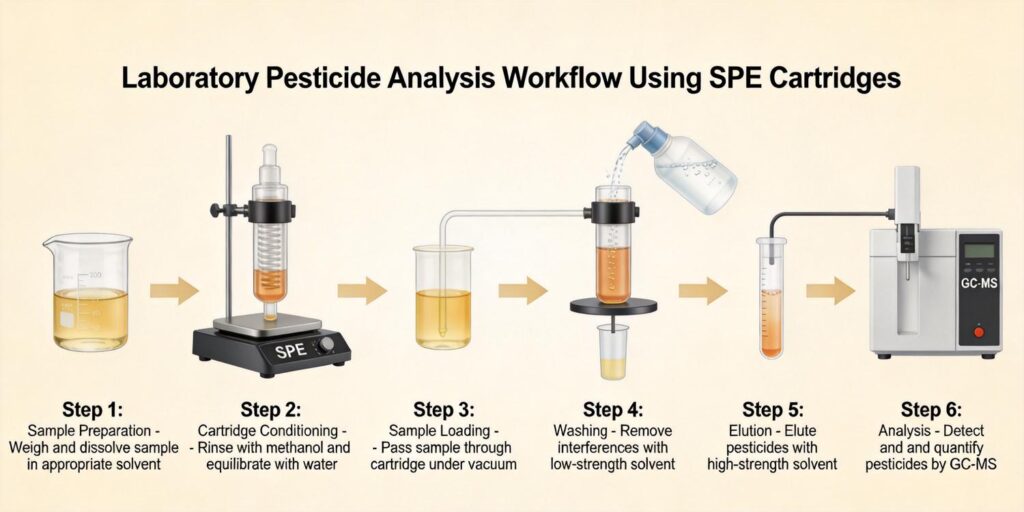
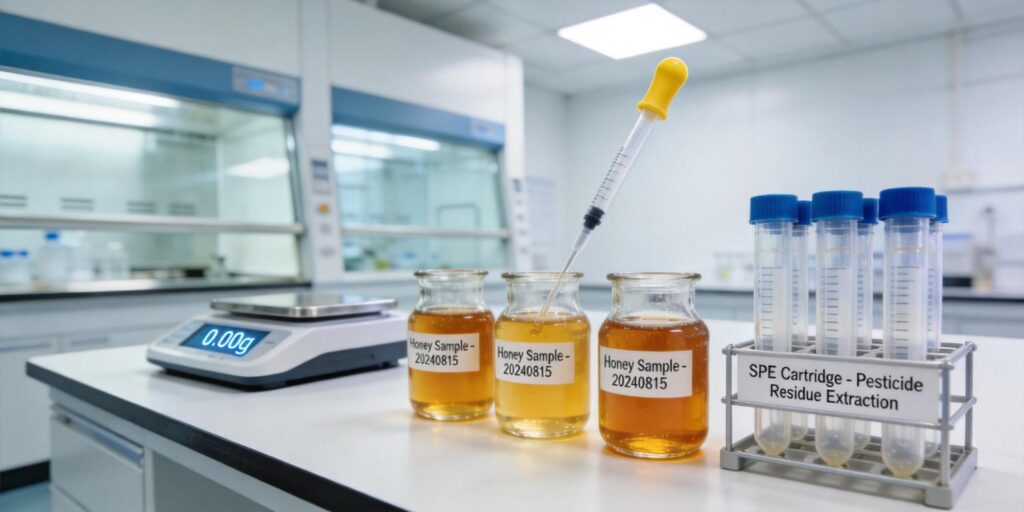
Honey’s high viscosity and sugar content (up to 80% monosaccharides and disaccharides) necessitate dilution before SPE. A typical protocol begins with dissolving 5–10 g of honey in 10–20 mL of deionized water or buffer (e.g., 0.1 M phosphate buffer, pH 7.0) to achieve a homogenous solution. Some methods incorporate acidification (e.g., 1% acetic acid) to enhance recovery of acidic pesticides. For liquid-liquid extraction (LLE) prior to SPE, the diluted honey is often partitioned with ethyl acetate or acetonitrile to remove bulk sugars and waxes. However, direct loading of diluted honey onto an SPE cartridge after centrifugation (10 min at 4000 rpm) is common for streamlined workflows. The key is to ensure the sample is particle-free to avoid clogging the sorbent bed.
SPE Sorbent Selection for Pesticide Residues
Choosing the right SPE sorbent is critical for selective retention of pesticides while excluding sugars and other matrix components. For multi-residue analysis, reversed-phase sorbents such as C18 (octadecyl) are popular due to their broad retention of nonpolar to moderately polar pesticides. However, for more polar pesticides (e.g., neonicotinoids), polymeric sorbents like HLB (hydrophilic-lipophilic balanced) provide better retention and recovery across a wider polarity range. HLB cartridges, such as Poseidon Scientific’s HLB SPE Cartridges, offer high surface area and dual retention mechanisms (reversed-phase and polar interactions), making them ideal for comprehensive pesticide screening. Alternatively, mixed-mode sorbents like MCX (mixed-mode cation exchange) or MAX (mixed-mode anion exchange) can be used for selective extraction of ionizable pesticides (e.g., acidic or basic compounds). For honey, HLB is often the first choice due to its versatility and compatibility with LC-MS/MS.
Cartridge Conditioning Protocols
Proper conditioning of the SPE cartridge ensures reproducible retention and minimizes carryover. A typical conditioning sequence for polymeric sorbents like HLB involves: (1) 3–5 mL of methanol to activate the sorbent, (2) 3–5 mL of deionized water to equilibrate the bed. For C18 cartridges, conditioning is similar but may use acetonitrile if the elution solvent is nonpolar. It’s crucial to avoid letting the sorbent bed dry out between steps, as this can cause channeling and reduced retention. Some protocols include a buffer wash (e.g., 0.1% formic acid in water) to maintain a consistent pH for ionizable compounds.
Loading Honey Extracts
The diluted or extracted honey sample is loaded onto the conditioned SPE cartridge at a controlled flow rate of 1–2 mL/min. To prevent overloading, the sample volume should not exceed the cartridge’s capacity—typically 100–200 mg of sorbent per gram of honey. After loading, the cartridge is often air-dried or washed with a low-solvent volume to remove residual water. The analytes of interest are retained on the sorbent while sugars and other polar matrix components pass through the bed or are later removed during washing.
Washing Steps Removing Sugars
Sugars are the primary interferents in honey, and they must be efficiently removed before elution. A typical wash step employs 5–10 mL of 5% methanol in water (v/v) to selectively elute sugars while keeping pesticides retained on the sorbent. For HLB or C18, a higher water content (e.g., 0.1% formic acid in water) can be used for more polar pesticides. A second wash with a slightly stronger solvent (e.g., 10% methanol in water) may be applied for dirty samples. It’s important to monitor the wash volume to avoid premature elution of target analytes. After washing, the cartridge is dried under vacuum for 5–10 minutes to remove residual moisture, which could affect elution efficiency.
Elution Solvents for LC-MS/MS Analysis
Elution of pesticide residues from the SPE cartridge is typically achieved with 5–10 mL of an organic solvent or mixture. For reversed-phase sorbents, methanol or acetonitrile are common choices, often acidified with 0.1% formic acid to enhance ionization in positive electrospray ionization (ESI+). For polymeric sorbents like HLB, ethyl acetate or dichloromethane may be used for nonpolar pesticides. The eluate is collected, evaporated to dryness under nitrogen at 40°C, and reconstituted in a small volume (200–500 µL) of mobile phase (e.g., water:methanol 1:1 with 0.1% formic acid) for LC-MS/MS injection. This step concentrates the analytes by 10–50x, improving sensitivity for trace-level detection.
Food Safety Monitoring Workflow
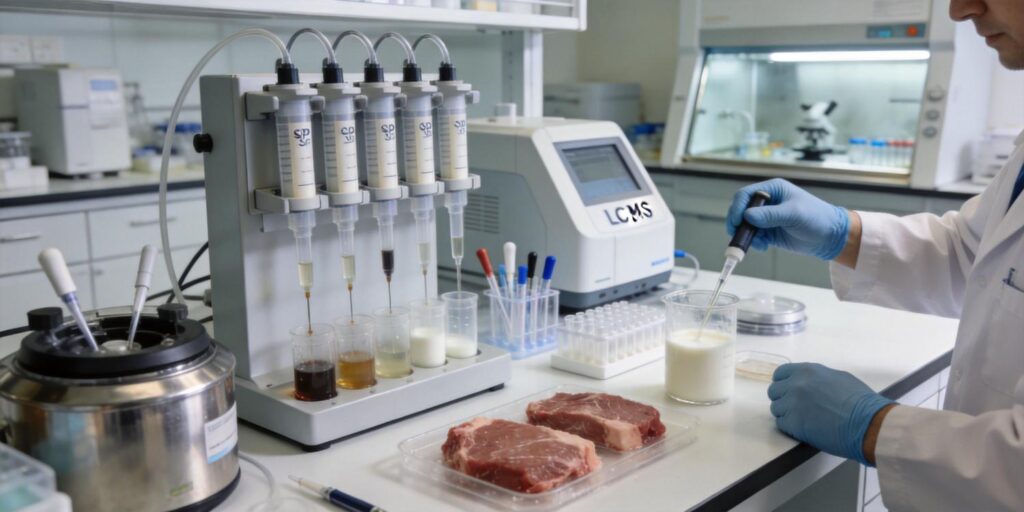
A comprehensive food safety monitoring workflow integrates SPE sample preparation with LC-MS/MS analysis. After elution and reconstitution, the sample is injected into a liquid chromatography system equipped with a C18 analytical column (e.g., 2.1 x 100 mm, 1.7 µm) and a triple-quadrupole mass spectrometer operating in multiple reaction monitoring (MRM) mode. Quantification is performed using matrix-matched calibration curves, with internal standards (e.g., isotopically labeled pesticides) to correct for matrix effects. For high-throughput laboratories, 96-well SPE plates from Poseidon Scientific can process dozens of honey samples simultaneously, accelerating regulatory compliance testing. The entire workflow—from sample dilution to data acquisition—typically takes 2–4 hours per batch, delivering reliable results for pesticide residues at concentrations as low as 0.5 ppb, ensuring consumer safety and regulatory adherence.