The Growing Demand for Therapeutic Drug Monitoring in Clinical Settings
Therapeutic drug monitoring (TDM) has become an essential practice in modern hospitals, enabling clinicians to personalize drug dosages for improved efficacy and reduced toxicity. Drugs with narrow therapeutic windows—such as immunosuppressants (tacrolimus, cyclosporine), anticonvulsants (valproic acid, phenytoin), antibiotics (vancomycin, gentamicin), and antiretrovirals—require precise blood concentration measurements. TDM laboratories process hundreds of samples daily, demanding robust, reproducible sample preparation methods. Solid-phase extraction (SPE) is the gold standard for cleaning up biological matrices before LC-MS/MS analysis, offering superior selectivity and throughput compared to liquid-liquid extraction or protein precipitation.
Biological Matrices Encountered in TDM
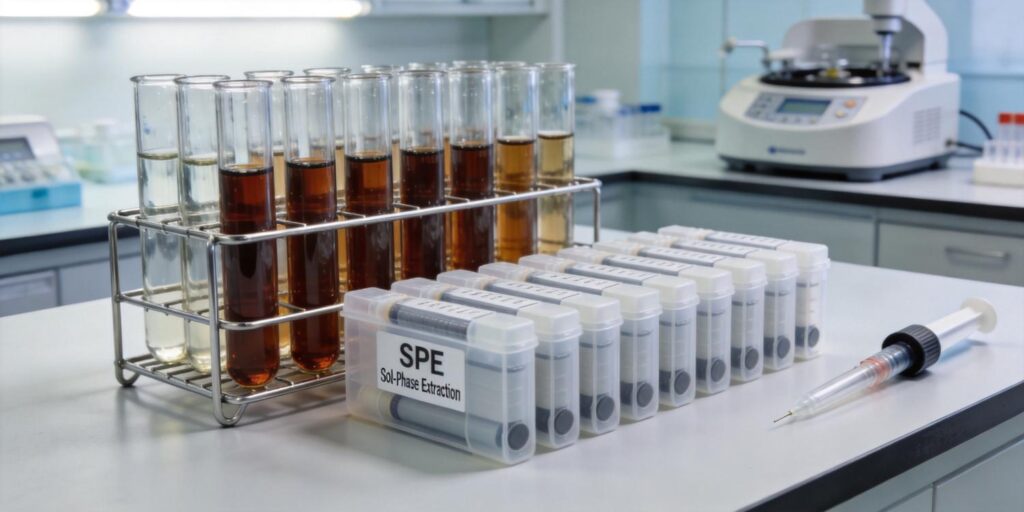
Whole blood, plasma, and serum are the most common matrices in TDM. However, urine, saliva, and dried blood spots (DBS) are also used for specific drugs or pediatric populations. Each matrix presents unique challenges: whole blood contains hemoglobin and cellular debris, plasma has high protein content, and urine includes variable salt and metabolite levels. Effective SPE methods must remove phospholipids, proteins, and salts that can cause ion suppression in mass spectrometry. For instance, HLB SPE cartridges (hydrophilic-lipophilic balance) are versatile for extracting drugs from plasma and whole blood, while mixed-mode sorbents offer additional selectivity for acidic or basic analytes.
Selecting the Optimal SPE Sorbent for Drug Cleanup
The choice of sorbent depends on the drug’s physicochemical properties. For neutral and moderately polar drugs, polymeric HLB sorbents provide excellent retention via reversed-phase interactions. Ionizable drugs benefit from mixed-mode sorbents:
- Mixed-mode strong cation exchange (MCX): Ideal for basic drugs (e.g., amitriptyline, metformin). Learn more about our MCX SPE cartridges.
- Mixed-mode weak anion exchange (WAX): Suited for acidic drugs (e.g., NSAIDs, penicillins). Explore WAX SPE cartridges.
- Mixed-mode weak cation exchange (WCX): For quaternary amines and strong bases. See WCX SPE cartridges.
- Mixed-mode strong anion exchange (MAX): Retains acidic compounds in their anionic form. Check MAX SPE cartridges.
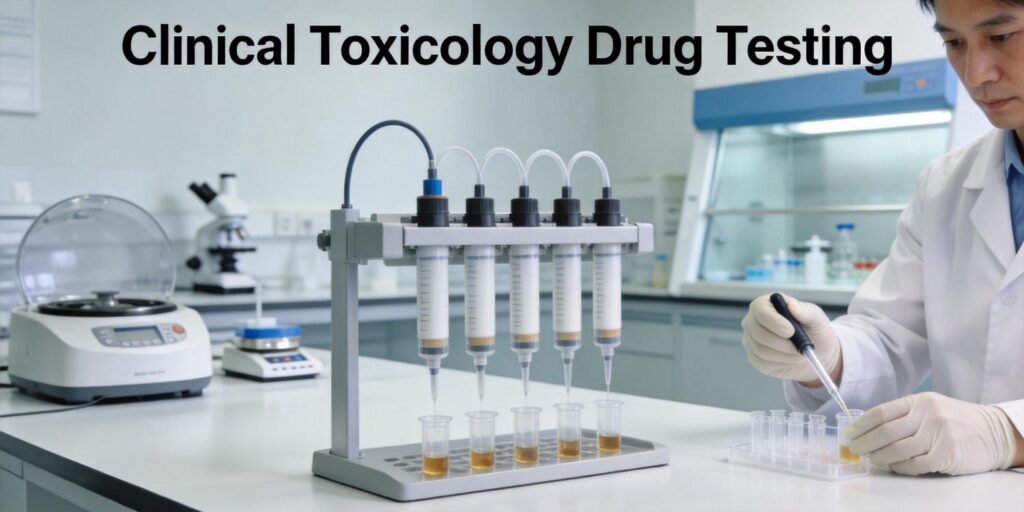
For multi-drug panels, a combination of sorbents or a 96-well plate format can enhance throughput. Poseidon’s 96-well SPE plates are compatible with automated liquid handlers, processing 96 samples in parallel—critical for high-volume TDM labs.
Sample Pretreatment: From Collection to SPE Loading
Proper pretreatment is vital to prevent sorbent fouling and ensure reproducibility. Common steps include:
- Protein precipitation: Add acetonitrile or methanol (1:1 to 1:3 v/v) to plasma, vortex, and centrifuge. The supernatant is diluted with water (≤10% organic) before loading onto the SPE cartridge.
- Enzymatic digestion: For conjugated drugs (e.g., glucuronides), use β-glucuronidase to cleave metabolites before extraction.
- pH adjustment: For ionizable drugs, adjust the sample pH to ensure the drug is in its non-ionized form (for reversed-phase) or ionized form (for ion-exchange).
For whole blood, hemolysis must be minimized; adding a reducing agent like ascorbic acid can stabilize labile drugs. DBS samples are punched and extracted with a methanol:water mixture, then directly loaded onto conditioned SPE cartridges.
Cartridge Conditioning and Sample Loading Protocols
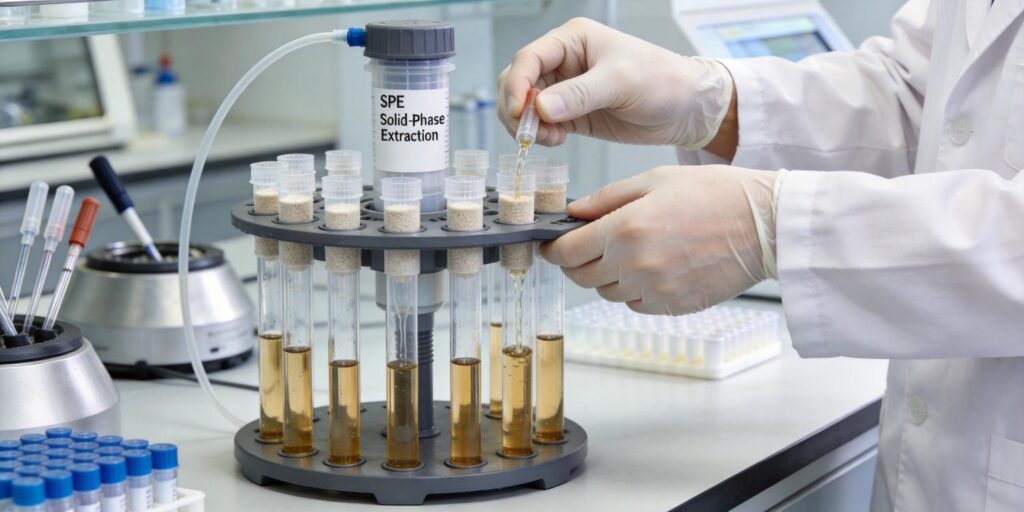
Conditioning the SPE sorbent activates the functional groups and creates a uniform environment. A typical protocol with HLB SPE cartridges:
- Condition: 1 mL methanol, then 1 mL water (or buffer at the desired pH).
- Load: Pretreated sample (e.g., 500 µL diluted plasma) applied dropwise at 1–2 mL/min.
- Wash: 1 mL 5% methanol in water containing 0.1% formic acid (for basic drugs) or 1 mL water with 1% ammonium hydroxide (for acidic drugs).
- Elute: 1 mL methanol (for reversed-phase) or methanol with 2–5% formic acid/ammonia (for ion-exchange).
For mixed-mode sorbents like MCX, the wash step can include a higher percentage of organic solvent (e.g., 20% methanol) to remove neutral interferences while retaining the charged drug.
Washing Protocols to Reduce Matrix Interference
Matrix effects from phospholipids, salts, and endogenous compounds are the primary culprits of ion suppression in LC-MS/MS. An optimized wash protocol should:
- Remove salts and polar compounds: Wash with water or low-organic buffer (e.g., 0.1% formic acid in 5% methanol).
- Remove phospholipids: Use a wash with 100% acetonitrile (for HLB) or a dedicated phospholipid removal step. Some sorbents, like hybrid SPE (not covered here), offer phospholipid depletion.
- Retain the analyte: Ensure the drug’s pKa and logP are considered—adjust pH to keep the drug in its retained form.
A two-step wash (e.g., water then 10% methanol in water) often yields cleaner extracts. For lipophilic drugs, a hexane wash can remove nonpolar lipids, but ensure the drug does not elute in hexane.
Elution Solvents Compatible with LC-MS/MS
The final elution solvent must be compatible with the subsequent LC-MS/MS mobile phase. Typical eluents:
- Reversed-phase sorbents (HLB): Methanol, acetonitrile, or a mixture (e.g., 70:30 acetonitrile:isopropanol) is recommended. Evaporation and reconstitution in mobile phase are common.
- Mixed-mode ion-exchange (MCX, MAX, WAX, WCX): Add a volatile acid (e.g., 2% formic acid) or base (e.g., 2% ammonium hydroxide) to the organic solvent to disrupt ionic interactions. For example, 5% ammonium hydroxide in methanol for MAX or 5% formic acid in methanol for MCX.
Elution volumes typically range from 250 µL to 1 mL. For high-throughput methods, the eluate can be directly injected after dilution with water (if < 50% organic) to avoid peak distortion.
Ensuring Analytical Accuracy and Validation
SPE method validation for TDM must follow FDA or EMA guidelines. Key parameters include:
- Recovery: ≥ 90% with RSD < 10%.
- Matrix effect: Less than 15% ion suppression/enhancement, assessed via post-column infusion or matrix-matched calibration.
- Carryover: < 20% of the lower limit of quantification (LLOQ).
- Selectivity: No interferences from endogenous compounds or co-administered drugs.
Internal standards (IS) are mandatory; isotopically labeled analogs (e.g., d3-, 13C-labeled) correct for recovery and matrix effects. The SPE process should yield identical recovery for IS and analyte—if not, a surrogate matrix or standard addition may be needed.
Poseidon Scientific’s SPE products, including HLB, MCX, WAX, WCX, and MAX cartridges, as well as 96-well plates, provide consistent lot-to-lot performance, ensuring reliable TDM results. By carefully optimizing each step—from sorbent selection to elution—laboratories can achieve the accuracy and precision demanded by clinical regulations.