The Critical Role of Toxicology Screening in Modern Healthcare
Clinical toxicology testing represents a cornerstone of modern diagnostic medicine, providing essential information for emergency medicine, occupational health monitoring, substance abuse treatment, and forensic investigations. The importance of comprehensive toxicology screening cannot be overstated—it enables healthcare providers to identify potentially life-threatening exposures, guide appropriate treatment interventions, and monitor therapeutic drug compliance.
According to established literature, systematic toxicological analysis (STA) must address three fundamental tasks: sample work-up/isolation/concentration, differentiation/detection, and identification of toxicologically relevant substances. The traditional approach to sample preparation in analytical toxicology has been liquid-liquid extraction (LLE), but this method presents significant disadvantages including unpredictable recoveries, matrix interferences, emulsion formation, and the use of large amounts of hazardous solvents.
Drug and Toxin Detection in Biological Fluids: The Matrix Challenge
Biological samples—including urine, plasma, whole blood, serum, and tissues—present unique analytical challenges due to their complex matrices. These samples contain numerous endogenous compounds that can interfere with analytical methods, making effective sample preparation essential for accurate detection and quantification of drugs and toxins.
Research demonstrates that SPE has become particularly valuable for the simultaneous qualitative and quantitative determination of drugs of abuse (including opiates, cocaine, and amphetamines) and prescribed drugs (such as tricyclic antidepressants, phenothiazines, and benzodiazepines) in biological fluids. The development of mixed-mode cartridges providing both hydrophobic and cation exchange interactions, combined with pH-dependent sample application and extraction, has enabled high recoveries of analytes from various biological matrices.
As noted in the literature, “SPE is a very useful tool for sample workup, isolation and concentration in STA. The strategy of a mixed-mode cartridge providing hydrophobic and cation exchange interactions, combined with a pH-dependent sample application and extraction, can give high recoveries of analytes from plasma, urine, whole blood, and tissues.”
SPE Cleanup Before LC-MS Analysis: Enhancing Analytical Performance
Liquid chromatography-mass spectrometry (LC-MS) has become the gold standard for clinical toxicology testing due to its exceptional sensitivity, specificity, and ability to analyze a wide range of compounds. However, the success of LC-MS analysis depends heavily on effective sample preparation to remove matrix interferences that can suppress ionization, contaminate instrumentation, and compromise analytical results.
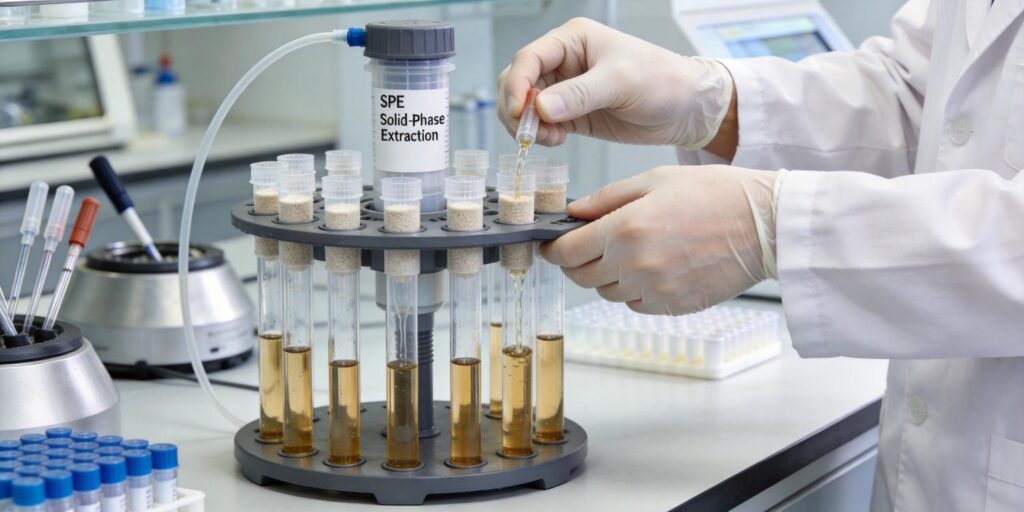
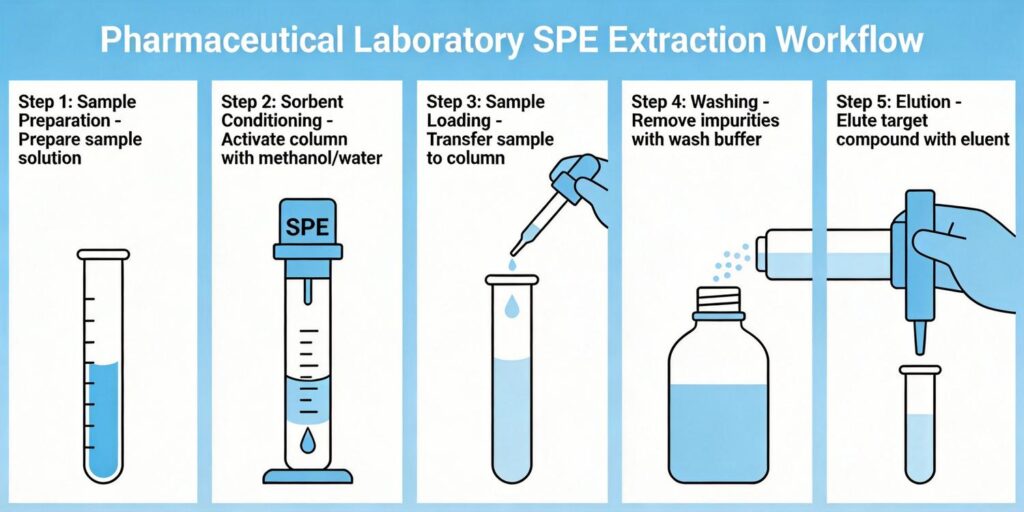
Solid-phase extraction serves as a critical bridge between complex biological samples and sophisticated analytical instrumentation. The process involves several key steps:
1. Cartridge Conditioning
Proper conditioning of SPE cartridges with appropriate solvents ensures optimal interaction between the sorbent and target analytes.
2. Sample Pretreatment and Application
Biological samples often require pretreatment steps such as pH adjustment, dilution, or protein precipitation before application to SPE cartridges.
3. Selective Washing
Washing steps remove interfering matrix components while retaining target analytes on the sorbent.
4. Analyte Elution
Target compounds are selectively eluted using appropriate solvents, resulting in concentrated, purified extracts ready for LC-MS analysis.
The advantages of SPE over traditional LLE for LC-MS applications are significant. SPE recoveries typically exceed 90% absolute recovery when parameters such as solubility, pH, and solvent strength are properly adjusted. Furthermore, SPE actually concentrates samples on the column, allowing for reproducible results at very low analyte levels—a critical requirement for detecting trace concentrations of drugs and metabolites in clinical samples.
Example Clinical Workflows: From Emergency Room to Forensic Laboratory
Clinical toxicology workflows vary depending on the clinical setting and analytical requirements, but several common approaches demonstrate the versatility of SPE in different scenarios:
Emergency Toxicology Screening
In emergency departments, rapid identification of intoxicants is crucial for patient management. A comprehensive SPE procedure using mixed-mode cartridges can extract a broad spectrum of drugs from plasma and whole blood for subsequent HPLC analysis. This approach enables simultaneous screening for multiple drug classes while minimizing matrix interferences.
Therapeutic Drug Monitoring
For monitoring therapeutic drugs such as anticonvulsants, antidepressants, or immunosuppressants, SPE provides the selectivity and sensitivity required for accurate quantification. Methods have been developed for specific drug classes, including automated SPE procedures for high-throughput analysis in clinical laboratories.
Forensic and Workplace Testing
Forensic applications often require confirmation of presumptive positive screening results. SPE methods have been developed for specific analytes such as benzoylecgonine (cocaine metabolite) from urine, providing clean extracts suitable for confirmatory analysis by GC-MS or LC-MS/MS.
Postmortem Toxicology
Analysis of tissues and postmortem specimens presents unique challenges due to sample decomposition and complex matrices. SPE procedures have been adapted for tissue samples, including enzymatic digestion protocols followed by SPE extraction for comprehensive drug screening in liver tissue.
Advantages of Modern SPE Technologies in Clinical Toxicology
The evolution of SPE technology has addressed many of the limitations of earlier extraction methods. Modern SPE cartridges offer several advantages specifically relevant to clinical toxicology:
High Selectivity and Clean Extracts
Mixed-mode sorbents combining reversed-phase and ion-exchange mechanisms provide exceptional selectivity for basic, acidic, and neutral drugs. The resulting extracts show minimal interference from endogenous matrix components, enabling clear detection and quantitation of toxicologically relevant substances.
Automation Compatibility
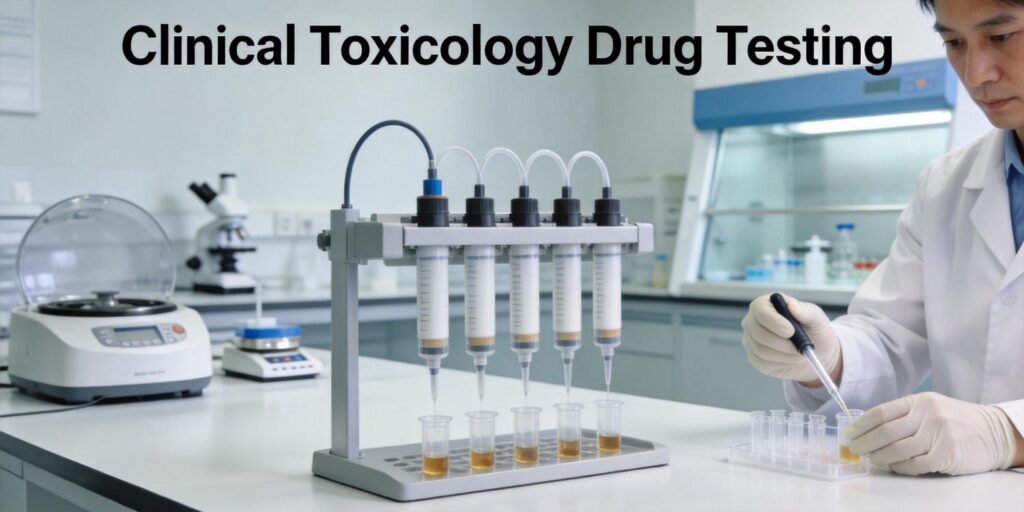
SPE procedures lend themselves well to automation, which can increase throughput and substantially reduce manual labor. Automated systems can process multiple samples simultaneously, improving reproducibility and efficiency in high-volume clinical laboratories.
Versatility Across Sample Types
SPE methods have been successfully applied to various biological matrices including plasma, urine, whole blood, tissues, and even alternative specimens such as hair and meconium. This versatility makes SPE suitable for diverse clinical and forensic applications.
Improved Method Development
The availability of specialized sorbents and standardized protocols has simplified method development for new analytes. Researchers can build upon established SPE procedures when developing methods for newly introduced pharmaceuticals or emerging drugs of abuse.
Future Directions and Considerations
As clinical toxicology continues to evolve, SPE technology must adapt to new analytical challenges. The increasing number of target analytes—including new therapeutics, designer drugs, and synthetic polypeptides—requires ongoing method development and validation. Additionally, the need for faster analysis times and lower detection limits drives innovation in SPE technology.
Recent developments in SPE include miniaturized formats, disc-based extraction devices, and solid-phase microextraction techniques. These innovations offer potential for reduced solvent consumption, faster extraction times, and improved sensitivity—all valuable attributes for modern clinical toxicology laboratories.
However, it remains essential to validate SPE methods for new drugs and their metabolites, particularly as pharmaceutical development continues to introduce novel compounds with unique chemical properties. The extraction behavior of metabolites with existing SPE procedures represents an important area for ongoing research, though this is often limited by the availability of appropriate reference standards.
Conclusion
Solid-phase extraction has established itself as an indispensable tool in clinical toxicology testing, providing the sample preparation foundation for accurate, sensitive, and specific detection of drugs and toxins in biological fluids. By effectively removing matrix interferences and concentrating target analytes, SPE enables reliable LC-MS analysis that supports critical clinical decisions in emergency medicine, therapeutic drug monitoring, and forensic investigations.
The continued evolution of SPE technology—including improved sorbents, automated systems, and miniaturized formats—promises to further enhance the capabilities of clinical toxicology laboratories. As analytical demands increase and new substances emerge, SPE will remain a vital component of comprehensive toxicological analysis, supporting patient care and public health through accurate detection and quantification of potentially harmful substances.
For laboratories seeking to implement or optimize SPE methods for clinical toxicology applications, careful consideration of sorbent selection, method parameters, and validation requirements is essential. By leveraging the strengths of modern SPE technology, clinical laboratories can achieve the analytical performance necessary to meet the complex challenges of contemporary toxicology testing.