The Critical Role of Hormone Monitoring in Clinical Research
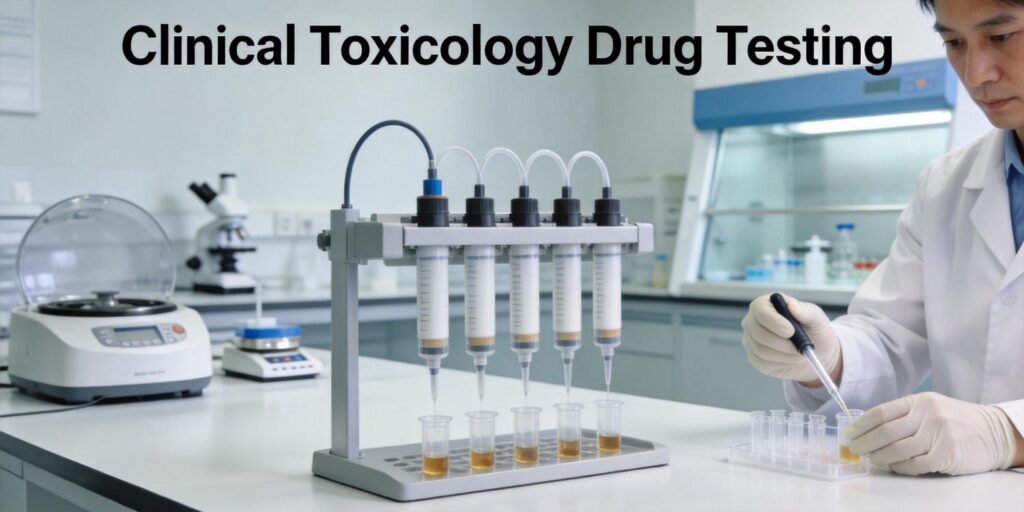
Hormone analysis represents one of the most fundamental and challenging aspects of modern clinical research and diagnostics. As signaling molecules that regulate virtually every physiological process—from metabolism and growth to reproduction and stress response—hormones provide crucial insights into endocrine function, disease states, and therapeutic interventions. The accurate quantification of these compounds in biological matrices has become indispensable for diagnosing endocrine disorders, monitoring hormone replacement therapies, assessing reproductive health, and understanding metabolic syndromes.
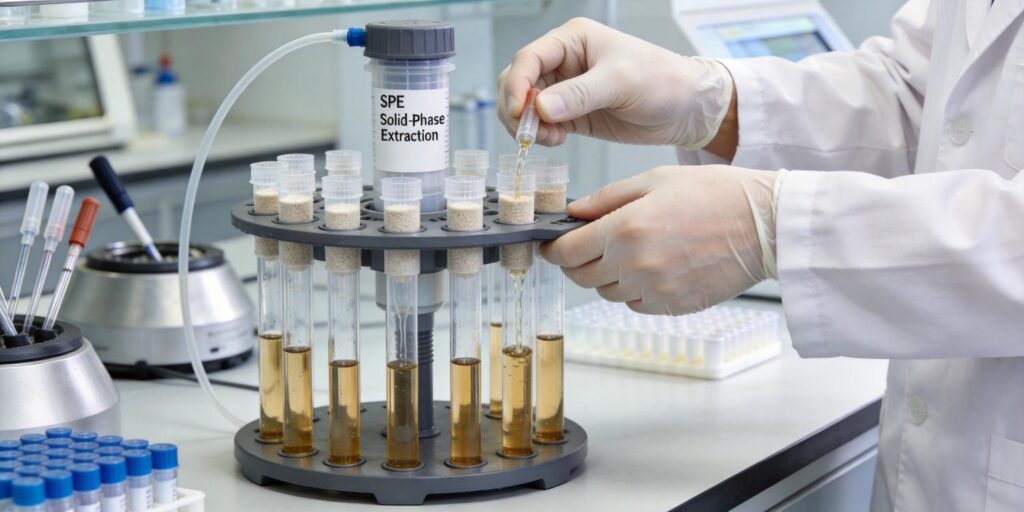
According to established literature on biological sample preparation, solid-phase extraction (SPE) has emerged as the gold standard for hormone isolation from complex biological matrices. The technique’s popularity stems from its ability to achieve high selectivities and recoveries while minimizing hazardous solvent consumption—a critical consideration in clinical laboratories handling large sample volumes. As noted in comprehensive SPE references, “The emphasis in this chapter has been laid on extraction of blood plasma for HPLC assay. This should not imply serious limitations because many of the basic principles for extracting plasma are generally applicable to other biological matrices.”
Typical Hormones Analyzed in Clinical Settings
Clinical laboratories routinely analyze a diverse array of hormones, each presenting unique analytical challenges:
Steroid Hormones
• Cortisol and cortisone (glucocorticoids)
• Testosterone, estradiol, progesterone (sex steroids)
• Aldosterone (mineralocorticoid)
• Vitamin D metabolites
Peptide and Protein Hormones
• Insulin and C-peptide
• Growth hormone (GH)
• Thyroid-stimulating hormone (TSH)
• Parathyroid hormone (PTH)
Catecholamines and Related Compounds
• Epinephrine, norepinephrine
• Dopamine
• Serotonin and metabolites
Research demonstrates that SPE procedures for anabolic steroids and corticosteroids have been particularly well-developed, with specific methods available for compounds like testosterone, 19-noretiocholanone, oxymethalone, and various hydroxylated metabolites. These methods often employ mixed-mode sorbents that provide both hydrophobic and cation exchange interactions for optimal recovery.
Challenges in Plasma and Urine Matrices
Biological samples present formidable analytical challenges that SPE must overcome. As noted in authoritative SPE texts, “Biological samples are notoriously dirty; injecting them with minimum cleanup onto very sensitive and expensive instruments makes very little sense.”
Plasma/Serum Challenges
• High protein content (60-80 mg/mL) causing binding and matrix effects
• Lipids that can interfere with chromatography
• Endogenous compounds with similar chemical properties to target hormones
• Low hormone concentrations (often pg/mL to ng/mL)
• Protein binding that must be disrupted for accurate quantification
Urine Challenges
• Variable pH (4.5-8.0) affecting analyte stability and extraction efficiency
• High salt content and electrolyte variability
• Conjugated metabolites (glucuronides, sulfates) requiring hydrolysis
• Bacterial contamination potentially degrading analytes
• Dilute analyte concentrations requiring concentration steps
The literature emphasizes that “urine is characterized by a low protein content and by a less well defined sample matrix than plasma. For instance, urine pH varies between 4.5 and 8 in normal subjects and the content of electrolytes also varies considerably, depending on the diet and the rate of urine production.”
SPE Workflow for Hormone Extraction
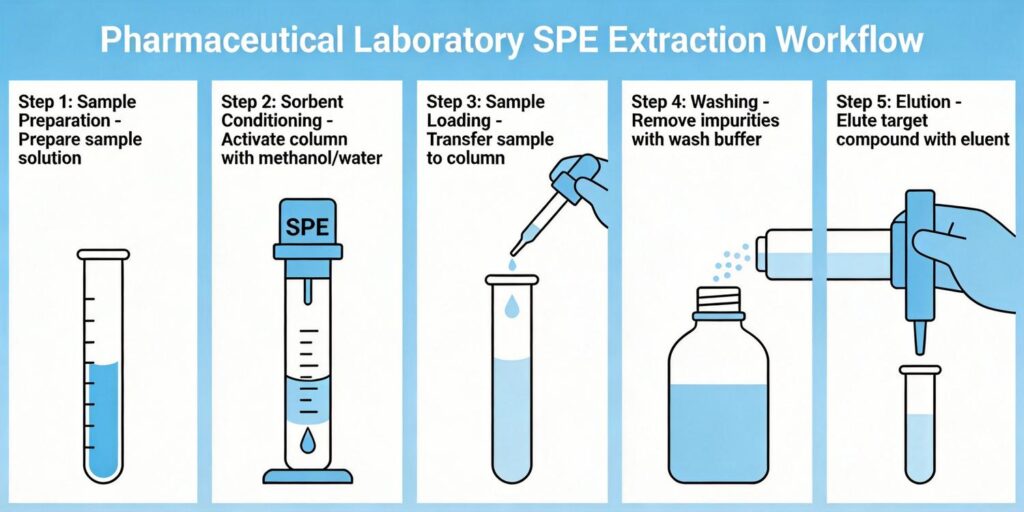
A well-optimized SPE procedure for hormone extraction follows a systematic approach that addresses the specific challenges of biological matrices:
1. Sample Pretreatment
• Plasma: Protein precipitation using organic solvents or acids
• Urine: Enzymatic hydrolysis (β-glucuronidase) for conjugated hormones
• pH adjustment to optimize retention based on analyte pKa
• Addition of internal standards for quantification accuracy
2. Sorbent Selection
The choice of SPE sorbent depends on hormone polarity and functional groups:
• Reversed-phase sorbents (C18, C8, HLB): Ideal for hydrophobic steroids and lipophilic hormones. HLB (hydrophilic-lipophilic balanced) sorbents from Poseidon Scientific offer superior wetting characteristics and capacity for a wide polarity range.
• Mixed-mode sorbents (MCX, WCX): Combine reversed-phase and ion-exchange mechanisms for compounds with ionizable groups. MCX (mixed-mode cation exchange) is excellent for basic hormones, while WCX (weak cation exchange) suits compounds with pKa values in specific ranges.
• Specialty sorbents: Phenylboronic acid phases for compounds with cis-diol groups (catecholamines, glycosylated metabolites).
3. SPE Procedure Steps
Conditioning: Activation with methanol or acetonitrile followed by equilibration with aqueous buffer matching sample pH.
Loading: Sample application at controlled flow rates (1-3 drops/second) to ensure optimal binding.
Washing: Removal of interfering matrix components while retaining analytes. Typically 5-10% organic in water or buffer.
Elution: Strong solvent (70-100% organic) to recover hormones in minimal volume for concentration.
Method development guidelines suggest that “SPE recoveries should exceed 90% absolute recovery. If you don’t get that kind of recovery you are not adjusting other parameters (such as solubility, pH, and solvent strength) correctly.”
4. Post-SPE Processing
• Evaporation under nitrogen or vacuum
• Reconstitution in mobile phase compatible with LC-MS/MS
• Filtration if necessary
Integration with LC-MS/MS Systems
The true power of SPE for hormone analysis is realized when coupled with liquid chromatography-tandem mass spectrometry (LC-MS/MS). This combination provides the sensitivity, specificity, and throughput required for modern clinical applications.
Method Development Considerations
• Ionization compatibility: Ensure elution solvents are compatible with ESI or APCI ionization
• Matrix effects: SPE clean-up reduces ion suppression/enhancement
• Carryover prevention: Proper washing eliminates late-eluting interferences
• Throughput optimization: 96-well SPE plates enable high-volume processing
LC-MS/MS Method Parameters
• Chromatography: Reversed-phase columns (C18, phenyl-hexyl) with gradient elution
• Mass spectrometry: Multiple reaction monitoring (MRM) for target hormones
• Internal standards: Stable isotope-labeled analogs for each analyte
• Quality controls: At multiple concentration levels across calibration range
Advantages of SPE-LC-MS/MS Integration
1. Enhanced sensitivity: SPE concentration enables detection at pg/mL levels
2. Improved specificity: Reduced matrix interference yields cleaner chromatograms
3. Extended instrument life: Protection of expensive LC-MS/MS systems from matrix damage
4. Method robustness: Consistent recovery and reproducibility across batches
5. Multiplexing capability: Simultaneous analysis of multiple hormone classes
Research confirms that “SPE has been shown to significantly increase gas (GC) and liquid chromatography (LC) column life while reducing the downtime on equipment like gas chromatography and liquid chromatography mass spectrometers (GCMS and LCMS) for source cleaning.”
Practical Implementation and Best Practices
Successful hormone analysis requires attention to several critical factors:
Method Validation
• Recovery studies across physiological concentration ranges
• Matrix effect evaluation using post-extraction spiking
• Stability assessment of hormones during sample processing
• Carryover testing to ensure complete elution
Quality Assurance
• Use of appropriate internal standards (preferably stable isotopes)
• Implementation of process controls in each batch
• Regular assessment of sorbent lot-to-lot consistency
• Documentation of all method parameters and modifications
Troubleshooting Common Issues
• Low recovery: Check pH adjustment, sorbent conditioning, and elution strength
• Poor reproducibility: Standardize flow rates and drying times
• Matrix interference: Optimize wash steps and consider alternative sorbents
• Carryover: Implement stronger wash or conditioning between samples
Future Directions and Innovations
The field of hormone analysis continues to evolve with several promising developments:
• Automated SPE systems: Increasing throughput and reproducibility
• Miniaturized formats: Reducing sample and solvent requirements
• Novel sorbent chemistries: Improved selectivity for specific hormone classes
• On-line SPE-LC-MS/MS: Direct coupling for real-time analysis
• Multiplexed panels: Simultaneous quantification of dozens of hormones
As noted in comprehensive SPE literature, “The future of SPE lies in its continued adaptation to meet the demands of modern analytical chemistry, with innovations in sorbent technology, device design, and integration with analytical instrumentation driving progress in hormone analysis and other clinical applications.”
For laboratories seeking reliable SPE solutions for hormone analysis, Poseidon Scientific offers a comprehensive range of HLB, MAX, MCX, WAX, and WCX cartridges, as well as 96-well SPE plates for high-throughput applications. These products are designed to meet the rigorous demands of clinical hormone analysis while providing consistent performance and excellent value.