Role of SPE in Forensic and Clinical Toxicology
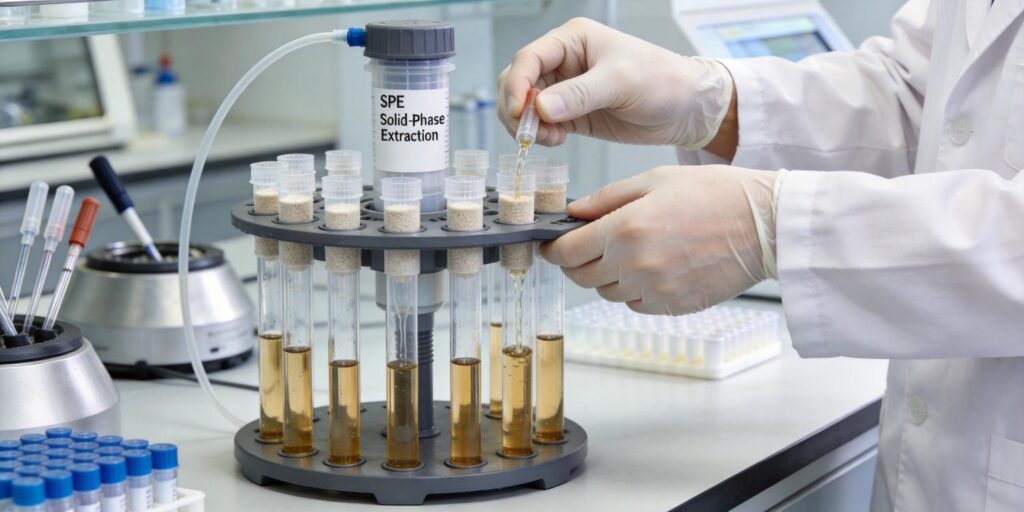
Solid-phase extraction (SPE) has emerged as a cornerstone technology in both forensic and clinical toxicology laboratories, revolutionizing how blood samples are prepared for drug analysis. The technique’s utility stems from its ability to achieve high selectivities and recoveries while minimizing hazardous solvent consumption. In systematic toxicological analysis (STA), SPE provides a powerful tool for sample workup, isolation, and concentration, particularly when dealing with complex biological matrices like whole blood.
Forensic laboratories rely on SPE for broad-spectrum drug screening where a single extraction method must capture acidic, neutral, and basic drugs from challenging matrices. The strategy of using mixed-mode cartridges that provide both hydrophobic and cation exchange interactions, combined with pH-dependent sample application and extraction, yields high recoveries of analytes from plasma, urine, whole blood, and tissues. The resulting SPE eluates show minimal interference from endogenous matrix components, allowing toxicologically relevant substances to be easily detected and quantitated.
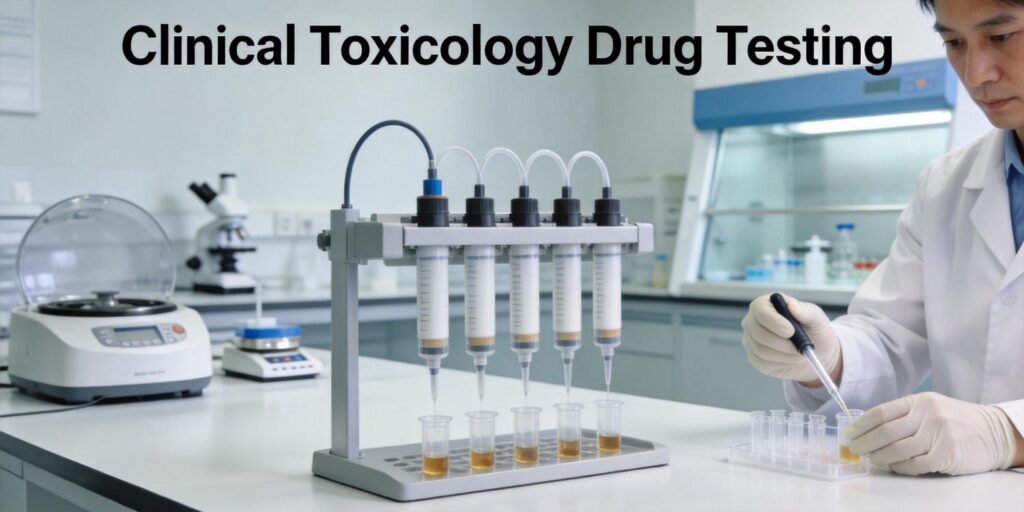
Clinical toxicology benefits from SPE’s ability to produce clean plasma extracts essential for pharmacokinetic studies, where modern drug candidates are often very potent substances administered at low doses. The technique’s reproducibility and automation capabilities make it ideal for high-throughput environments where both sensitivity and reliability are paramount.
Pretreatment of Blood Samples Before Extraction
Proper pretreatment of blood samples is critical for successful SPE extraction. Whole blood presents unique challenges due to its cellular components, proteins, and lipids that can interfere with extraction efficiency. The standard approach involves dilution and protein precipitation before SPE application.
For whole blood samples, a typical pretreatment involves adding 8 mL of deionized water to 2 mL of blood, mixing thoroughly, and allowing the mixture to stand for 5 minutes. This dilution helps lyse red blood cells and reduces viscosity. Following this, 150-300 μL of 1.0 M acetic acid is added to adjust the sample pH to between 4.8 and 5.5, which is optimal for many mixed-mode SPE procedures. The sample is then centrifuged for 10 minutes at 670g to pellet cellular debris, with the supernatant being transferred for SPE processing.
For plasma and serum samples, enzymatic digestion or protein precipitation may be necessary to eliminate protein binding and prevent column clogging. The choice between acid precipitation, organic solvent precipitation, or enzymatic digestion depends on the target analytes and their stability under different conditions. Proper pH adjustment is crucial at this stage, as it determines the ionization state of both target compounds and interfering substances.
Selecting Sorbent Chemistries for Drug Compounds
The selection of appropriate sorbent chemistry is fundamental to successful SPE method development for drug toxicology. Mixed-mode sorbents have proven particularly effective for broad-spectrum drug screening, as they combine hydrophobic interactions with ion-exchange capabilities.
For basic drugs (amphetamines, opioids, antidepressants), mixed-mode cation exchange sorbents (MCX) provide excellent retention through both hydrophobic interactions and ionic bonding with protonated amine groups. These sorbents typically contain both non-polar (C8 or C18) and strong cation exchange (sulfonic acid) functionalities. When the sample is applied at acidic pH, basic drugs are positively charged and interact strongly with the sulfonic acid groups.
For acidic drugs (barbiturates, NSAIDs, some benzodiazepines), mixed-mode anion exchange sorbents (MAX) combine hydrophobic interactions with weak anion exchange (primary/secondary amine) functionalities. These are most effective when samples are applied at basic pH, where acidic compounds are negatively charged.
For neutral drugs and compounds with mixed functionality, reversed-phase sorbents (C18, C8, HLB) provide retention through hydrophobic interactions. Hydrophilic-lipophilic balanced (HLB) sorbents have gained popularity due to their ability to retain both polar and non-polar compounds without requiring ion-pairing reagents.
The educated approach to sorbent selection involves considering the analyte’s structure, pKa, polarity, and functional groups, as well as potential interferences from the blood matrix. Mixed-mode sorbents like Bond Elut Certify and CLEAN SCREEN have demonstrated excellent lot-to-lot reproducibility and reusability for drug extraction from whole blood.
Washing Strategies to Remove Proteins and Lipids
Effective washing strategies are essential for removing proteins, lipids, and other endogenous interferences while retaining target analytes. The washing step represents a critical balance between removing matrix components and maintaining analyte recovery.
For mixed-mode SPE procedures on blood samples, typical washing sequences include:
- Water wash: Removes water-soluble salts, sugars, and polar interferences
- Organic solvent wash: Typically methanol-water mixtures (10-40% methanol) to remove proteins and moderately polar interferences
- pH-adjusted wash: For mixed-mode cartridges, washing with acidic or basic solutions can remove weakly retained compounds while maintaining strong ionic interactions with target analytes
- Additional organic washes: Ethyl acetate or hexane can be used to remove lipids and non-polar interferences
For mixed-mode cation exchange extractions, washing with 0.1 M acetic acid followed by methanol helps remove acidic and neutral interferences while retaining basic drugs. For mixed-mode anion exchange procedures, washing with basic solutions (ammonium hydroxide or acetate buffers) followed by methanol achieves similar cleanup.
The drying step after washing is particularly important for blood samples, as residual water can interfere with elution efficiency and subsequent analysis. Typically, columns are dried under vacuum (5-10 minutes at 10 in. Hg) or with positive pressure until the sorbent appears dry.
Elution Solvent Optimization
Elution solvent optimization is crucial for achieving high recoveries while maintaining extract cleanliness. The elution solvent must be strong enough to disrupt both hydrophobic and ionic interactions for mixed-mode sorbents.
For mixed-mode cation exchange sorbents retaining basic drugs, elution typically requires organic solvents containing 2-5% ammonium hydroxide or other basic modifiers. Common elution solvents include:
- 2% ammonium hydroxide in methanol
- 2% ammonium hydroxide in ethyl acetate
- Methanol:acetonitrile (50:50) with 2% ammonium hydroxide
The basic conditions neutralize the ionic interactions by deprotonating the sulfonic acid groups and protonating the basic drugs, allowing them to be eluted primarily through hydrophobic interactions.
For mixed-mode anion exchange sorbents retaining acidic drugs, elution typically involves organic solvents with acidic modifiers:
- 2% formic acid in methanol
- 2% acetic acid in ethyl acetate
- Methanol with 1-2% trifluoroacetic acid
The acidic conditions protonate the anion exchange sites and deprotonate the acidic analytes, disrupting ionic interactions.
Elution volume optimization is equally important. Typically, 1-2 mL of elution solvent is sufficient for complete analyte recovery from 200 mg sorbent cartridges. Multiple small-volume elutions (2 × 0.5 mL) often yield better recovery than a single large-volume elution due to more efficient mass transfer.
Integration with LC-MS/MS Detection
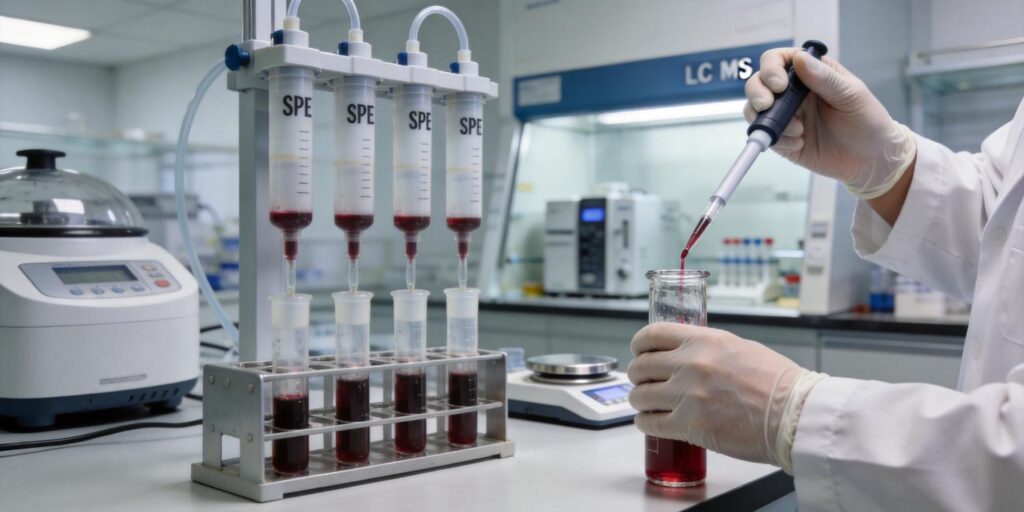
The integration of SPE with liquid chromatography-tandem mass spectrometry (LC-MS/MS) represents the gold standard for drug toxicology analysis. SPE-prepared extracts are ideally suited for LC-MS/MS due to their cleanliness and compatibility with aqueous-organic mobile phases.
The transition from SPE to LC-MS/MS involves several critical considerations:
- Solvent compatibility: The SPE elution solvent must be compatible with the LC mobile phase. Methanol or acetonitrile-based eluents typically require evaporation and reconstitution in initial mobile phase conditions (often 5-10% organic in water).
- Matrix effects: Despite SPE cleanup, residual matrix components can cause ion suppression or enhancement in electrospray ionization. The use of stable isotope-labeled internal standards is essential for compensating for these effects.
- Concentration factor: SPE allows significant concentration (typically 10-50×), enabling detection at sub-ng/mL levels required for many drugs of abuse and therapeutic drug monitoring.
- Automation compatibility: SPE procedures can be fully automated and integrated with LC-MS/MS systems using 96-well plate formats, enabling high-throughput analysis essential for clinical and forensic laboratories.
Studies have demonstrated that SPE extracts show almost no interference from endogenous matrix components, allowing toxicologically relevant substances to be easily detected and quantitated by LC-MS/MS. The technique’s ability to remove phospholipids—a major source of matrix effects in blood samples—is particularly valuable for LC-MS/MS applications.
Method Validation Parameters for Toxicology Labs
Comprehensive method validation is essential for SPE-based toxicology methods to ensure reliability, accuracy, and regulatory compliance. Key validation parameters include:
- Recovery: Absolute recovery should exceed 85-90% for most analytes. Recovery is determined by comparing peak areas from extracted samples with those from neat standards at equivalent concentrations.
- Precision and accuracy: Intra-day and inter-day precision (expressed as %RSD) should be ≤15% for QC samples at low, medium, and high concentrations. Accuracy should be within ±15% of nominal values.
- Linearity: The method should demonstrate linearity over the expected concentration range with correlation coefficients (r²) ≥0.99.
- Limit of detection (LOD) and quantification (LOQ): LOD is typically 3× the signal-to-noise ratio, while LOQ is 10× S/N with precision and accuracy meeting acceptance criteria.
- Selectivity and specificity: The method should demonstrate no interference from endogenous compounds, metabolites, or commonly co-administered drugs at the retention times of target analytes.
- Matrix effects Ion suppression/enhancement should be evaluated by comparing responses from post-extraction spiked samples with neat standards. Matrix effects should be ≤15% or compensated by appropriate internal standards.
- Stability: Analyte stability should be evaluated under various conditions including benchtop, processed sample, freeze-thaw, and long-term storage.
- Carryover: Should be ≤20% of LLOQ or ≤5% of internal standard response in blank samples following high-concentration samples.
For forensic applications, additional validation may include evaluation of lot-to-lot reproducibility of SPE cartridges, reusability studies, and robustness testing under varying conditions (pH, flow rates, washing volumes). The use of certified reference materials and participation in proficiency testing programs further ensures method reliability.
SPE methods for blood drug analysis have demonstrated excellent performance in validation studies, with mixed-mode procedures showing high recoveries (often >90%) for broad panels of drugs while effectively removing interfering matrix components. The technique’s adaptability to automation and 96-well formats makes it particularly suitable for high-volume toxicology laboratories where throughput, reproducibility, and regulatory compliance are paramount concerns.