Environmental Sources of Pharmaceutical Contamination
Pharmaceutical compounds enter surface water systems through multiple pathways, creating complex environmental monitoring challenges. The primary sources include wastewater treatment plant effluents, agricultural runoff containing veterinary pharmaceuticals, improper disposal of unused medications, and industrial discharges from pharmaceutical manufacturing facilities. These compounds persist in aquatic environments due to their designed biological stability, with concentrations typically ranging from parts-per-trillion (ppt) to parts-per-billion (ppb) levels.
According to environmental SPE research, surface water matrices present unique challenges due to the presence of natural organic matter (NOM), which includes both particulate matter (PM) and dissolved organic matter (DOM). These components can bind to pharmaceutical analytes, altering their extraction behavior and complicating analytical determinations. The interaction between pharmaceutical compounds and environmental matrices requires specialized SPE approaches to ensure accurate quantification.
Key Contamination Pathways
- Municipal wastewater treatment plant effluents
- Agricultural runoff containing veterinary antibiotics
- Industrial pharmaceutical manufacturing discharges
- Landfill leachate and improper medication disposal
- Hospital and clinical waste streams
Importance of Trace Detection Limits
Environmental monitoring of pharmaceutical compounds demands exceptional sensitivity, with detection limits often required at the ppt level. Unlike clinical applications where drug concentrations typically exist at ppm or ppb levels, environmental trace analysis must detect compounds at concentrations 100-1000 times lower. This sensitivity requirement directly impacts SPE method development, particularly in terms of sample volume requirements and concentration factors.
The breakthrough volume concept becomes critical when dealing with trace pharmaceutical analysis. As defined by Larrivee and Poole (1994), breakthrough volume represents “the volume of sample, assumed to have a constant concentration, that can be passed through the SPE device before the concentration of the analyte at the outlet reaches a certain fraction of the concentration at the inlet.” For pharmaceutical compounds with log Pow values above approximately 3.5, there is typically no breakthrough from alkyl-bonded silica sorbents up to sample volumes of one liter, provided adequate sorbent mass is used.
Detection Limit Considerations
- Typical environmental concentrations: ppt to ppb levels
- Required concentration factors: 100-1000×
- Method detection limits: 1-100 ng/L for most pharmaceuticals
- Instrument sensitivity requirements: LC-MS/MS with MRM capabilities
Large-Volume Sample Loading Techniques
Environmental SPE applications frequently require processing liter-scale samples to achieve necessary concentration factors. The relationship between sorbent mass and sample volume follows established guidelines, with Pfaab and Jork (1994) recommending 1 g of reversed-phase octadecyl bonded sorbent per liter of water for phenylurea herbicides. This ratio provides a practical starting point for pharmaceutical compound extraction from surface water.
Large-volume loading presents several technical considerations:
Flow Rate Optimization
Bidlingmeyer (1984) demonstrated that recovery depends on flow rate through the SPE device, as breakthrough volume decreases due to band-broadening at higher flow rates. Mayer and Poole (1994) confirmed significant flow-rate dependence when sample volume exceeds the breakthrough volume of the analyte. Optimal flow rates typically range from 1-3 drops per second for cartridge formats and 10-100 mL/min for disk formats.
Breakthrough Monitoring Strategies
Implementing a second cartridge in series with the primary extraction cartridge provides a simple indicator of breakthrough. If any analyte appears in the eluent of the second cartridge after sample loading and separate elution of each cartridge, the sorbent capacity of the first cartridge has clearly been exceeded. This approach is particularly valuable for weakly retained species or when poor analyte detectivity requires extraction of high microgram quantities.
Cartridge Capacity and Breakthrough Considerations
The breakthrough volume represents the maximum sample volume that can be processed without significant analyte loss. This parameter depends on three key factors: the strength of analyte-sorbent interaction, sample volume, and sorbent mass. For reversed-phase sorbents, breakthrough volume is primarily a function of analyte hydrophobicity and sorbent mass.
Bidlingmeyer (1984) first described theoretical breakthrough volume profiles, demonstrating that recovery is theoretically 100% up to and including loading volumes determined by capacity factors. For compounds with capacity factors of 10 and 30, with an assumed column volume of 1.0 mL, breakthrough volumes would be 11 mL and 31 mL respectively. Beyond these points, recovery efficiency drops nonlinearly.
Practical Capacity Guidelines
- 1 g sorbent mass per liter of water for most pharmaceutical compounds
- Sample volumes of 100-200 mL with 100 ppb concentrations as starting points
- For wastewater containing complex matrices: 1 g-to-100 mL ratio
- Foreman et al. (1993) successfully isolated multiple pesticide classes from 10L water samples using 10 g sorbent cartridges
Breakthrough Prediction Methods
Poole’s research group has developed substantial methodology for predicting SPE breakthrough volumes using solvation or solvatochromic parameters to characterize analyte retention. The solvation parameter model allows prediction of breakthrough volumes with different sample co-solvents, with changes up to an order of magnitude when organic modifiers are added at the 1% (v/v) level.
Washing Strategies to Remove Natural Organic Matter
Natural organic matter (NOM) presents significant challenges in surface water pharmaceutical analysis. NOM comprises both particulate matter (PM) and dissolved organic matter (DOM), which can bind pharmaceutical analytes and interfere with extraction efficiency. The presence of humic substances can reduce recovery, particularly for compounds with log Pow values above 4 when using alkyl-bonded silicas, or above 3 when using polystyrene sorbents.
Particulate Removal Strategies
Prefiltering samples through 0.45 μm glass-fiber filters without organic binders is recommended for particulate removal. Durand and Barcelo (1993) successfully employed step-wise filtration through 0.7 μm followed by 0.45 μm glass-fiber filters for seawater samples. For sediment or soil extracts, centrifugation followed by filtration effectively reduces SPE disk plugging.
DOM Interference Mitigation
Nakamura et al. (1996) established guidelines for humic acid effects on SPE behavior, finding that compounds with log Pow below approximately 4 (alkyl-bonded silicas) or 3 (polystyrene sorbents) show minimal interference from 1 ppm humic acid. Several strategies can minimize DOM interference:
- Oxidative Treatment: Bonifazi et al. (1994) used sulfuric acid and potassium permanganate to oxidize humic substances prior to SPE
- Alternative Sorbents: Altenbach and Giger (1995) employed graphitized carbon black for permanent retention of negatively charged humic substances
- pH Adjustment: Strategic pH control can disrupt analyte-DOM complexes
- Wash Optimization: Systematic testing of methanol/water combinations from 100% water through to 100% methanol
Wash Solvent Optimization
For non-polar extractions, washing solvent composition should be systematically varied using increasing concentrations of methanol or acetonitrile in water. Typically, methanol composition is increased in steps of 10% from 100% water through to 100% methanol. This approach removes weakly retained matrix components while preserving pharmaceutical analyte retention.
Elution Optimization for LC-MS Analysis
Elution optimization for LC-MS analysis requires careful consideration of both extraction efficiency and compatibility with mass spectrometric detection. The ideal elution solvent should provide complete analyte recovery while minimizing ionization suppression and instrument contamination.
Elution Solvent Selection
For pharmaceutical compounds in surface water matrices, elution typically employs organic solvents with appropriate modifiers:
- Reversed-phase SPE: Methanol, acetonitrile, or mixtures with water
- Ion-exchange SPE: Buffered solutions with appropriate pH and ionic strength
- Mixed-mode SPE: Sequential elution with different solvent systems
LC-MS Compatibility Considerations
LC-MS analysis imposes specific requirements on SPE eluates:
- Minimal Salt Content: Buffer salts can mask analytes during evaporation and reconstitution
- Reduced Matrix Effects: Co-extracted interferences can suppress ionization
- Solvent Compatibility: Elution solvents must be compatible with LC mobile phases
- Concentration Factors: Evaporation and reconstitution can improve sensitivity 3-5×
On-line SPE-LC-MS Integration
On-line SPE-LC-MS systems offer significant advantages for high-throughput pharmaceutical monitoring. Bowers et al. (1997) demonstrated sensitivities of 50 pg/mL for sample sizes of only 200 μL using ion-spray MS/MS systems linked to on-line SPE robotics. These systems achieve cycle times of 5-7 minutes per sample, making them ideal for large-scale monitoring programs.
Monitoring Program Examples
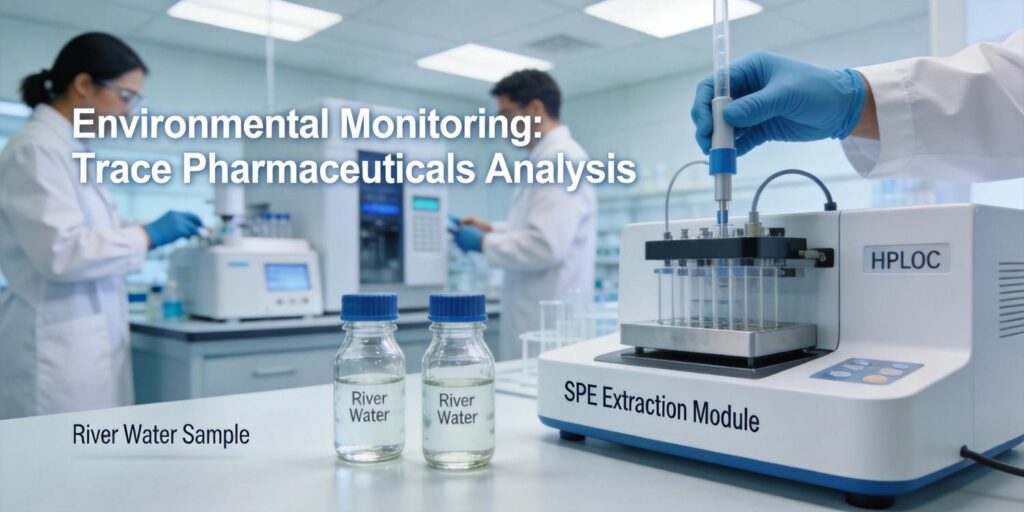
Effective pharmaceutical monitoring programs combine optimized SPE methods with appropriate analytical instrumentation and sampling strategies. Several successful approaches demonstrate the practical application of SPE for trace pharmaceutical analysis in surface water.
Comprehensive Pharmaceutical Screening
Beaudry et al. (1998) reported sample throughput of 320-960 samples per day for broad-range pharmaceutical screening in human plasma using on-line SPE-LC-MS technology. Similar throughput (5 minutes total preparation and analysis time per sample) was achieved by Marchese et al. (1998) for environmental applications.
Multi-residue Methods
Wells et al. (1994) developed and optimized SPE schemes for simultaneous determination of metribuzin, atrazine, metolachlor, and esfenvalerate in agricultural runoff water. These methods demonstrate the capability of SPE to handle diverse pharmaceutical classes with varying physicochemical properties.
Automated Monitoring Systems
Brinkman (1995) described on-line monitoring systems for aquatic samples that increase analysis speed and improve analyte detectability. Automated SPE procedures integrated with LC-MS systems enable continuous monitoring of pharmaceutical compounds in surface water, providing real-time data for environmental risk assessment.
Quality Control Measures
Successful monitoring programs incorporate comprehensive quality control:
- Method blanks to assess background contamination
- Matrix spikes to evaluate extraction efficiency
- Duplicate analyses to assess precision
- Certified reference materials when available
- Regular calibration and system suitability testing
Conclusion
Optimizing SPE for trace pharmaceutical compounds in surface water requires careful consideration of multiple factors, including sample volume requirements, breakthrough characteristics, natural organic matter interference, and LC-MS compatibility. By implementing systematic method development approaches and leveraging established guidelines for sorbent selection and washing strategies, environmental laboratories can achieve the sensitivity and reliability required for effective pharmaceutical monitoring.
The continued evolution of SPE technology, particularly in automation and miniaturization, promises even greater capabilities for trace pharmaceutical analysis. As environmental regulations become more stringent and analytical requirements more demanding, optimized SPE methods will remain essential tools for protecting water resources from pharmaceutical contamination.
For laboratories seeking to implement or improve pharmaceutical monitoring programs, Poseidon Scientific offers a comprehensive range of HLB SPE cartridges, MAX SPE cartridges, MCX SPE cartridges, and 96-well SPE plates specifically designed for environmental applications.