Veterinary Antibiotics Commonly Found in Livestock Products
The detection and quantification of veterinary antibiotic residues in meat products represents a critical analytical challenge for food safety laboratories worldwide. These compounds, administered to livestock for therapeutic purposes and growth promotion, can persist in animal tissues and pose potential health risks to consumers. The most frequently encountered antibiotic classes in meat analysis include sulfonamides, tetracyclines, macrolides, β-lactams, and quinolones.
Sulfonamides such as sulfamethazine, sulfadimethoxine, and their metabolites are particularly problematic due to their widespread use and potential for residue accumulation. Tetracyclines including oxytetracycline, tetracycline, and chlortetracycline are commonly detected in pork, beef, and poultry muscle tissues. Research by Long et al. (1990) demonstrated effective multiresidue methods for sulfonamide determination in pork tissue using advanced extraction techniques. The persistence of these compounds varies significantly based on their chemical properties, administration routes, and withdrawal periods before slaughter.
Extraction of Meat Samples Prior to SPE Cleanup
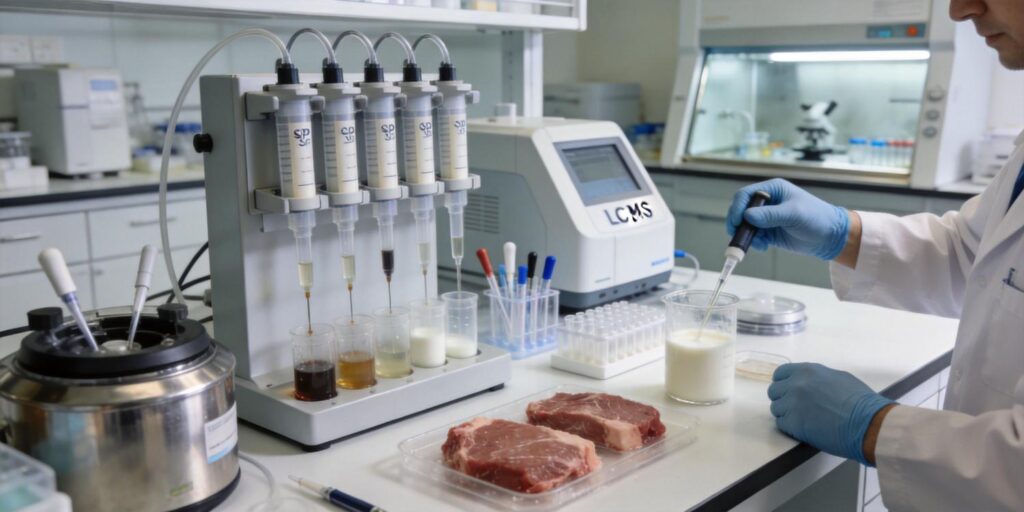
Effective sample preparation is the cornerstone of reliable veterinary antibiotic analysis in meat matrices. The complex nature of animal tissues, rich in proteins, lipids, and connective tissues, necessitates robust extraction protocols to liberate target analytes while minimizing matrix interference. The initial extraction typically involves homogenization of meat samples with appropriate solvent systems.
Horie et al. (1991) developed a comprehensive approach for antibacterial drug extraction from fish tissue involving homogenization in metaphosphoric acid/methanol (3:2 v/v) to effectively deproteinize samples. This methodology has been successfully adapted for various meat types. For sulfonamide analysis in meat, Horie et al. (1990) employed homogenization with aqueous methanol followed by filtration and evaporation to concentrate analytes before SPE cleanup. The choice of extraction solvent depends on the target antibiotic class, with acetonitrile, methanol, and acidified aqueous solutions being most common.
Matrix Solid Phase Dispersion (MSPD) has emerged as a particularly effective technique for solid tissue samples, as described by Barker (1993). This approach combines sample disruption and extraction in a single step, eliminating the need for separate homogenization and filtration steps. The method involves blending tissue samples with appropriate sorbents, creating a homogeneous mixture that can be packed into columns for subsequent elution.
Sorbent Chemistries Suitable for Antibiotic Extraction
The selection of appropriate SPE sorbent chemistry is paramount for successful antibiotic extraction from meat matrices. Different antibiotic classes exhibit varying physicochemical properties that dictate optimal sorbent selection and extraction conditions.
Mixed-Mode Sorbents for Broad-Spectrum Extraction
Mixed-mode sorbents combining reversed-phase and ion-exchange functionalities have proven exceptionally effective for veterinary drug screening. These sorbents, such as those containing both C18 and strong cation exchange (SCX) groups, allow simultaneous extraction of acidic, basic, and neutral compounds. Wynne (2000) documented the superior performance of mixed-mode extraction for basic drugs including β-blockers, β-agonists, and opiates from biological matrices.
Reversed-Phase Sorbents for Non-Polar Antibiotics
C18 and C8 sorbents remain workhorse materials for extracting less polar antibiotic classes. Horie et al. (1990) conducted comparative studies of commercially available C18 sorbents for sulfamethazine extraction from meat, highlighting the importance of bed mass on recovery and extract purity. These sorbents effectively retain antibiotics through hydrophobic interactions while allowing removal of polar matrix components.
Ion-Exchange Sorbents for Charged Analytes
Strong anion exchange (SAX) and strong cation exchange (SCX) sorbents are indispensable for extracting ionizable antibiotics. Sydenham et al. (1992) demonstrated effective fumonisin recovery from maize using SAX cartridges, illustrating the utility of ion-exchange mechanisms for potentially ionic compounds. For basic antibiotics like aminoglycosides, SCX sorbents provide excellent retention through ionic interactions.
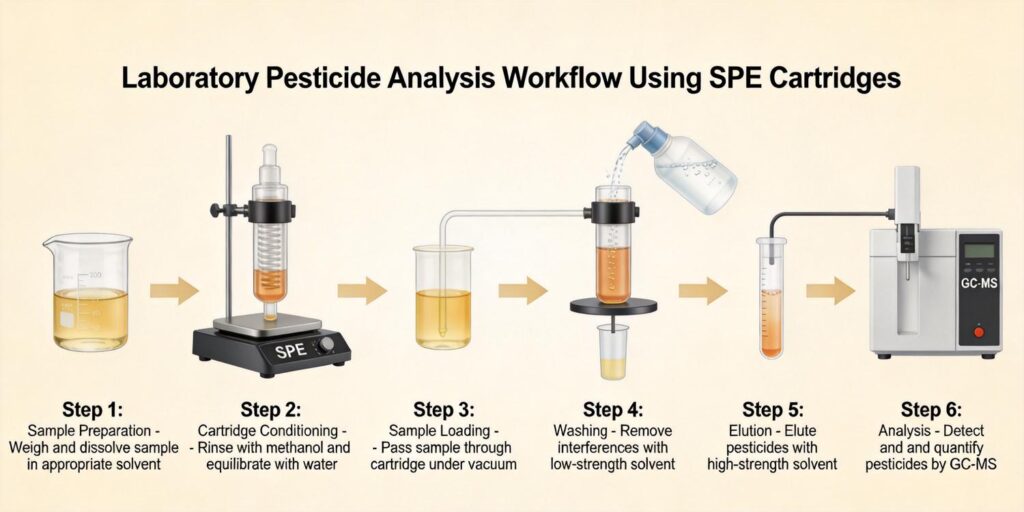
Washing Steps to Remove Fats and Proteins
Meat extracts contain significant amounts of co-extracted lipids and proteins that can interfere with subsequent chromatographic analysis and instrument performance. Strategic washing protocols are essential for removing these matrix components while retaining target antibiotics.
For reversed-phase extractions, aqueous washes containing 5-10% methanol or acetonitrile effectively remove polar interferences while retaining hydrophobic antibiotics. Acidified water (0.1-1% formic or acetic acid) can help disrupt protein interactions and improve cleanup efficiency. Hansen-Moller (1992) developed a defatting procedure for pig fat analysis involving acetone-tris buffer extraction followed by C18 column cleanup, effectively removing lipid components before antibiotic analysis.
Mixed-mode sorbents offer enhanced cleanup capabilities through sequential washing steps. Typical protocols include water or dilute buffer washes to remove salts and polar compounds, followed by organic washes (methanol or acetonitrile) to elute neutral interferences while retaining ionically-bound antibiotics. The careful transition from non-polar organic loading conditions to aqueous wash conditions, as described by Gross (1990), allows effective separation of matrix components from target analytes.
Elution Conditions Compatible with LC-MS Detection
Modern antibiotic residue analysis increasingly relies on liquid chromatography-mass spectrometry (LC-MS) detection due to its superior sensitivity, selectivity, and ability to confirm compound identity. Elution conditions must be optimized for compatibility with both SPE recovery and subsequent LC-MS analysis.
Solvent Selection for Maximum Recovery
For reversed-phase sorbents, methanol and acetonitrile, often acidified with formic acid (0.1-1%), provide effective elution of most antibiotic classes. The addition of ammonium acetate or ammonium formate buffers can improve recovery of ionizable compounds. Horie et al. (1990) achieved successful sulfamethazine elution using methanol-based solvents, noting the importance of solvent strength optimization.
pH-Controlled Elution for Mixed-Mode Sorbents
Mixed-mode sorbents require strategic pH manipulation for efficient antibiotic elution. Basic antibiotics retained through cation-exchange mechanisms typically elute with organic solvents containing 2-5% ammonium hydroxide. Acidic compounds may require acidified organic solvents for effective recovery. The sequential elution of different antibiotic classes from mixed-mode sorbents allows fractionation and simplified analysis.
Compatibility with Mass Spectrometry
Elution solvents must be compatible with LC-MS ionization sources. Volatile additives like formic acid, acetic acid, ammonium formate, and ammonium acetate are preferred over non-volatile buffers. Solvent composition should be optimized to minimize ion suppression and maximize signal intensity. Barshick and Buchanan (1994) demonstrated effective microcolumn SPE with thermal desorption ion-trap MS for animal drug residue analysis, highlighting the importance of solvent compatibility.
Recovery Validation Procedures
Method validation is essential for establishing the reliability and accuracy of antibiotic extraction procedures from meat matrices. Comprehensive validation should address recovery, precision, linearity, limit of detection (LOD), and limit of quantification (LOQ).
Spike-and-Recovery Experiments
Recovery validation typically involves spiking antibiotic standards into blank meat matrices at multiple concentration levels spanning the expected analytical range. Horie et al. (1990) conducted systematic recovery studies for sulfamethazine in various meat types, establishing method robustness across different matrices. Recovery values should ideally fall within 70-120% with relative standard deviations below 15%.
Internal Standardization
The use of stable isotope-labeled internal standards provides the most accurate correction for recovery variations and matrix effects. For antibiotics lacking commercially available labeled analogs, structurally similar compounds can serve as surrogate internal standards. Long et al. (1990) employed multiresidue methods with appropriate internal standards for sulfonamide analysis in pork tissue.
Matrix Effect Evaluation
Matrix effects, particularly ion suppression in LC-MS analysis, must be thoroughly evaluated. This involves comparing standard curves prepared in neat solvent versus matrix-matched standards. Post-column infusion experiments can identify regions of significant ion suppression in chromatographic runs.
Regulatory Testing Requirements
Veterinary antibiotic testing in meat products is governed by stringent regulatory frameworks worldwide, including the European Union’s Maximum Residue Limits (MRLs), the U.S. Food and Drug Administration’s tolerances, and Codex Alimentarius standards.
Compliance with Maximum Residue Limits
Analytical methods must demonstrate sufficient sensitivity to quantify antibiotics at or below established MRLs, which typically range from 10-1000 μg/kg depending on the compound and tissue type. Method detection limits should be at least three times lower than the relevant MRL to ensure reliable quantification.
Multiresidue Method Requirements
Regulatory laboratories increasingly require multiresidue methods capable of detecting multiple antibiotic classes in a single analysis. Long et al. (1990) developed comprehensive multiresidue approaches for sulfonamides in pork tissue, demonstrating the efficiency gains of such methods. These approaches must maintain adequate sensitivity and specificity for all target compounds.
Quality Assurance Protocols
Regulatory testing mandates rigorous quality assurance including method validation, proficiency testing, instrument calibration, and documentation of all analytical procedures. The use of certified reference materials and participation in interlaboratory comparison programs are essential for maintaining analytical credibility.
Confirmatory Analysis Requirements
Positive screening results typically require confirmatory analysis using orthogonal techniques or different detection principles. LC-MS/MS has become the gold standard for confirmatory analysis due to its superior specificity through multiple reaction monitoring (MRM).
The extraction of veterinary antibiotics from meat using SPE represents a sophisticated analytical challenge requiring careful consideration of sample preparation, sorbent selection, cleanup strategies, and regulatory compliance. As analytical technologies continue to advance and regulatory standards become more stringent, SPE methodologies will remain essential tools for ensuring food safety and protecting public health.