
Chemical Diversity of Pesticide Compounds
Pesticide residue analysis presents one of the most challenging sample preparation scenarios due to the extraordinary chemical diversity of modern pesticide compounds. Today’s analytical laboratories must contend with hundreds of active ingredients spanning multiple chemical classes including organochlorines, organophosphates, carbamates, pyrethroids, neonicotinoids, triazines, and phenoxy acids. These compounds exhibit a wide range of physicochemical properties, from highly non-polar organochlorines like DDT (log P ~6) to moderately polar triazines like atrazine (log P ~2.6) to highly polar acidic herbicides like 2,4-D (log P ~2.8).
This chemical diversity necessitates a strategic approach to solid-phase extraction (SPE) that can accommodate compounds with varying hydrophobicity, pKa values, and functional groups. According to Waters Oasis documentation, SPE enables scientists to reduce chromatographic complexity, increase signal-to-noise ratios, improve detection limits, minimize matrix effects, concentrate analytes of interest, and increase column lifetime. These benefits are particularly crucial in pesticide analysis where regulatory limits often reach parts-per-billion levels.
Sorbent Chemistries Commonly Used in Pesticide Analysis
The selection of appropriate sorbent chemistry represents the cornerstone of successful pesticide residue analysis. Traditional silica-based sorbents like C18, C8, and silica remain widely used, but polymeric sorbents have revolutionized pesticide extraction capabilities.
Hydrophilic-Lipophilic Balanced (HLB) Sorbents
Oasis HLB, introduced in 1996, represents a breakthrough in SPE technology. This water-wettable copolymer is stable from pH 0-14 and eliminates the conditioning and equilibration steps required by traditional polymeric and silica-based sorbents. The balanced hydrophilic-lipophilic nature provides high capacity for a wide range of compounds, making it particularly effective for multi-residue pesticide analysis where compounds span a broad polarity range.
Mixed-Mode Sorbents
For enhanced selectivity and cleaner extracts, mixed-mode sorbents combine reversed-phase and ion-exchange functionality:
- Oasis MCX: Mixed-mode cation exchange for basic compounds (pKa ~6)
- Oasis MAX: Mixed-mode anion exchange for acidic compounds (pKa 2-8)
- Oasis WCX: Weak cation exchange for strong bases and quaternary amines (pKa >10)
- Oasis WAX: Weak anion exchange for strong acids (pKa <1)
These mixed-mode sorbents provide orthogonal selectivity that can significantly reduce matrix interferences in complex samples. The Waters Oasis 2×4 strategy simplifies method development with only two protocols and four sorbents to analyze all types of compounds: acids, bases, and neutrals.
Specialized Sorbents for Specific Applications
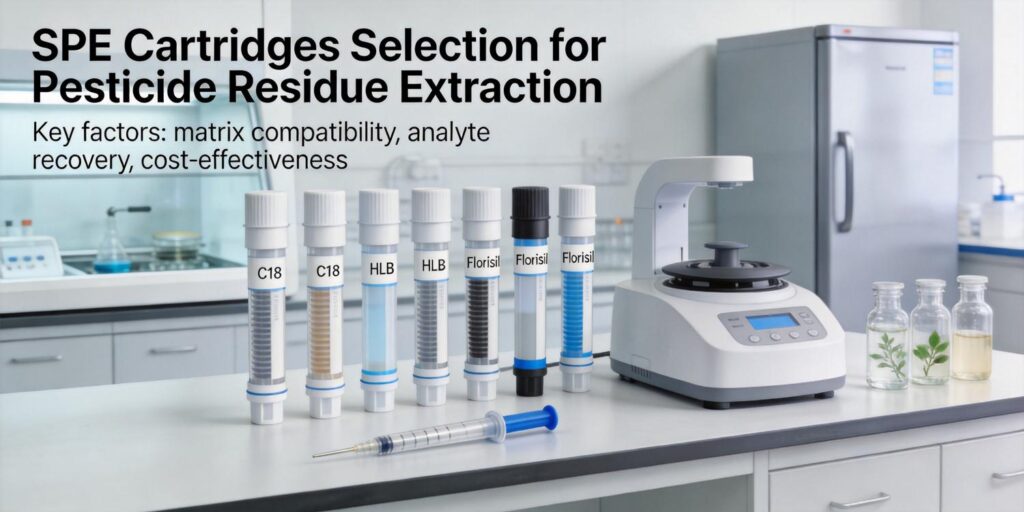
For organochlorine pesticide analysis, Florisil sorbents remain important. Certified Sep-Pak Florisil cartridges have demonstrated superior performance in removing interferences like BHA, BHT, and various unknown terpenes and fatty compounds that can contaminate extracts from competitor’s SPE devices.
Sample Matrix Considerations
Water Samples
Aqueous environmental samples represent the most straightforward matrix for pesticide analysis. However, dissolved organic material (DOM) can interfere with extraction efficiency. Research by Johnson et al. (1991) demonstrated that dissolved organic material can affect solid-phase extraction of pesticides from water. For water samples, HLB sorbents typically provide excellent recovery across a broad pesticide spectrum, while mixed-mode sorbents offer enhanced cleanup for specific compound classes.
Food and Agricultural Samples
Food matrices present significant challenges due to high concentrations of pigments, lipids, sugars, and other co-extractives. The Luke procedure, a well-established multi-residue method, incorporates SPE steps for matrix removal using SAX/PSA stacked cartridges to retain plant sugars and acids while allowing pesticides to pass through unretained. For fatty matrices, additional cleanup with Florisil or silica may be necessary to remove lipids.
Soil and Sediment Samples
Soil samples require careful consideration of humic and fulvic acid interferences. Research by Senseman et al. (1995) investigated the influence of dissolved humic acid on pesticide extraction efficiency from water using solid-phase extraction disks. For soil extracts, polymeric sorbents like HLB often outperform traditional silica-based materials due to their resistance to irreversible adsorption of humic materials.
Conditioning and Loading Conditions
The water-wettable nature of modern polymeric sorbents like Oasis HLB has simplified conditioning protocols. Traditional silica-based sorbents require careful conditioning with organic solvent followed by equilibration with aqueous solution to ensure proper wetting and analyte retention. In contrast, water-wettable sorbents allow direct loading of aqueous samples without sacrificing recovery, reducing solvent consumption by up to 70% and saving 40% in sample preparation time.
For mixed-mode sorbents, conditioning remains important to ensure proper ionization of the ion-exchange groups. MCX and WCX sorbents typically require conditioning with methanol followed by acidified water, while MAX and WAX sorbents require conditioning with methanol followed by basic aqueous solution.
Washing Strategies to Remove Pigments and Lipids
Effective washing protocols are essential for removing matrix interferences while retaining target pesticides. Common strategies include:
Water-Based Washes
For reversed-phase sorbents like HLB, 5% methanol in water effectively removes polar interferences like sugars and some pigments while retaining most pesticides. This wash is particularly effective for food samples where water-soluble compounds represent significant interferences.
Acid or Base Washes for Mixed-Mode Sorbents
For mixed-mode sorbents, specific washing conditions enhance selectivity:
- MCX/WCX: 2% formic acid in water protonates basic pesticides, strengthening cation-exchange retention while washing away neutral and acidic interferences
- MAX/WAX: 5% ammonium hydroxide in water deprotonates acidic pesticides, strengthening anion-exchange retention while removing basic and neutral interferences
Organic Washes for Lipid Removal
For fatty matrices, a 5-10% methanol or acetonitrile in water wash can remove some lipids without eluting target pesticides. More aggressive lipid removal may require specialized sorbents like Oasis PRiME HLB, which removes >95% of common matrix interferences including phospholipids and fats with a simple protocol.
Elution Solvent Design for LC-MS Analysis
Elution solvent selection must balance complete analyte recovery with compatibility with subsequent LC-MS analysis. Common strategies include:
Reversed-Phase Elution
For HLB and other reversed-phase sorbents, methanol or acetonitrile typically provides efficient elution. For multi-residue methods, methanol often offers better solubility for a broader range of pesticides. ACN:MeOH mixtures (90:10) can provide optimal elution strength for challenging compounds.
Mixed-Mode Elution
Mixed-mode sorbents require two-step elution to disrupt both reversed-phase and ion-exchange interactions:
- MCX/WCX: First elute with 100% methanol to disrupt reversed-phase interactions, then elute with 5% ammonium hydroxide in methanol to disrupt cation-exchange interactions
- MAX/WAX: First elute with 100% methanol, then elute with 2% formic acid in methanol to disrupt anion-exchange interactions
Solvent Considerations for LC-MS
Elution solvents should be compatible with LC-MS mobile phases. Methanol and acetonitrile are generally preferred over acetone or ethyl acetate, which can cause ionization suppression in ESI sources. For maximum sensitivity, elution volumes should be minimized and compatible with injection volumes for subsequent analysis.
Practical Cartridge Selection Guidelines
Multi-Residue Screening
For broad-spectrum pesticide screening, Oasis HLB represents the first choice due to its ability to retain compounds across a wide polarity range. The water-wettable nature simplifies method development and reduces solvent consumption. For routine analysis with maximum simplicity, Oasis PRiME HLB offers a generic method that removes >95% of common matrix interferences.
Targeted Analysis of Specific Classes
When analyzing specific pesticide classes, mixed-mode sorbents provide enhanced selectivity:
- Acidic herbicides (2,4-D, MCPA): Oasis MAX or WAX
- Basic pesticides (triazines, carbamates): Oasis MCX or WCX
- Organochlorines: Certified Sep-Pak Florisil
- Polar degradation products: HLB for maximum retention
Matrix-Specific Considerations
High-fat matrices: Consider PRiME HLB or additional cleanup with Florisil
High-pigment matrices: Use appropriate washing conditions and consider cartridge size (larger cartridges handle more matrix)
High-salt matrices: Dilute samples to reduce ionic strength before loading
Complex environmental samples: Mixed-mode sorbents provide cleaner extracts
Cartridge Format Selection
Cartridge size should match sample volume and analyte concentration. For typical pesticide analysis in food and environmental samples:
- 1 cc/30 mg: Small sample volumes, high analyte concentrations
- 3 cc/60 mg: Standard for most applications
- 6 cc/150-500 mg: Large sample volumes, complex matrices
- 96-well plates: High-throughput laboratories
Particle size also affects performance: 30 μm particles offer higher efficiency for challenging separations, while 60 μm particles provide faster flow rates for high-throughput applications.
Method Development Strategy
When developing new methods for pesticide analysis:
- Start with HLB for broad-spectrum retention
- Evaluate recovery for target compounds
- If matrix interferences are problematic, consider mixed-mode sorbents
- Optimize washing conditions to balance cleanup and recovery
- Minimize elution volume for maximum sensitivity
- Validate method with appropriate QC samples
By following these guidelines and selecting appropriate SPE cartridges based on pesticide properties and sample matrix, laboratories can achieve reliable, sensitive, and robust pesticide residue analysis that meets regulatory requirements while maximizing laboratory efficiency.


