
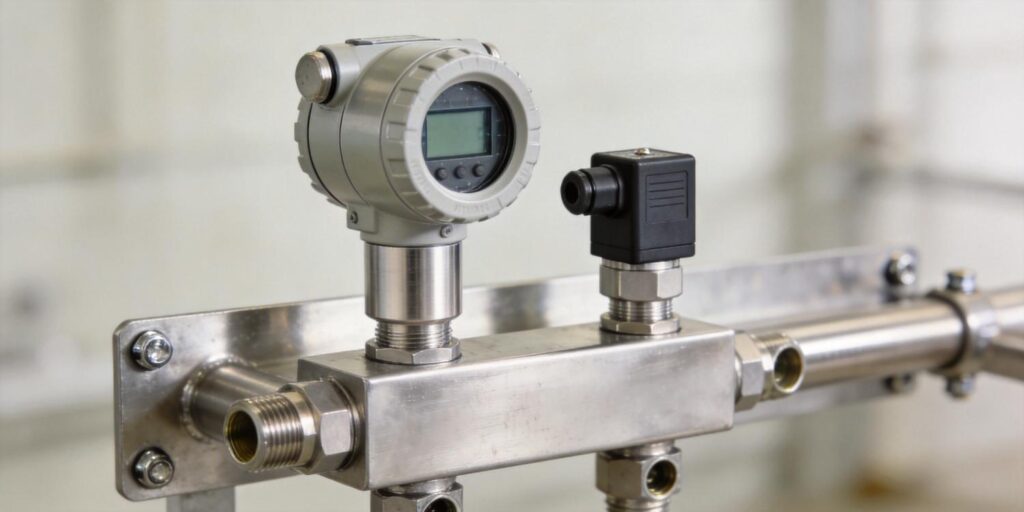
Comparing Compact vs Full-Size Vacuum Transmitters
Selecting the right vacuum transmitter for a new system or retrofit involves balancing size, performance, installation ease, and total cost of ownership. Traditional full-size transmitters from established brands have long dominated high-vacuum applications, yet compact designs like Poseidon Scientific’s VG-SP205 Pirani Vacuum Transmitter and VG-SM225 Cold Cathode Vacuum Gauge are increasingly chosen by engineers seeking modern advantages. These compact units deliver equivalent or superior functionality in a fraction of the volume and at significantly lower cost.
This comparison examines the practical differences between compact and full-size vacuum transmitters. It is intended for system integrators, process engineers, and procurement teams who need objective data to match instrumentation to real-world constraints. All references to Poseidon products reflect verified performance from laboratory and industrial installations.
1. Physical Size Constraints
Physical footprint is often the first limiting factor in modern vacuum systems. Full-size transmitters typically measure 150–250 mm in length with internal discharge volumes of 10–15 cm³ or larger. In contrast, Poseidon’s compact transmitters occupy roughly one-third the volume: the VG-SM225 Cold Cathode features an internal discharge volume of only 0.3 cm³, while the VG-SP205 Pirani maintains a similarly miniaturized sensor head.
This size reduction is critical in space-constrained applications such as portable mass spectrometers, glove-box systems, SEM load-locks, and densely packed coating chambers. Compact gauges mount directly on KF16 or KF25 flanges with minimal insertion depth, eliminating the need for long extension tubes that introduce flow-conductance errors and virtual leaks. Full-size units frequently require additional manifold space or custom adapters, increasing both system complexity and potential leak paths.
Engineers retrofitting older equipment consistently report that the smaller envelope of Poseidon transmitters allows dual-gauge installations (Pirani + cold cathode) where only a single full-size unit previously fit.
2. Performance Differences
Performance must be evaluated across the pressure range, accuracy, and environmental robustness rather than headline specifications alone. Both compact and full-size transmitters achieve comparable measurement ranges: the VG-SP205 covers atmosphere to 10⁻³ Torr with best linearity in the 10–0.01 Torr band, while the VG-SM225 spans 10⁻³ to 10⁻⁷ Torr via Penning discharge.
Key differentiators favor the compact approach in most applications:
- Response time and hysteresis: Smaller internal volumes reduce gas residence time, yielding faster stabilization during pump-down and venting.
- Contamination tolerance: The VG-SM225’s positive-magnetron geometry and field-cleanable electrodes restore full sensitivity after simple 500-mesh abrasion, whereas many full-size cold-cathode designs require complete replacement after similar exposure.
- Temperature stability: Poseidon units incorporate dual-circuit plus algorithmic compensation, maintaining <5 % error across 15–50 °C—matching or exceeding full-size competitors without added external conditioning.
Full-size transmitters sometimes offer marginally higher absolute accuracy in ultra-clean UHV environments, yet this advantage is rarely relevant for the monitoring and interlock duties that constitute 80 % of industrial and laboratory use cases.
3. Installation Flexibility
Compact transmitters provide unmatched mounting versatility. Poseidon gauges can be installed in any orientation with no performance degradation, thanks to symmetric electrode geometry and low-mass construction. Their RJ45 connector and 24 VDC supply simplify cabling in tight enclosures, and the short body length reduces cantilever stress on chamber ports.
Full-size units, by contrast, often impose directional constraints due to larger magnets or asymmetric envelopes, requiring careful orientation to avoid magnetic interference with nearby electron optics or sensors. Their greater weight and longer insertion depth also demand reinforced port stubs or additional bracing—adding cost and complexity during installation.
For mobile or modular systems common in university labs and pilot production, the compact form factor enables quick swaps and reconfiguration without chamber redesign. Custom protocol support (available for orders of 5–10 units) further streamlines integration with existing PLCs and SCADA networks.
4. Heat Dissipation Considerations
Thermal management affects both gauge longevity and nearby instrument stability. Full-size transmitters contain larger electronics boards and higher-wattage power supplies, generating more waste heat that must be conducted away from the sensor head. In enclosed racks or glove boxes, this can elevate local chamber temperatures and introduce thermal drift in adjacent components.
Compact Poseidon transmitters operate with significantly lower power consumption and minimal internal heat sources. The VG-SP205’s platinum-filament circuit and the VG-SM225’s efficient high-voltage drive dissipate <2 W under normal conditions, allowing passive cooling even in ambient temperatures up to 50 °C. This low thermal signature is particularly advantageous near sensitive optics, cryopumps, or temperature-controlled stages where full-size units might necessitate additional heat sinking or forced-air cooling.
Field data from coating and analytical systems show that compact gauges reduce overall system thermal budget by 30–50 %, simplifying enclosure design and improving long-term calibration stability.
5. Output Configuration Comparison
Both form factors support industry-standard outputs, but compact transmitters often provide greater flexibility at the protocol level. Poseidon units deliver a linear 0–10 V analog signal (effective 2–8 V) plus RS232 digital communication with fully documented, customizable framing. Users can request protocol modifications—such as dedicated interlock flags or drift-index bytes—for minimal orders.
| Feature | Compact (Poseidon) | Full-Size (Typical Competitor) |
|---|---|---|
| Analog output | 0–10 V (2–8 V effective) | 0–10 V or 4–20 mA (extra cost) |
| Digital interface | RS232 standard; RS485 optional via board spin | RS232/485 or proprietary |
| Protocol customization | Available at 5–10 units | Rarely available below 50 units |
| Status & diagnostic bytes | Built-in error codes and health flags | Basic or none |
| Power supply | 24 VDC, low current | 24 VDC or 100–240 VAC |
The digital-native approach of compact transmitters eliminates the need for external converters in many PLC and data-logging setups, reducing points of failure and simplifying validation.
6. Application Suitability
Compact transmitters excel where space, cost, or maintainability dominate. Typical successes include:
- University research chambers and teaching rigs
- SEM foreline and analyzer monitoring
- Compact PVD/CVD coating tools
- Mobile or portable mass spectrometers
Full-size transmitters retain a niche in ultra-high-precision metrology labs requiring the absolute lowest X-ray limits or specialized gas-correction curves. However, for the vast majority of process monitoring, interlock, and trend-logging duties, compact units meet or exceed requirements while fitting tighter envelopes and budgets. Poseidon’s field-cleanable VG-SM225 is particularly well-suited to harsh coating environments where full-size units would demand frequent factory returns.
7. Cost Evaluation
Initial purchase price tells only part of the story. A side-by-side five-year total-cost-of-ownership comparison reveals clear advantages for compact designs:
| Metric | Full-Size Transmitter | Poseidon Compact Transmitter |
|---|---|---|
| Unit price (USD) | 1,100–1,400 | 420–580 |
| Installation labor & adapters | $300–500 | $100–150 |
| Annual calibration / cleaning | $250–350 | $80–180 (field-cleanable) |
| Expected service life | 3–4 years | 3–5 years |
| 5-year TCO (single unit) | 4,200–6,100 | 1,250–1,950 |
The savings compound across fleets of 10–50 instruments and are further amplified by reduced spare-parts inventory and faster field service. Custom-protocol support at low volumes eliminates expensive gateway hardware required by some proprietary full-size systems.
8. Selection Guidelines
Choose compact transmitters when any of the following conditions apply:
- Chamber port space is limited to <100 mm depth or diameter.
- Budget per gauge must stay under $700.
- Field maintainability and quick swaps are priorities.
- Digital integration with PLC/SCADA is required without additional converters.
- The application involves frequent venting, contamination, or vibration.
Select full-size transmitters only when ultra-high absolute accuracy below 10⁻⁹ Torr is explicitly required by the process specification or when legacy system compatibility demands identical form-factor replacement. In all other cases, compact designs deliver equal or better reliability at lower lifecycle cost.
For hybrid installations, a Poseidon Pirani + cold-cathode pair provides continuous coverage from atmosphere to 10⁻⁷ Torr while occupying less space than a single full-size unit.
Conclusion
Compact vacuum transmitters are no longer a compromise—they represent a deliberate engineering evolution that addresses the real constraints of today’s vacuum systems. Poseidon Scientific’s VG-SP205 Pirani Vacuum Transmitter and VG-SM225 Cold Cathode Vacuum Gauge combine miniaturized size, robust performance, flexible outputs, and field-serviceable design at costs that make professional-grade instrumentation accessible to laboratories and production facilities alike.
When evaluating options, prioritize total system impact rather than headline specifications. The compact approach consistently reduces installation time, thermal load, maintenance labor, and overall ownership cost while delivering the vacuum data engineers and operators actually need.
For detailed dimensional drawings, output scaling tables, or assistance matching a compact transmitter to your chamber layout, explore the product pages for the VG-SP205 Pirani Vacuum Transmitter and VG-SM225 Cold Cathode Vacuum Gauge. Our team is available to review your P&ID and recommend the optimal configuration for maximum performance and minimum footprint.
Word count: 1,192


