1. Retention Mechanism of Mixed-Mode Cation Exchange
Mixed-mode cation exchange (MCX) SPE cartridges represent a sophisticated approach to sample preparation by combining two distinct retention mechanisms in a single sorbent. As documented in forensic and clinical literature, these copolymeric sorbents typically incorporate a reversed-phase hydrophobic component (such as C8 or C18 functionality) with a strong cation exchange (SCX) component, usually benzene sulfonic acid groups.
The dual mechanism operates through:
- Hydrophobic interactions: The alkyl chains provide reversed-phase retention for neutral and acidic compounds based on their lipophilicity
- Cation exchange interactions: The sulfonic acid groups (-SO3H) provide strong cation exchange sites that retain protonated basic compounds through ionic interactions
Research from Simpson (2000) demonstrates that “mixed-mode materials are prevalent in drug extractions because they offer multiple binding mechanisms for improved sensitivity and excellent sample cleanup.” The benzene sulfonic acid groups are particularly effective for basic drugs, as they remain ionized across a wide pH range (pKa < 1), ensuring consistent cation exchange capacity regardless of sample pH.
How the Dual Mechanism Works in Practice
When a sample containing basic drug metabolites is applied under acidic conditions (typically pH 4-6), the amine groups become protonated and are retained by ionic interactions with the sulfonic acid sites. Simultaneously, hydrophobic components of the molecules interact with the alkyl chains. This dual retention provides exceptional selectivity and capacity compared to single-mechanism sorbents.
As noted in forensic applications, “The versatility of SPE can be best exhibited by its usage in the separation of a wide variety of drugs using a combination of separation strategies” (Telepchak et al., 2004). The mixed C8/SCX phases allow for fractionation of drugs into their general classes—acids, bases, and neutrals—through careful manipulation of application and elution conditions.
2. Target Metabolites with Basic Functional Groups
MCX SPE cartridges are specifically designed for the extraction of basic compounds containing protonatable amine groups. These include a wide range of therapeutic drugs and their metabolites commonly encountered in clinical drug metabolism studies.
Primary Target Classes
- Amphetamines and related stimulants: Amphetamine, methamphetamine, MDMA, and their hydroxylated metabolites
- Opiates and opioids: Morphine, codeine, hydrocodone, hydromorphone, oxycodone, and their glucuronide conjugates
- Benzodiazepines: Diazepam, nordiazepam, temazepam, oxazepam, and their reduced metabolites
- Tricyclic antidepressants: Amitriptyline, imipramine, doxepin, and their N-desmethyl metabolites
- β-blockers: Propranolol, metoprolol, atenolol, and their hydroxylated metabolites
- Local anesthetics: Lidocaine, bupivacaine, and their dealkylated metabolites
- Antipsychotics: Chlorpromazine, haloperidol, and their ring-hydroxylated metabolites
Metabolite Characteristics
Basic drug metabolites often retain the amine functionality of the parent drug while acquiring additional polar groups through metabolic transformations. Common metabolic modifications include:
- N-dealkylation (primary and secondary amines)
- Ring hydroxylation (phenolic metabolites)
- N-oxidation (amine oxides)
- Conjugation with glucuronic acid or sulfate
These metabolites typically have pKa values between 7 and 10, making them amenable to cation exchange at acidic pH. As demonstrated in veterinary drug abuse studies, mixed-mode cartridges “allow the rapid recovery of such diverse groups as β-blockers, β-agonists, opiates, and other narcotic analgesics” (Simpson, 2000).
3. Sample Pretreatment Steps for Urine or Plasma
Proper sample pretreatment is crucial for successful MCX SPE extraction of basic drug metabolites from biological matrices. The approach differs between urine and plasma due to their distinct matrix characteristics.
Urine Sample Preparation
For urine samples, the following pretreatment steps are recommended:
- pH adjustment: Adjust urine pH to 6.0 ± 0.5 using 0.1 M phosphate buffer. This ensures basic compounds are protonated while minimizing hydrolysis of labile conjugates.
- Dilution: Dilute urine 1:1 with phosphate buffer (pH 6.0) to reduce ionic strength and improve retention efficiency.
- Enzymatic hydrolysis (if needed): For glucuronide conjugates, add β-glucuronidase (5000 FU/mL in 1.0 M acetate buffer, pH 5.0) and incubate at 65°C for 3 hours.
- Centrifugation: Centrifuge at 2000 × g for 10 minutes to remove particulates that could clog the SPE cartridge.
Plasma Sample Preparation
Plasma requires more extensive pretreatment due to protein binding and lipid content:
- Protein precipitation: Add 2 volumes of methanol or acetonitrile to 1 volume of plasma, vortex mix, and centrifuge at 3000 × g for 15 minutes.
- pH adjustment: Transfer supernatant and adjust pH to 6.0 with phosphate buffer.
- Dilution: Dilute with phosphate buffer to reduce organic solvent concentration below 20% to prevent breakthrough.
- Alternative method for whole blood: For whole blood samples, sonicate for 15 minutes to disrupt cell membranes, then dilute with 6 volumes of phosphate buffer before centrifugation.
Research by Chen et al. (1992) demonstrated that sonication pretreatment of whole blood “disrupts the cell membranes to the extent that no clogging occurs when the supernatant after centrifugation is applied to the conditioned SPE cartridge.”
4. Conditioning and Loading Parameters
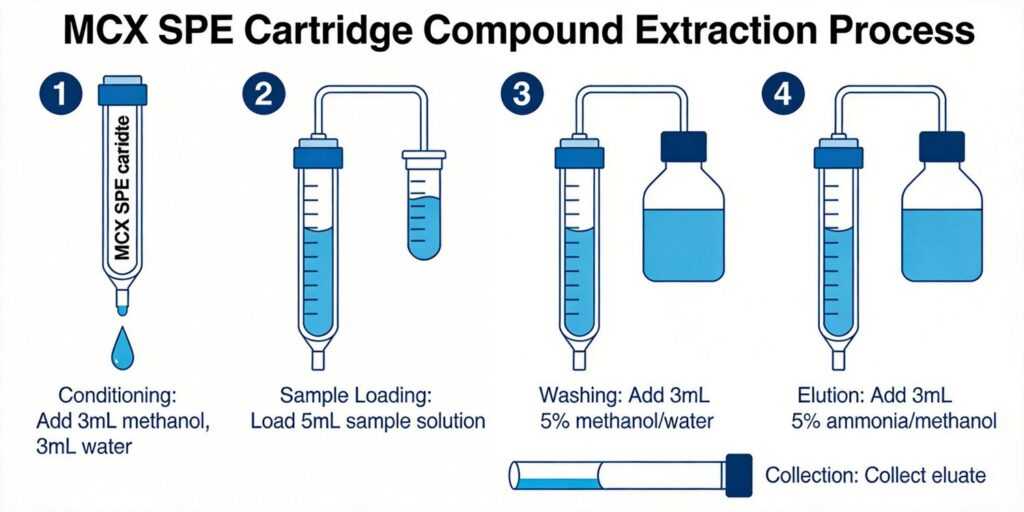
Proper conditioning of MCX cartridges is essential for optimal performance. The conditioning sequence activates both the hydrophobic and ion-exchange sites while ensuring the sorbent bed remains wetted throughout the process.
Standard Conditioning Protocol
- Methanol activation: 2-3 mL methanol per 100 mg sorbent at 1-2 mL/min flow rate
- Water equilibration: 2-3 mL deionized water at 1-2 mL/min
- Buffer conditioning: 1-2 mL 0.1 M phosphate buffer (pH 6.0) at 1-2 mL/min
Critical note: The cartridge must not be allowed to dry between conditioning and sample application. Maintain a slight positive pressure or vacuum (approximately 3 in. Hg) to prevent sorbent drying.
Sample Loading Conditions
- Flow rate: 1-2 mL/min for optimal retention efficiency
- pH: Maintain sample pH at 6.0 ± 0.5 throughout loading
- Organic content: Keep organic solvent concentration below 20% to prevent breakthrough of basic compounds
- Volume: Typical loading volumes are 1-5 mL for urine and 0.5-2 mL for plasma extracts
As documented in forensic protocols, “aspirate at approximately 3 in. Hg to prevent sorbent drying” during conditioning steps (UCT internal publication). The phosphate buffer serves dual purposes: it maintains optimal pH for cation exchange and provides potassium ions that help condition the cation exchange sites.
5. Washing Solvents to Remove Neutral Impurities
Effective washing is critical for removing matrix interferences while retaining target basic metabolites. The washing sequence typically progresses from aqueous to organic solvents of increasing elution strength.
Standard Washing Protocol
- Water wash: 2-3 mL deionized water removes salts, sugars, and other polar interferences
- Acidic wash: 1-2 mL 0.1 M acetic acid (pH ~3) enhances ionic retention of basic compounds and removes weakly retained acids
- Methanol wash: 2-3 mL methanol removes neutral lipids and hydrophobic interferences
- Drying step: Apply vacuum (10-15 in. Hg) for 5 minutes to remove residual water
- Optional hexane wash: 2 mL hexane can be added for particularly dirty samples to remove non-polar lipids
Specialized Wash Conditions
For challenging matrices or specific applications:
- 20% acetonitrile/80% water wash: Effective for removing polar endogenous compounds from urine without eluting basic drugs
- Buffer washes: Additional phosphate buffer washes can help remove ionic interferences
- Mixed solvent washes: Solvent mixtures like hexane-ethyl acetate (70:30) can be used for specific cleanup needs
Research demonstrates that “basic drug recoveries of over 80% with relative standard deviations of less than 7.3% were obtained” using optimized washing protocols (de Zeeuw and Franke, 2000). The acidic wash is particularly important as it converts zwitterionic compounds (like benzoylecgonine) to simple cations, improving their retention on the cation exchange sites.
6. Elution with Basic Organic Solvent Mixtures
Elution of basic metabolites from MCX cartridges requires simultaneous disruption of both ionic and hydrophobic interactions. This is achieved through basic organic solvent mixtures that neutralize the cation exchange sites and provide sufficient elution strength for hydrophobic interactions.
Primary Elution Solvents
- Methanol-ammonium hydroxide (98:2): Simple and effective for most basic compounds. Prepare fresh daily as ammonia evaporates.
- Methylene chloride-isopropanol-ammonium hydroxide (78:20:2): More effective for highly hydrophobic basic drugs. Provides excellent elution strength while maintaining basic pH.
- Ethyl acetate-ammonium hydroxide (96:4): Suitable for compounds requiring less polar elution conditions.
Elution Protocol
- Volume: 2-3 mL elution solvent per 100 mg sorbent
- Flow rate: 0.5-1 mL/min for maximum efficiency
- Collection: Collect in silanized glass tubes to prevent adsorption
- pH verification: Ensure elution solvent pH is 11.0-12.0 for complete neutralization of cation exchange sites
Post-Elution Processing
- Evaporation: Evaporate to dryness at 40°C under gentle nitrogen stream
- Reconstitution: Reconstitute in mobile phase compatible with subsequent analysis (HPLC or GC)
- Derivatization (if needed): For GC analysis, derivatives such as BSTFA or MTBSTFA can be added at this stage
As noted in clinical applications, “the elution solvent must be able to reverse or disrupt all bonding mechanisms simultaneously, so pH, polarity, and solubility must all be considered” (Telepchak et al., 2004). The basic conditions (pH 11-12) neutralize the sulfonic acid groups, eliminating ionic interactions, while the organic components disrupt hydrophobic interactions.
7. Application in Clinical Drug Metabolism Studies
MCX SPE has become an indispensable tool in clinical drug metabolism studies due to its ability to isolate basic drug metabolites from complex biological matrices with high recovery and excellent cleanup.
Key Applications
- Pharmacokinetic studies: Monitoring parent drug and metabolite concentrations over time in plasma and urine
- Metabolite identification: Isolating metabolites for structural characterization by MS and NMR
- Therapeutic drug monitoring: Quantifying drug and active metabolite levels for dose optimization
- Drug interaction studies: Assessing metabolic pathways affected by co-administered drugs
- Renal and hepatic impairment studies: Evaluating metabolite accumulation in special populations
Specific Clinical Examples
- Antidepressant metabolism: Extraction of fluoxetine and norfluoxetine from serum for therapeutic monitoring
- Opioid metabolism: Isolation of morphine, codeine, and their glucuronides for pain management studies
- Cardiovascular drugs: Recovery of β-blockers and their hydroxylated metabolites for pharmacokinetic analysis
- Antipsychotic drugs: Extraction of chlorpromazine and its ring-hydroxylated metabolites for metabolic profiling
- Antiepileptic drugs: Isolation of carbamazepine and its epoxide metabolite for therapeutic monitoring
Advantages in Clinical Research
MCX SPE offers several advantages for clinical drug metabolism studies:
- High recovery: Typically 80-95% for basic drug metabolites
- Excellent cleanup: Removes endogenous interferences that can complicate chromatographic analysis
- Concentration capability: Allows detection of low-concentration metabolites
- Compatibility: Extracts are clean and compatible with HPLC, GC-MS, and LC-MS/MS analysis
- Automation friendly: Easily adapted to automated SPE systems for high-throughput studies
As demonstrated in comprehensive drug screening applications, MCX cartridges have been used to isolate “a wide variety of drugs including acepromazine, amitriptyline, amphetamine, benzoylecgonine, cocaine, codeine, diazepam, methadone, morphine, and many others” (Telepchak et al., 2004). This versatility makes MCX SPE particularly valuable for clinical studies involving multiple analytes or unknown metabolites.
Future Directions
The continued development of MCX SPE technology includes:
- 96-well plate formats: For high-throughput clinical studies
- Reduced solvent volumes: Environmentally friendly approaches
- Enhanced selectivity: New sorbent chemistries for specific metabolite classes
- Integration with direct analysis: Coupling with ambient ionization mass spectrometry
For researchers and clinicians involved in drug metabolism studies, MCX SPE provides a robust, reliable method for isolating basic drug metabolites from biological samples. When properly optimized, it delivers the sensitivity, selectivity, and reproducibility required for rigorous clinical research while simplifying sample preparation workflows.
For specific applications or custom method development, consult with our technical support team or refer to our comprehensive MCX SPE product documentation for detailed protocols and application notes.