Properties of Basic Analytes
Basic compounds represent a diverse class of analytes characterized by their ability to accept protons or donate electron pairs. These compounds typically contain nitrogen atoms with lone electron pairs, such as amines, alkaloids, pharmaceuticals, and various drug metabolites. The fundamental property governing their behavior in solid-phase extraction (SPE) is their pKa value, which determines their ionization state at different pH levels.
Basic analytes exist in two forms: protonated (cationic) and neutral. When the pH of the solution is below the compound’s pKa, the basic functional groups become protonated and carry a positive charge. Conversely, when the pH is above the pKa, these compounds remain neutral. This pH-dependent ionization is crucial for SPE method development, as it directly influences retention mechanisms and extraction efficiency.
According to SPE literature, “Many drugs have acidic or basic properties, and it can be anticipated that their cartridge retention and elution behavior will be affected by the pH of the extraction system.” This underscores the importance of understanding the physicochemical properties of basic compounds before selecting appropriate SPE cartridges.
Basic compounds can be further categorized based on their strength:
Weak Bases (pKa 2-10)
These compounds include most pharmaceutical amines and alkaloids. They exhibit pH-dependent ionization and require careful pH control during extraction.
Strong Bases (pKa >10)
Quaternary amines and other permanently charged compounds fall into this category. These compounds remain ionized across a wide pH range and require specialized extraction approaches.
The solubility characteristics of basic compounds also vary significantly. Most basic drugs are soluble in polar organic solvents like methanol and acetonitrile, but their aqueous solubility depends heavily on pH and ionization state. This solubility profile directly impacts sample preparation and loading conditions.
MCX Sorbent Mechanism
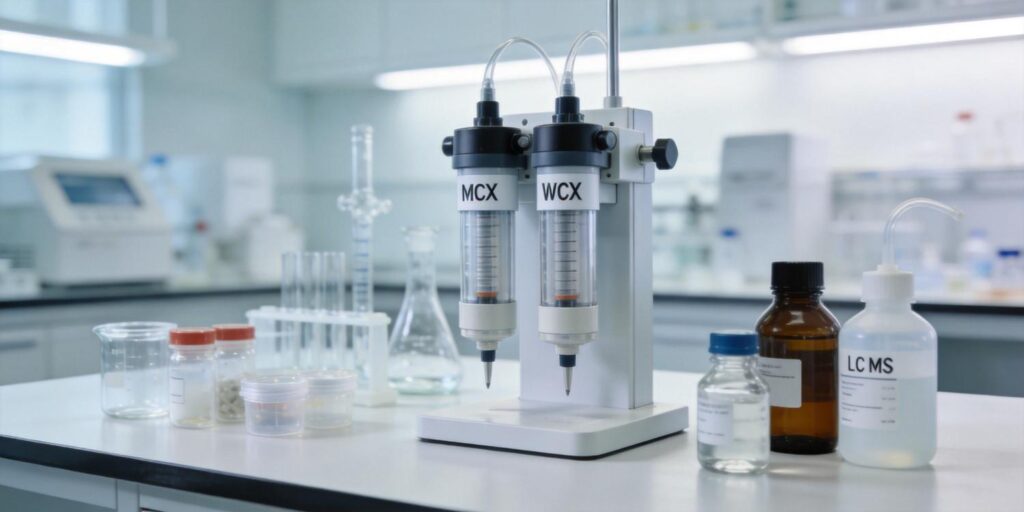
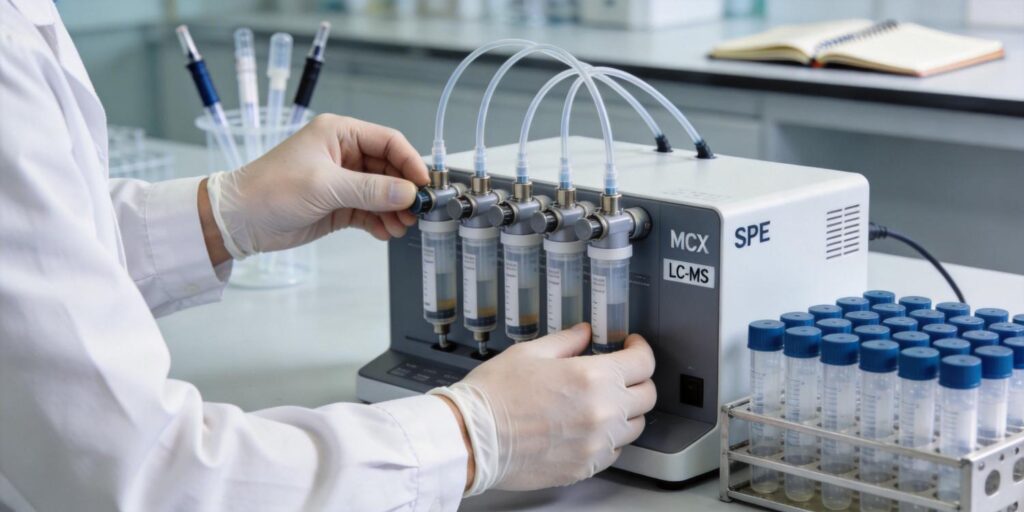
Mixed-mode cation exchange (MCX) sorbents represent a sophisticated approach to basic compound extraction, combining multiple retention mechanisms for enhanced selectivity and cleanup. The MCX sorbent operates through dual retention mechanisms: reversed-phase hydrophobic interactions and strong cation exchange.
The MCX sorbent contains sulfonic acid groups (-SO3H) that provide strong cation exchange capacity, typically around 0.25 meq/g according to Waters documentation. These ion-exchange sites interact electrostatically with protonated basic compounds when the sample pH is appropriately adjusted. Simultaneously, the hydrophobic polymeric backbone provides reversed-phase retention for neutral forms of basic compounds and other hydrophobic interferences.
This dual mechanism offers several advantages:
Enhanced Selectivity
The combination of ionic and hydrophobic interactions allows for more selective retention of basic compounds compared to single-mechanism sorbents. As noted in SPE literature, “Mixed-mode sorbents should be tested as well at this stage, as these will often yield extracts of higher purity than conventional reversed-phase cartridges.”
Improved Cleanup
The ionic interaction provides an additional dimension of selectivity that helps remove neutral and acidic interferences that might co-extract with basic compounds on traditional reversed-phase sorbents.
Flexible Elution Strategies
The dual retention mechanism enables sequential elution strategies where neutral compounds can be eluted first using organic solvents, followed by ionic elution of basic compounds using appropriate pH-adjusted solvents.
The MCX sorbent is particularly effective for weak bases (pKa 2-10), where pH manipulation can control the ionization state and optimize retention. The sorbent’s stability across pH 0-14 makes it suitable for a wide range of extraction conditions.
pH Optimization Strategy
pH optimization is the cornerstone of successful basic compound extraction using MCX sorbents. The fundamental principle is simple: adjust the sample pH to ensure basic compounds are protonated (positively charged) during loading to maximize ionic retention on the cation exchange sites.
A systematic approach to pH optimization involves several key steps:
Initial pH Screening
Begin with a pH profiling experiment using buffers across the relevant pH range. As described in SPE methodology, “For each sorbent tested, buffers with pH values of 2, 3, 4, 5, 6, 7, 8, and 9 are used for diluting the sample before application to the SPE cartridge.” Common buffers include phosphoric acid (pH 2.1), potassium phosphate (pH 6-8), sodium formate/triethylamine (pH 2.5-4), sodium acetate (pH 4.5-5.5), and tris (pH 9).
Target pH Selection
For most basic compounds, optimal retention occurs when the sample pH is at least 2 units below the compound’s pKa. This ensures >99% protonation. However, practical considerations may require adjustment based on matrix effects and interference removal.
Matrix Considerations
Biological matrices like plasma or urine often require pH adjustment after sample dilution. A typical protocol involves mixing “1.5-2 mL of various buffer solutions with 0.5 mL of plasma before application to the cartridge.” The buffer should match the conditioning buffer to maintain consistent pH throughout the extraction.
Practical Implementation
For routine applications with MCX sorbents, loading at pH 3-4 generally provides excellent retention for most basic compounds. As one protocol specifies, “The pH of the extraction system is adjusted to a slightly acidic pH value by applying 0.5 mL of 0.01 mol/L acetic acid (pH=3.3).”
It’s important to note that quoted pKa values serve as guides, but actual behavior near bonded silica surfaces may differ. As cautioned in the literature, “The effective acidity or basicity of a functional group close to a bonded silica surface may be very different. Consequently, you may use quoted values of molecular properties as a guide for selection of experimental conditions of pH, but it is always wise to verify the selection by experiment.”
Loading and Washing Conditions
Proper loading and washing conditions are essential for achieving high recovery and clean extracts when working with basic compounds on MCX sorbents.
Conditioning Protocol
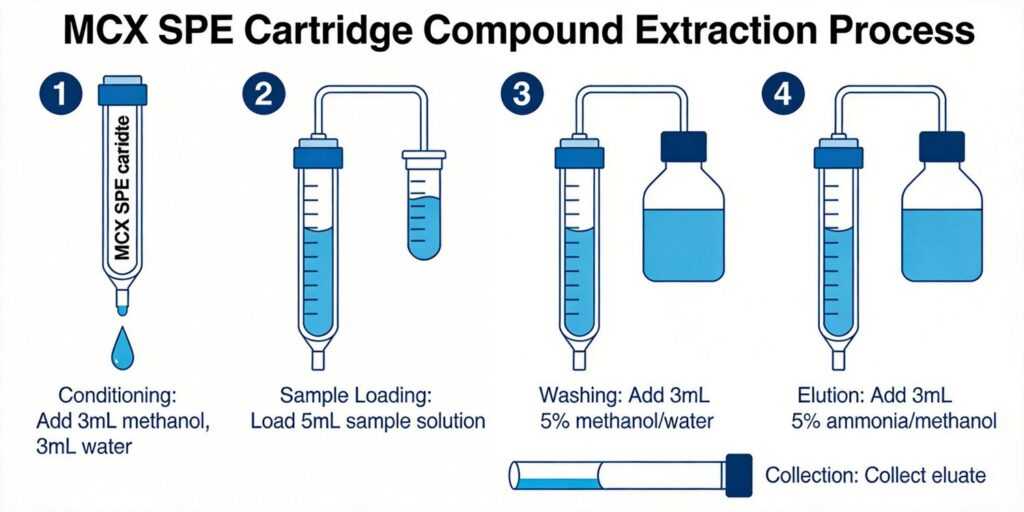
MCX cartridges require proper conditioning to activate both hydrophobic and ionic sites:
- Organic Solvent: 1-2 column volumes of methanol or acetonitrile to wet the hydrophobic phase
- Water: 1-2 column volumes of deionized water to remove excess organic solvent
- Conditioning Buffer: 1-2 column volumes of buffer matching the sample pH to equilibrate ionic sites
As emphasized in SPE guidelines, “Columns are shipped dry, but those with hydrophobic character need to be solvated to interact efficiently and reproducibly with aqueous matrices. Sample capacity is severely reduced on a dry column.”
Sample Loading
Sample preparation for loading typically involves:
- Dilution with appropriate buffer to achieve target pH
- Removal of particulates by centrifugation or filtration
- Application at controlled flow rates (typically 1-2 mL/min)
One protocol describes: “Blood plasma or urine (2 mL) containing the analyte is diluted with 6 mL of the same phosphate buffer used to condition the cartridge, and the mixture is briefly vortexed. The diluted sample is applied to the top of the cartridge and pulled through slowly under light vacuum at a flow rate of approximately 1.5 mL/min.”
Washing Optimization
Washing serves to remove matrix interferences while retaining target basic compounds. For MCX sorbents, a sequential washing approach is often most effective:
- Water Wash: Removes water-soluble salts and polar interferences
- Organic Wash: Typically 5-20% methanol in water to remove hydrophobic interferences without eluting basic compounds
- pH-Adjusted Wash: Optional wash with weak acid to remove weakly basic interferences
Washing optimization involves testing increasing concentrations of organic solvent. As described in methodology development: “Typically the wash solvent methanol composition is increased in steps of 10% from 100% water through to 100% methanol.” The goal is to identify “the strongest wash solvent that will not elute analyte.”
Drying Step
Proper drying is crucial before elution, especially when using water-immiscible elution solvents. As noted in protocols: “The sorbent bed is dried by sucking air through the cartridge at a vacuum of at least 10 inHg, for 4 minutes, followed by the application of 50 μL methanol and a second vacuum drying step for 1 minute.” However, caution is advised: “It is also possible to overdry the sorbent in some reversed phase applications. Hydrophobic bonding depends on accessibility of alkyl chains for H–C interactions.”
Elution Optimization
Elution optimization focuses on achieving quantitative recovery of basic compounds while maintaining extract purity. For MCX sorbents, elution typically involves disrupting both ionic and hydrophobic interactions.
Dual Elution Strategy
A common approach for MCX involves sequential elution:
- Neutral Elution: Organic solvent to elute neutral compounds retained by hydrophobic interactions
- Ionic Elution: Basic organic solvent to disrupt ionic interactions and elute basic compounds
One effective elution solvent combination is methylene chloride/isopropyl alcohol/ammonium hydroxide (78/20/2), which simultaneously provides organic solvent strength and high pH to disrupt ionic bonds.
pH Considerations for Elution
To elute basic compounds from cation exchange sites, the elution solvent must have a pH at least 2 units above the compound’s pKa. This neutralizes the positive charge on basic compounds, disrupting the ionic interaction with sulfonic acid groups.
Common basic elution modifiers include:
- Ammonium hydroxide (2-5% in methanol)
- Triethylamine (1-2% in organic solvents)
- Diethylamine (1-2% in organic solvents)
Solvent Selection
The choice of organic solvent affects both recovery and extract cleanliness. Methanol and acetonitrile are common choices, but solvent mixtures often provide better performance. As noted in optimization strategies: “Several smaller eluent aliquots can improve recovery” compared to a single large volume.
Practical Elution Protocol
A typical MCX elution protocol might include:
- Elution 1: 2-3 mL of organic solvent (methylene chloride, ethyl acetate, or hexane/ethyl acetate mixture) to remove neutral interferences
- Optional methanol wash to remove polar interferences not ionically bound
- Elution 2: 2-3 mL of 5% ammonium hydroxide in methanol to elute basic compounds
As emphasized in SPE tips: “Allow cartridge/plate to soak with eluent for 0.5-1 min. (increases recovery).” This soaking period allows the elution solvent to fully penetrate the sorbent bed and disrupt all retention interactions.
Recovery Assessment
Final optimization should focus on achieving the necessary recovery for analytical sensitivity requirements. As wisely noted in SPE literature: “In an optimized method, recovery is a balance between sensitivity and selectivity. Chromatographic signal-to-noise ratio (S/N) and resolution of interfering substances are paramount to absolute recovery. If acceptable limits of detection are achieved (with no interfering compounds) at only 30% recovery, then a higher recovery may not be necessary.”
By systematically addressing each of these areas—understanding basic compound properties, leveraging MCX dual mechanisms, optimizing pH conditions, refining loading/washing protocols, and perfecting elution strategies—analysts can develop robust, high-performance SPE methods for basic compounds that deliver both excellent recovery and superior extract cleanliness.