Challenges in Extracting Chemically Diverse Drug Classes
Developing SPE methods for multi-class pharmaceutical compounds presents unique analytical challenges due to the chemical diversity of modern drug molecules. Pharmaceutical compounds span a wide spectrum of chemical properties including varying pKa values (typically ranging from 2-12), diverse functional groups (amines, carboxylic acids, hydroxyl groups, aromatic systems), and significant differences in hydrophobicity (log P values from -3 to +6). This chemical heterogeneity creates a fundamental dilemma: how to achieve simultaneous extraction of compounds with opposing retention characteristics.
According to research from pharmaceutical cream analysis, the extraction of basic hydrophobic drugs like promethazine requires different conditions than hydrophilic basic drugs such as chlorhexidine and benzydamine. For instance, while C-18 sorbents work well for hydrophobic drugs in 20% methanol solutions, SCX (strong cation exchange) packing materials are preferred for hydrophilic basic drugs at pH 4.5. This demonstrates that no single extraction mechanism can optimally retain all drug classes simultaneously.
The matrix complexity further complicates method development. Pharmaceutical formulations contain excipients, preservatives, and formulation bases that can interfere with extraction efficiency. As noted in studies of pharmaceutical creams, hydrophobic preservatives like methyl- and propyl-parabens can interfere with spectrophotometric assays and require specific SPE strategies for removal. The high concentration of active compounds in pharmaceutical formulations (compared to biological fluids) means that while preconcentration is rarely needed, matrix removal becomes critical for accurate analysis.
Selecting Polymeric vs Silica Sorbents
Silica-Based Sorbents: Traditional Workhorses
Silica-based sorbents remain the foundation of SPE technology, accounting for approximately 90% of extraction columns manufactured. These materials offer several advantages: they are cost-effective, available in well-defined surface areas (50-500 m²/g), and provide a rigid backbone with minimal swelling in various solvents. The surface chemistry of silica is dominated by silanol groups (Si-OH), which can be chemically modified to create different functional phases.
Common silica-based phases include C18, C8, C2, CN, and various ion-exchange sorbents (SCX, SAX, WCX, WAX). According to surveys, over two-thirds of all SPE applications are developed on just four sorbents: C18, C8, CN, and SI (silica). The versatility comes from the ability to create mixed-mode sorbents where silica particles are bonded with both hydrophobic chains and ion-exchange functional groups.
Polymeric Sorbents: Modern Alternatives
Polymeric sorbents, particularly those based on styrene-divinylbenzene (SDVB/SDB), polymethacrylates, and functionalized polymers, have gained significant traction in recent years. These materials offer several distinct advantages:
- pH Stability: Polymers can withstand pH extremes (typically 1-14) that would degrade silica-based sorbents
- Wetting Tolerance: Some polymeric sorbents (like Oasis™) are less sensitive to drying out after conditioning
- Enhanced Polar Retention: Modified polymers (like Bond Elut™ PPL) show improved retention of highly polar analytes
- High Surface Area: Some polymers achieve surface areas up to 1200 m²/g for maximum retention capacity
Research indicates that polymeric sorbents are particularly valuable for high-throughput applications where LC-MS compatibility is crucial. Their ability to eliminate the need for modifiers or buffers during elution makes them ideal for mass spectrometric detection.
Mixed-Mode Sorbents: The Best of Both Worlds
For multi-class pharmaceutical extractions, mixed-mode sorbents offer the most comprehensive solution. These sorbents combine multiple binding mechanisms—typically reversed-phase (hydrophobic) and ion-exchange—in a single cartridge. True copolymeric phases, where different functional silanes are polymerized to the substrate, provide superior lot-to-lot reproducibility compared to physically blended phases.
As documented in forensic applications, mixed-mode sorbents allow maximum selectivity for extracting acids, neutrals, and bases simultaneously. The C8/SCX combination, for example, provides separation of acid/neutral drugs using reversed-phase C8 functionality while the benzene sulfonic acid mechanism works on basic drugs through cation exchange of amine functionalities.
Optimization of pH Conditions During Sample Loading
pH optimization is arguably the most critical parameter in multi-class SPE method development. The ionization state of pharmaceutical compounds directly affects their retention on both reversed-phase and ion-exchange sorbents. A systematic approach to pH optimization involves several key considerations:
pH Profiling Strategy
Initial method development should include pH profiling experiments across a broad range (typically pH 2-9). Research demonstrates that for comprehensive drug screening, starting at pH 2.2 results in less ionization of acidic drugs and better retention on mixed-mode cartridges. For basic drugs, higher pH conditions (above their pKa + 2) ensure complete ionization for effective cation exchange retention.
As shown in studies of ibuprofen extraction (pKa = 5.9), lowering the sample pH from 6.0 to 5.0 increases recovery on hydrophobic phases by shifting the equilibrium toward the non-ionized form. This principle applies broadly: acidic compounds require pH conditions at least 2 units below their pKa for optimal hydrophobic retention, while basic compounds need pH conditions at least 2 units above their pKa.
Buffer Selection and Ionic Strength
Buffer selection must consider both pH control and compatibility with subsequent analytical techniques. Common buffers include:
- Phosphate buffers (pH 6-8): Good buffering capacity but may cause precipitation with certain cations
- Formate buffers (pH 2.5-4): Excellent for LC-MS compatibility but limited buffering range
- Acetate buffers (pH 4.5-5.5): Good compromise between buffering and MS compatibility
- Tris buffers (pH 9): Useful for basic compounds but may interfere with some detection methods
Ionic strength optimization is equally important. Higher ionic strength can improve retention on reversed-phase sorbents through salting-out effects but may interfere with ion-exchange mechanisms. Typically, 0.1-0.2 M buffer concentrations provide adequate pH control without excessive ionic effects.
Multi-Stage Washing Procedures
Effective washing strategies are essential for achieving clean extracts while maintaining high analyte recovery. Multi-stage washing typically involves sequential application of solvents with increasing elution strength, carefully calibrated to remove interferences without displacing target analytes.
Wash Solvent Optimization
The ideal wash solvent should be strong enough to remove matrix interferences but weak enough to retain all target analytes. For mixed-mode extractions, this often involves:
- Aqueous wash: Typically water or dilute buffer to remove salts and highly polar interferences
- Low-organic wash: 5-20% methanol or acetonitrile in water to remove moderately polar compounds
- pH-adjusted wash: Buffer solutions at specific pH to disrupt weak ionic interactions of interferences
- Organic wash: Pure organic solvents (methanol, acetonitrile) for final cleaning of hydrophobic interferences
Research on forensic drug screening demonstrates that using 0.1 M phosphate buffer (pH 6.0) followed by 0.1 M acetic acid provides effective washing for mixed-mode extractions. The acetic acid wash serves dual purposes: it removes weakly retained acidic compounds and adjusts the cartridge pH for subsequent elution steps.
Wash Volume Considerations
Wash volumes must be optimized to balance cleanliness and recovery. Studies on paracetamol extraction from plasma show that excessive wash volumes (particularly aqueous washes) can significantly reduce recovery of polar compounds. Typically, 1-3 mL wash volumes per 100 mg sorbent provide adequate cleaning without excessive analyte loss.
Elution Strategies for Diverse Analytes
Elution optimization presents the greatest challenge in multi-class SPE, as the elution solvent must disrupt all binding mechanisms simultaneously while maintaining compatibility with downstream analysis.
Sequential vs Simultaneous Elution
For mixed-mode sorbents, two primary elution strategies exist:
Sequential Elution: Different solvent systems are applied to elute different compound classes separately. For example:
- Acidic/neutral fraction: Chloroform/acetone (1:1) or methylene chloride
- Basic fraction: Ammoniated ethyl acetate (2% NH4OH) or ammoniated methylene chloride/isopropanol
Simultaneous Elution: A single solvent system containing both organic modifier and pH adjuster elutes all compounds together. Common combinations include methanol with 2% formic acid (for acidic/neutral compounds) or methanol with 2% ammonium hydroxide (for basic compounds).
Elution Solvent Optimization
The elution solvent must meet several criteria:
- Sufficient elution strength: Typically 70-100% organic content
- Appropriate pH: Acidic for cation exchange disruption, basic for anion exchange disruption
- Compatibility with analysis: Volatile for GC, MS-compatible for LC-MS
- Minimal volume: Typically 1-3 mL per 100 mg sorbent for concentration
Research demonstrates that for mixed-mode sorbents, elution solvents containing both organic modifier and competing ions (ammonium acetate, formic acid, etc.) provide the most effective disruption of multiple binding mechanisms.
LC-MS Compatibility Considerations
LC-MS compatibility has become a driving force in modern SPE method development, particularly for pharmaceutical analysis. Several key considerations ensure optimal MS performance:
Ion Suppression Minimization
Matrix components that co-elute with analytes can cause significant ion suppression in ESI and APCI sources. Effective SPE strategies must remove:
- Proteins and phospholipids: Major sources of ion suppression in biological matrices
- Salts and buffers: Particularly non-volatile salts like phosphates and sulfates
- Detergents and surfactants: Common in pharmaceutical formulations
Studies show that washing SPE cartridges with pure water before elution significantly reduces ion suppression by removing excess ions and salts.
Solvent Compatibility
Final extracts should be in solvents compatible with LC-MS systems:
- Preferred: Methanol, acetonitrile, water, or mixtures thereof
- Avoid: Non-volatile buffers, detergents, high salt concentrations
- Organic content: Typically 50-100% organic for optimal electrospray performance
On-Line SPE-LC-MS Integration
For high-throughput applications, on-line SPE-LC-MS systems offer significant advantages. These systems typically use:
- Small particle sorbents (3-10 μm) for better separation during elution
- Narrow-bore cartridges (1-2 mm ID) for improved sensitivity
- Automated switching valves for seamless integration
Research demonstrates that on-line SPE-LC-MS can achieve cycle times of 5-7 minutes per sample with sensitivities down to 50 pg/mL using only 200 μL sample volumes.
Method Validation for Multi-Class Assays
Comprehensive validation is essential for multi-class SPE methods to ensure reliability and regulatory compliance. Key validation parameters include:
Recovery and Precision
Recovery should be determined for each compound class across the expected concentration range. Acceptable recovery typically ranges from 70-120% with RSD < 15%. Precision should be evaluated at multiple concentrations (low, medium, high) with at least 6 replicates per level.
Selectivity and Specificity
Method selectivity must be demonstrated by analyzing blank matrices from at least 6 different sources. No significant interference (typically < 20% of LLOQ response) should be observed at the retention times of target analytes.
Carryover and Cross-Contamination
Carryover should be evaluated by injecting blank samples after high-concentration standards. Acceptable carryover is typically < 20% of LLOQ. Cross-contamination in 96-well plate formats should be assessed by alternating high and low samples.
Robustness and Ruggedness
Robustness testing should evaluate the impact of minor method variations:
- pH variations (±0.2 units)
- Buffer concentration variations (±10%)
- Wash and elution volume variations (±10%)
- Flow rate variations (±20%)
- Cartridge drying time variations (±50%)
Stability
Stability should be assessed for:
- Processed sample stability: In autosampler conditions
- Freeze-thaw stability: Typically 3 cycles
- Long-term stability: At storage temperatures
- Stock solution stability: At appropriate storage conditions
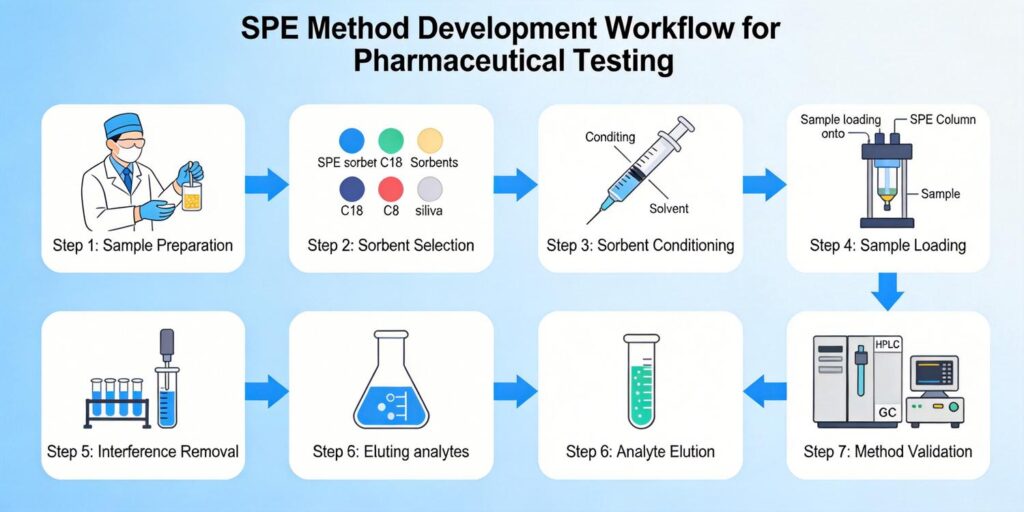
Successful multi-class SPE method development requires careful balancing of competing requirements. By systematically addressing each parameter—from sorbent selection through final validation—analysts can develop robust methods that provide reliable extraction of chemically diverse pharmaceutical compounds while maintaining compatibility with modern analytical techniques like LC-MS.
For laboratories seeking optimized SPE solutions, Poseidon Scientific offers a comprehensive range of HLB SPE cartridges, MAX SPE cartridges, MCX SPE cartridges, WAX SPE cartridges, WCX SPE cartridges, and 96-well SPE plates designed specifically for pharmaceutical applications.