What Cartridge Channeling Is and Why It Occurs
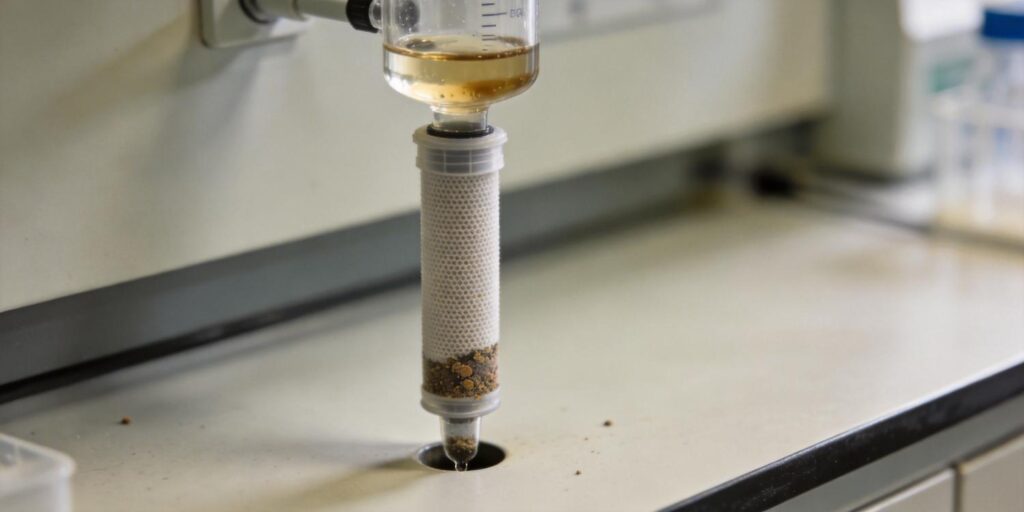
Cartridge channeling is a critical phenomenon in solid-phase extraction (SPE) where liquids take the path of least resistance through the sorbent bed, creating tunnels or channels instead of flowing uniformly across the entire cross-sectional area. This occurs when excessive vacuum or pressure is applied during conditioning or sample loading steps, causing the solvent to bypass portions of the sorbent material. According to forensic SPE literature, “If excessive vacuum or pressure is applied to SPE columns, liquids will take the path of least resistance and channels or tunnels will form in the sorbent bed.”
The fundamental causes include:
- Excessive flow rates during conditioning (typically above 3.0 mL/min)
- Insufficient solvent-sorbent contact time
- Improper conditioning that fails to fully wet the sorbent
- Drying of the sorbent bed between conditioning and sample loading
- Poorly packed cartridges with inconsistent bed density
Channeling is particularly problematic when SPE robots are used during unsupervised operation periods, where pressure overload devices may trip too easily during sample application.
Effects on Analyte Retention and Reproducibility
Channeling significantly reduces extraction efficiency and method reliability through several mechanisms:
Reduced Surface Area Contact
When channels form, only a portion of the sorbent is effectively utilized, dramatically reducing the available surface area for analyte interaction. This essentially decreases sorbent capacity, as noted in forensic applications: “Channeling is detrimental to efficient extraction and recovery because it reduces the available surface area for sample contact.”
Poor Mass Transfer
Successive liquid steps flow faster through established channels, reducing contact time necessary for effective mass transfer between analytes and sorbent functional groups. This leads to incomplete retention during loading and inefficient elution during the final step.
Compromised Reproducibility
Channeling creates inconsistent flow paths between cartridges and even within the same cartridge during different runs. This variability manifests as poor inter- and intra-cartridge reproducibility, with recovery variations that can exceed acceptable method validation limits.
Selectivity Issues
Different analytes may follow different channel paths based on their chemical properties, leading to inconsistent selectivity and potentially missing target compounds or retaining unwanted matrix components.
Proper Conditioning to Ensure Uniform Wetting
Effective conditioning is the first line of defense against channeling. The conditioning process serves to expand functional binding sites away from the solid surface, exposing them to diffusive flow of samples and reagents.
Optimal Conditioning Protocol
For reversed-phase procedures, methanol is frequently used because it meets all necessary conditions: miscible with aqueous matrices, diffuses easily into sorbent pores (low surface tension), provides high mass transfer of HCl bonds with sorbent alkyl chains, and universally elutes polar and nonpolar contaminants.
The standard conditioning approach includes:
- Apply 2-3 mL of methanol (or appropriate organic solvent) at controlled flow rates
- Follow with 2-3 mL of water or buffer to remove excess organic solvent
- Maintain approximately 1-2 mm of conditioning solvent above the sorbent bed to prevent drying
Critical Flow Rate Control
Flow rates between 0.5 and 3.0 mL/min are generally acceptable to allow sufficient solvent-sorbent contact for solvation without causing channeling. As emphasized in SPE literature: “Excessive flow creates insufficient contact for adequate H–C interaction to occur. In addition, excessive flow rate and/or redrying of the sorbent may result in channeling of the sorbent bed.”
Preventing Bed Drying
The cartridge must not become dry before sample application. If excessive time passes between conditioning steps, it’s recommended to restart the conditioning process. However, once channels have formed due to high flows or excessive drying, reconditioning will not correct the problem.
Flow Rate Control During Sample Loading
Sample loading represents the most critical phase for preventing channeling, as this is when the sorbent bed experiences the greatest stress from liquid flow.
Optimal Flow Rates
For most applications, flow rates of 1-2 mL/min provide optimal balance between throughput and extraction efficiency. Ion exchange extractions are particularly sensitive to flow rate variations, with symptoms including lower recoveries at higher flow rates or decreased reproducibility.
Pressure vs. Flow Rate Control
When using vacuum systems, analysts set specific vacuum pressure rather than flow rate. The resulting flow rate depends on vacuum pressure, sample viscosity, and cartridge packing characteristics. With negative pressure operation, pressure remains constant while flow rate through the SPE cartridge bed may vary.
Positive pressure systems, particularly those using syringe-driven displacement, provide more stable flow control. As noted in SPE workstation evaluations: “An automated SPE workstation that uses a pump or syringe to provide positive pressure displacement of a liquid volume through the SPE cartridge bed will provide the most stable flow.”
Viscous Sample Considerations
For viscous samples or those with high particulate content, flow characteristics can be improved by:
- Diluting the sample with water or appropriate buffer
- Filtering or centrifuging to remove particulates
- Using larger sorbent particle sizes or pore diameters
- Increasing frit pore diameter or changing frit type
Using Vacuum Manifolds vs Positive Pressure Systems
The choice between vacuum and positive pressure systems significantly impacts channeling risk and overall extraction performance.
Vacuum Manifold Characteristics
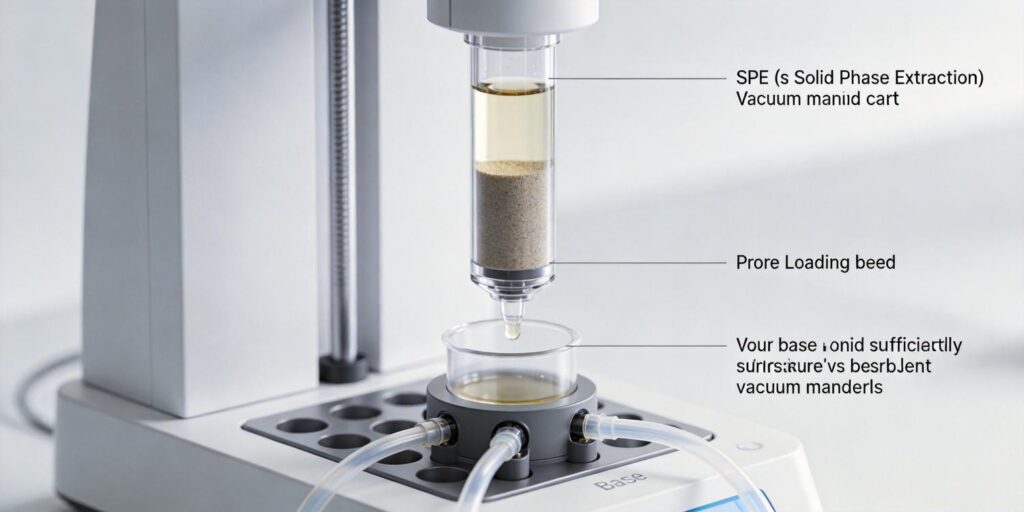
Vacuum systems are the most common technique for manual sample processing due to simplicity, convenience, and availability of various manifold types. However, they present specific channeling risks:
- Insufficient or poorly regulated vacuum can cause flow problems
- Weak vacuum sources may create vapor locks that require “bumps” in vacuum to disrupt liquid surface tension
- Excessive vacuum can collapse tubing and impede flow
- Bad seals or warped manifold heads can allow leaks and result in low vacuum
Positive Pressure Advantages
Positive pressure systems are becoming more popular due to commercially available manifolds and automated systems. Their benefits include:
- More precise flow control with less susceptibility to channeling
- Ability to use nitrogen or other inert gases for oxygen-sensitive analytes
- Better drying effectiveness with clean pressurized gas
- Superior performance with viscous or particulate-rich samples
System Selection Considerations
When choosing between systems, consider:
- Sample characteristics (viscosity, particulate content, oxygen sensitivity)
- Required throughput and automation level
- Method sensitivity to flow rate variations
- Available laboratory infrastructure and budget
Cartridge Packing Quality Considerations
The physical characteristics of SPE cartridges significantly influence channeling susceptibility.
Packing Consistency
Machine or automated packing processes generally produce more uniform beds than hand-packed cartridges. However, variations can occur from day to day even with automated systems. Many specialty phases are frequently hand-packed, introducing potential operator variation.
Bed Geometry Effects
Changing the surface area affects flow characteristics. Spreading the sample over a larger surface by using a wider-diameter cartridge can sometimes improve flow. Conversely, a narrower column may improve deficiencies in the flow source and facilitate better flow.
Sorbent Bed Depth
Similar to HPLC, packing diameter and length relate to backpressure in the system. A general guide is to use the least amount of sorbent that provides sufficient capacity for target compounds and matrix, packed in a cartridge suitable for sample volume.
Alternative Formats
Disk-type columns have evolved in part to overcome channeling problems. Tapered or wide-mouth cartridge types allow use of larger sample volumes while maintaining small sorbent volumes, potentially reducing channeling risk.
Quality Control Tests to Detect Channeling
Implementing systematic QC tests helps detect channeling before it compromises analytical results.
Visual Inspection
After conditioning, visually inspect the sorbent bed for uniform wetting. Dry spots or uneven coloration indicate potential channeling. The bed should appear consistently dark and uniformly moist.
Flow Rate Consistency Testing
Measure flow rates during conditioning and loading steps. Significant variations between cartridges or inconsistent flow within a single cartridge suggest channeling. Automated systems with flow monitoring capabilities can detect these variations in real-time.
Dye Test Method
Use a colored dye or tracer compound during method development to visualize flow paths. Apply the dye during conditioning or loading and observe its distribution through the sorbent bed. Uneven distribution indicates channeling.
Recovery Testing with Standards
Regularly run quality control samples with known concentrations of target analytes. Consistently low or variable recoveries may indicate channeling issues. Pay particular attention to recovery variations between different cartridge lots.
Pressure-Flow Relationship Analysis
Monitor the relationship between applied pressure and resulting flow rate. In properly packed cartridges, this relationship should be linear and consistent. Deviations suggest channeling or other packing defects.
Manufacturer Quality Assurance
Reputable manufacturers implement rigorous QC testing including:
- Sorbent bed voiding checks
- Consistent sample flow characteristic verification
- Chromatographic performance testing
- Extractables testing to ensure clean frits and barrels
When selecting SPE products, consider manufacturers who provide comprehensive quality data and consistent manufacturing processes.
Conclusion
Preventing cartridge channeling requires a comprehensive approach encompassing proper conditioning techniques, controlled flow rates, appropriate system selection, attention to cartridge quality, and systematic quality control. By understanding the mechanisms behind channeling and implementing preventive measures, laboratories can ensure consistent, reproducible SPE results that meet rigorous analytical standards. Regular monitoring and validation of SPE procedures remain essential for maintaining extraction efficiency and data quality in both research and routine analytical applications.
For high-quality SPE products designed to minimize channeling risks, explore our HLB SPE Cartridges, MAX SPE Cartridges, MCX SPE Cartridges, WAX SPE Cartridges, WCX SPE Cartridges, and 96-well SPE Plates.