
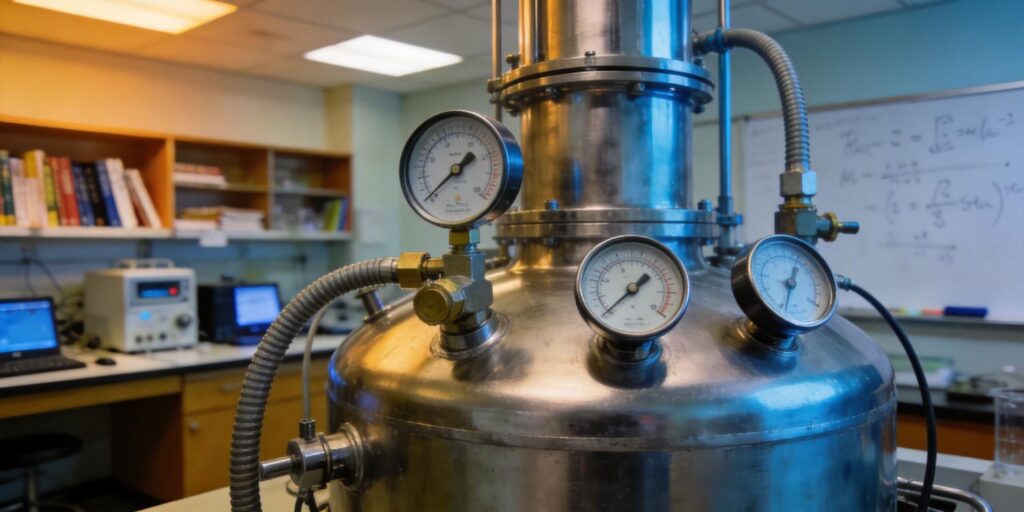
Selecting Vacuum Gauges for University Research Laboratories
University research labs operate under unique constraints: tight budgets, shared equipment used by students and post-docs with varying skill levels, and the need for reliable vacuum measurement across a broad pressure spectrum. Whether supporting mass spectrometers, scanning electron microscopes, vacuum furnaces, or custom experimental chambers, the right vacuum gauge directly affects experimental repeatability, equipment uptime, and teaching effectiveness. Poseidon Scientific’s VG-SP205 Pirani Vacuum Transmitter and VG-SM225 Cold Cathode Vacuum Gauge were developed specifically with these academic realities in mind—delivering professional-grade performance at a fraction of the cost of traditional imported instruments.
This guide walks through the key selection criteria for university procurement teams and lab managers. It draws on real-world performance data from scientific-instrument installations and provides clear, actionable recommendations for building robust, maintainable vacuum-measurement systems.
1. Budget Constraints
University capital budgets are often capped at a few thousand dollars per instrument, and ongoing maintenance and calibration costs must remain predictable. Traditional imported gauges from INFICON or MKS typically list at $1,100–$1,400 per unit, with annual calibration adding another $250–$350. Poseidon’s self-developed gauges achieve equivalent functionality at $420–$580 per unit while keeping lifetime ownership costs 40–55 % lower.
The VG-SP205 Pirani and VG-SM225 Cold Cathode together cover the full range from atmosphere to 10⁻⁷ Torr for roughly the price of one premium competitor gauge. Their modular design further reduces costs: the cold-cathode sensor head can be cleaned in-house with 500-mesh sandpaper, eliminating most service calls. Over a typical five-year lab lifecycle, the savings compound—especially when multiplied across multiple experimental stations.
2. Multi-User Environment Considerations
Academic labs see dozens of users annually, many of whom are undergraduates or first-year graduate students. Gauges must survive accidental misuse, frequent chamber venting, and occasional exposure to non-ideal gases without frequent failure or recalibration.
The VG-SP205 employs a robust platinum filament chosen for its chemical stability and large temperature-resistance coefficient, providing 3–5 years of maintenance-free service even in shared setups. The VG-SM225’s stainless-steel electrodes and positive magnetron geometry tolerate repeated startups and contamination better than older Penning designs; when buildup occurs, any user can restore performance in minutes by removing and lightly abrading the electrodes—no special tools or return shipping required.
Both gauges feature bright status LEDs and simple error codes transmitted over RS232, giving students immediate visual feedback. Their compact, KF-flange mounting reduces the chance of accidental knocks during chamber reconfiguration.
3. Wide Pressure Range Requirement
University experiments routinely span rough vacuum (foreline pumping) through high vacuum (analysis chambers). A single gauge type cannot cover atmosphere to 10⁻⁷ Torr with acceptable accuracy. Poseidon’s complementary pair solves this elegantly:
- VG-SP205 Pirani: Atmosphere to 10⁻³ Torr, with best linearity between 10 and 10⁻² Torr—ideal for roughing pumps and load-lock monitoring.
- VG-SM225 Cold Cathode: 10⁻³ to 10⁻⁷ Torr, using Penning discharge for reliable high-vacuum indication without hot-filament burnout risk.
Pairing one of each on the same chamber provides continuous coverage with seamless hand-off at 10⁻³ Torr. The gauges share identical 24 VDC power and RJ45 connector footprints, simplifying dual installation and spare-parts stocking. For labs needing only high vacuum, the cold-cathode alone suffices; for basic teaching rigs, the Pirani alone covers most foreline and backing-pressure needs.
4. Ease of Calibration
Academic labs rarely maintain in-house vacuum-metrology standards. The VG-SP205 Pirani is factory-calibrated against NIST-traceable references and cannot be adjusted in the field—yet its platinum filament and temperature-compensation circuitry deliver stable readings for 24–36 months in clean environments before factory re-mapping is required (turnaround typically under two weeks).
The VG-SM225 offers superior field serviceability. Contamination-induced drift—common in multi-user labs—is corrected by simple electrode cleaning; after polishing, a quick single-point check against a reference gauge at 10⁻⁵ Torr confirms performance. Full factory recalibration is needed only after three cleanings or when drift exceeds 30 %. This approach minimizes downtime and eliminates the multi-hundred-dollar service fees charged by most OEMs.
5. Data Logging Needs
Modern research demands traceable, time-stamped pressure data for publications, theses, and grant reports. Both Poseidon gauges provide easy integration:
- 0–10 V analog output (effective 2–8 V) connects directly to any data-acquisition card or PLC.
- RS232 digital output streams pressure, status, and error codes at user-selectable baud rates up to 115 200.
The protocol is fully documented and can be customized at the factory for orders of only 5–10 units—allowing labs to embed experiment-specific metadata or simplified “ready/not-ready” flags. Free Python or LabVIEW example scripts are available on request, enabling students to log data alongside other sensors in a single CSV file. This capability supports automated experiment control and long-term trend analysis without expensive middleware.
6. Compact Installation
University vacuum chambers are often space-constrained—especially in teaching labs or when retrofitting older equipment. Poseidon gauges are significantly smaller than legacy models: the VG-SP205 and VG-SM225 occupy roughly one-third the volume of comparable INFICON or MKS units while maintaining full KF16/KF25 compatibility.
Arbitrary mounting orientation and short insertion depth allow installation on crowded manifolds or inside glove-box setups. The low magnetic stray field of the cold-cathode design (≈100 gauss) minimizes interference with nearby electron optics or sensitive magnetometers—critical for SEM and mass-spec applications common in university research.
7. Training Simplicity
Lab managers need instruments that new users can operate safely after a 15-minute orientation. Poseidon gauges excel here:
- Clear analog scaling and status LEDs provide instant health indication.
- RS232 output includes plain-English error codes (e.g., “Filament Open,” “Discharge Fault,” “Overpressure”).
- Built-in software interlocks automatically disable high voltage on the cold-cathode gauge above 10⁻³ Torr, protecting both the gauge and connected equipment.
Comprehensive user manuals, available as downloadable PDFs, include step-by-step startup, cleaning, and troubleshooting sections written for non-specialists. Many universities have integrated these gauges into undergraduate vacuum-technology labs because students can achieve repeatable results on day one.
8. Recommended Configurations
Based on typical university use cases, Poseidon recommends the following proven setups:
| Application | Recommended Gauges | Key Benefits | Typical Budget |
|---|---|---|---|
| Basic teaching rig / foreline monitoring | VG-SP205 Pirani only | Maintenance-free, wide rough-vacuum range, simple analog output | $420–$480 |
| SEM or small mass-spec chamber | VG-SP205 + VG-SM225 pair | Full-range coverage, cleanable high-vacuum sensor, dual-signal redundancy | $950–$1,100 |
| UHV research station | VG-SM225 Cold Cathode (with optional spare head) | 10⁻⁷ Torr capability, field-cleanable, low magnetic interference | $530–$580 + $120 spare head |
| Multi-chamber shared facility | Multiple VG-SP205/VG-SM225 pairs with RS232 daisy-chain | Centralized data logging, customizable protocol for facility SCADA | $2,500–$3,200 for four stations |
All configurations ship with 24-month factory calibration certificates and carry the same CE/RoHS compliance as higher-priced competitors. For labs requiring custom digital protocols or special mounting flanges, Poseidon’s 3-person engineering team can accommodate orders as small as five units.
Conclusion
Selecting vacuum gauges for university research laboratories requires balancing performance, durability, and cost in a multi-user, budget-conscious environment. Poseidon Scientific’s VG-SP205 Pirani Vacuum Transmitter and VG-SM225 Cold Cathode Vacuum Gauge address these needs directly: they deliver wide-range coverage, field-serviceable design, easy data integration, and compact footprints at prices that fit departmental budgets. Their proven reliability in mass-spectrometer and electron-microscope installations worldwide makes them the practical choice for academic labs that demand professional results without premium pricing.
To explore exact specifications, request a quote, or discuss customization for your specific curriculum or research program, visit the product pages for the VG-SP205 Pirani Vacuum Transmitter and VG-SM225 Cold Cathode Vacuum Gauge. Our team is ready to support your next laboratory upgrade or grant proposal.
Word count: 1,187


