1. Common Causes of Low Analyte Recovery
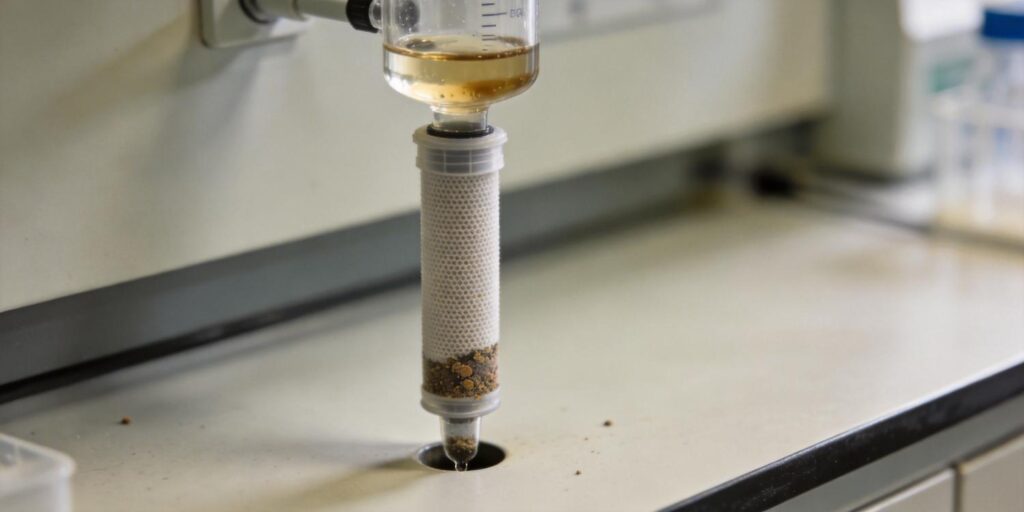
Low analyte recovery in SPE workflows is a persistent challenge that can compromise analytical accuracy and method validation. According to SPE troubleshooting literature, recovery problems typically stem from three primary sources: incomplete retention during sample loading, analyte loss during washing steps, or incomplete desorption during elution. The fundamental SPE process involves five critical steps—conditioning, sample application, washing, drying, and elution—each requiring precise optimization for optimal recovery.
Research indicates that when recoveries fall below 50%, the first diagnostic step should be a mass balance calculation. This involves collecting and analyzing all fractions including sample waste to determine where analyte loss occurs. The problem of incomplete retention is rarely encountered on reversed-phase sorbents if proper screening has been performed, but hydrophilic analytes can present particular challenges. For instance, very hydrophilic analytes can be difficult to retain on reversed-phase silica sorbents, requiring alternative approaches like ion pairing agents in the dilution buffer.
Flow rate optimization is crucial, as excessive flow rates during sample application can lead to breakthrough—where analytes fail to bind to sorbent sites due to inadequate mass transfer. Proper conditioning is equally important, as dry hydrophobic columns have severely reduced sample capacity. The SPE process should be viewed as “stop-and-go” chromatography where samples are totally retained and totally released, with each step carefully controlled to maximize recovery.
2. Impact of Incorrect pH Conditions During Loading
pH control during sample loading represents one of the most critical factors affecting SPE recovery, particularly for compounds with ionizable functional groups. The ionization state of analytes directly influences their interaction with sorbent materials. For hydrophobic retention mechanisms, analytes should be in their un-ionized form, while ion-exchange mechanisms require opposite charges between analyte and sorbent.
Research demonstrates that pH should be maintained at least 2 units away from the relevant pKa values of both analyte and sorbent. For acidic drugs like ibuprofen (pKa 5.9), lowering the pH from 6.0 to 5.0 increases recovery on hydrophobic phases by decreasing ionization and increasing the non-ionic molecular form. At the pKa, drugs exist as 50% ionized and 50% non-ionized forms, making pH optimization essential for maximizing retention.
Case studies show dramatic recovery improvements with proper pH adjustment. In one investigation, drug Y containing a phosphonic acid function (pKa < 2) showed substantially increased recovery across the pH interval studied when 10 mM tetrabutyl ammonium hydroxide was added to dilution buffers. This highlights how ion pairing agents can enhance retention of challenging analytes when pH alone proves insufficient.
3. Overly Strong Washing Solvents Removing Analytes
Washing steps present a delicate balance between removing matrix interferences and retaining target analytes. Overly strong washing solvents can prematurely elute analytes, leading to significant recovery losses. The optimal wash solvent should be the strongest composition that removes interferences without displacing target compounds.
Systematic optimization typically involves testing increasing concentrations of methanol or acetonitrile in water, typically in 10% increments from 100% water to 100% organic. Research shows that wash solvent methanol composition significantly affects recovery, with different analytes exhibiting varying tolerance to organic content. For non-polar extractions, the composition should first be varied using increasing concentrations of methanol or acetonitrile in water.
The retention factor (k’) plays a crucial role in wash optimization. If three interparticle volumes of wash solvent are employed, the retention factor must be greater than 2 to prevent analyte loss. A margin of safety dictates it should be significantly greater than this minimum threshold. Practical guidelines suggest using the weakest wash solvent that effectively removes interferences while maintaining analyte retention.
4. Sorbent Capacity Limitations
Sorbent capacity limitations represent a fundamental constraint in SPE workflows. Capacity depends on multiple factors including sorbent type, organic loading, bed mass, and competitive interactions from matrix components. Reversed-phase and adsorption columns generally offer greater capacities than ion-exchange columns, but all have finite limits.
The sample matrix itself can compete with analytes for binding sites, particularly in complex biological samples containing abundant acidic, neutral, and basic compounds. Solutions to capacity problems include: increasing bed size to overcome competitive interactions; changing to higher-loaded polymeric sorbents; switching to different retention mechanisms; or using coupled columns for sequential cleanup.
Research demonstrates that sorbent bed mass optimization can significantly impact recovery and purity. Proton NMR studies of ibuprofen metabolites showed that while 500 mg C18 cartridges gave good recovery, much less sorbent (as little as 25 mg) was actually needed for effective retention. This reduction in sorbent mass dramatically decreased co-retained interferences like citrate, hippurate, and creatinine while maintaining adequate analyte recovery.
5. Optimizing Elution Solvent Composition
Elution optimization requires identifying the weakest solvent that completely disrupts all binding mechanisms (hydrophobic, polar, and/or ion exchange). The elution solvent strength should be carefully balanced—too weak results in incomplete desorption, while too strong may co-elute unwanted interferences.
For ion-exchange mechanisms, elution solvents must have sufficient pH strength to reverse electrostatic bonds. Cation exchange procedures for basic drugs require elution solvents with pH at least 2 units above analyte pKa to fully protonate compounds. Ammonium hydroxide is commonly used but can weaken when exposed to air, necessitating fresh preparation.
Studies show that elution volume and composition significantly impact recovery. For hydrophilic analytes like NBQX, optimal recovery required 50% methanol/water (v/v) for both Certify II and C8 sorbents, indicating that water presence in eluting solvent was essential. Alternative approaches include using HPLC mobile phase or mobile phase-compatible systems as eluting solvents when sample concentration is unnecessary.
6. Experimental Troubleshooting Workflow
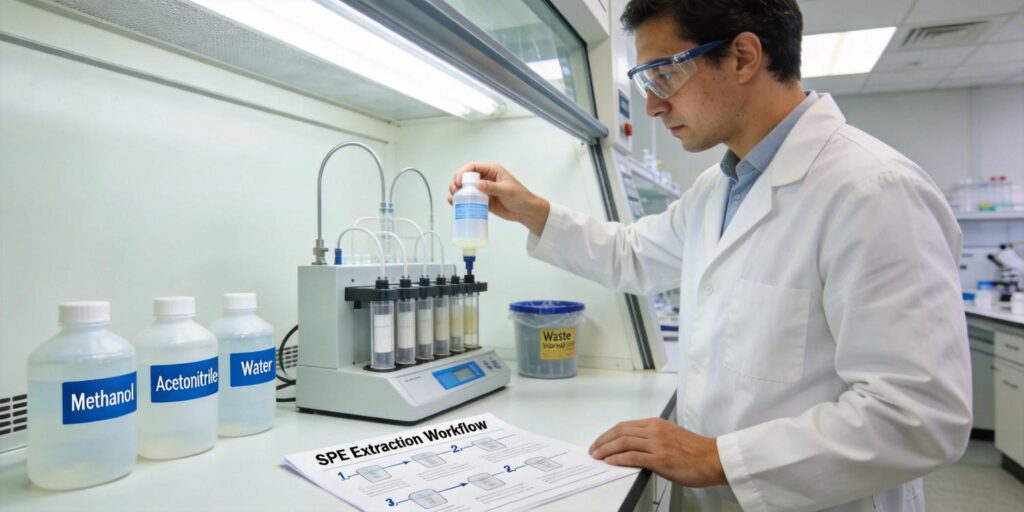
A systematic troubleshooting approach begins with identifying where analyte loss occurs. Collect all fractions (sample waste, wash fractions, and eluates) and perform mass balance calculations. This diagnostic step reveals whether low recovery stems from incomplete retention, wash step losses, or incomplete desorption.
For method optimization, follow this structured approach:
- Initial Screening: Test multiple sorbent types and pH values simultaneously
- Wash Optimization: Systematically test wash solvent compositions
- Elution Optimization: Evaluate elution solvent strength and volume
- Flow Rate Adjustment: Ensure optimal flow rates for each step
- Final Simplification: Reduce steps and volumes where possible
Practical tips include allowing cartridges to soak with eluent for 0.5-1 minute to improve recovery, using several smaller eluent aliquots rather than one large volume, and ensuring proper drying between aqueous and organic steps. Flow rates should be controlled carefully—dropwise flow when time permits, with maximum rates not exceeding 5 mL/min for most applications.
7. Validation Strategies After Optimization
Once optimization is complete, comprehensive validation ensures method robustness and reliability. Recovery should be evaluated based on signal-to-noise ratio (S/N) rather than absolute percentage alone. If acceptable detection limits are achieved at 30% recovery with no interfering compounds, higher recovery may not be necessary and could actually increase interferences.
Key validation parameters include:
- Precision: Replicate assays (4-6) of spiked samples
- Linearity: Across expected concentration range
- Selectivity: Against matrix interferences
- Robustness: To minor method variations
- Recovery Consistency: Across multiple batches and operators
Final optimization should consider practical aspects like reducing solvent consumption, minimizing processing time, and simplifying procedures for routine use. Remember that SPE today has become a precise science—if you’re not achieving at least 90% absolute recovery for your analyte, your method likely requires further optimization.
For laboratories using Poseidon Scientific SPE products including our HLB cartridges, MAX cartridges, MCX cartridges, WAX cartridges, WCX cartridges, and 96-well plates, these troubleshooting principles apply directly to achieving optimal performance from our engineered sorbent materials.