
1. Physicochemical Properties Influencing SPE Retention
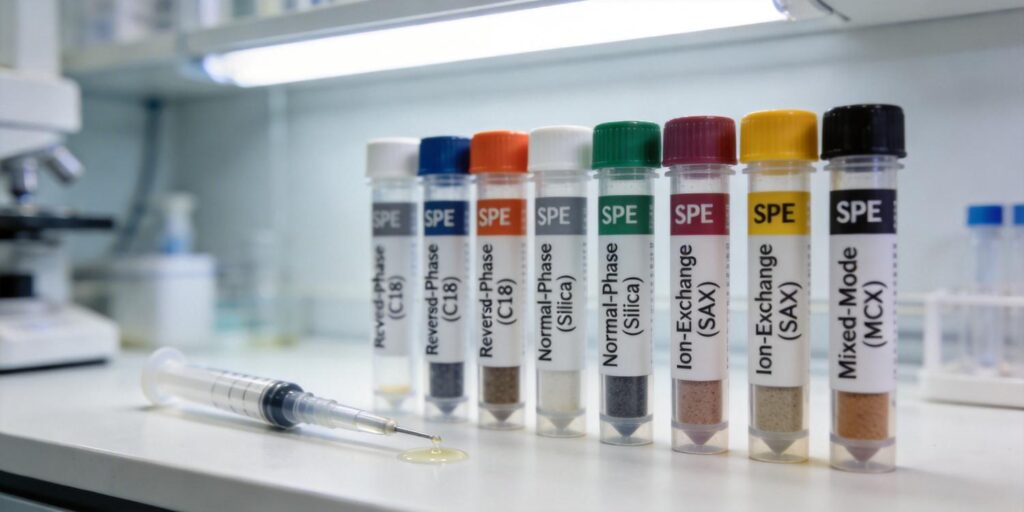
Solid-phase extraction (SPE) retention mechanisms are governed by fundamental physicochemical interactions between analytes and sorbent surfaces. Understanding these properties is crucial for selecting the appropriate SPE cartridge for polar versus nonpolar compounds. The primary retention mechanisms in SPE include:
Van der Waals (Non-polar/Hydrophobic) Interactions
These interactions, also known as dispersion forces, are the dominant mechanism for retaining nonpolar compounds. They occur between hydrocarbon chains on bonded silica sorbents (like C18, C8, C2) and nonpolar analytes such as hydrocarbons, fat-soluble vitamins, triglycerides, steroids, and phthalates. The strength of these interactions increases with the length of the bonded alkyl chain and the hydrophobicity of the analyte.
Dipole-Dipole and Hydrogen-Bonding (Polar) Interactions
Polar interactions involve dipole-dipole forces and hydrogen bonding between polar functional groups on the sorbent and analyte. These mechanisms are essential for retaining polar compounds like steroids, dioxins, amides, carbohydrates, and esters. Polar sorbents include silica (unbonded), alumina, Florisil, cyanopropyl (CN), and diol phases.
Ion-Exchange (Coulombic) Interactions
Ion-exchange mechanisms involve electrostatic interactions between charged sorbents and oppositely charged analytes. Strong cation exchange (SCX) sorbents like propylsulfonic acid (PRS) and ethylbenzene sulfonic acid retain cationic compounds, while strong anion exchange (SAX) sorbents like trimethylammonium propyl retain anionic compounds. Weak ion exchangers include diethylaminoethyl (DEA) for anions and carboxyethyl (CBA) for cations.
Secondary Interactions and Mixed-Mode Extraction
Secondary interactions often occur simultaneously with primary mechanisms. For example, silica-based sorbents contain silanol groups (Si-OH) that can form hydrogen bonds with polar analytes, even in reversed-phase applications. Mixed-mode sorbents combine multiple retention mechanisms, such as reversed-phase with ion exchange, providing superior selectivity for complex analyte mixtures.
2. Sorbent Chemistries Suited for Polar Analytes
Selecting the right sorbent chemistry is critical for effective extraction of polar compounds. The following sorbents are specifically designed for polar analyte retention:
Silica (SI)
Unbonded silica is a classic polar sorbent with surface silanol groups that interact with polar analytes through hydrogen bonding and dipole-dipole interactions. It’s particularly effective for extracting polar compounds from nonpolar organic matrices.
Alumina (AL) and Florisil (FL)
These unbonded oxide materials offer polar surfaces with varying degrees of acidity/basicity. Alumina exists in acidic, neutral, and basic forms, allowing pH-dependent selectivity. Florisil (magnesium silicate) provides moderate polarity suitable for various polar compounds.
Cyanopropyl (CN)
The cyano group (-CN) provides moderate polarity and can function as both a polar and weak nonpolar sorbent. CN phases are particularly useful for compounds with both polar and nonpolar characteristics.
Diol (20H)
Diol phases contain hydroxyl groups that form strong hydrogen bonds with polar analytes. They’re excellent for extracting compounds with hydroxyl, amino, or carbonyl functional groups from nonpolar matrices.
Aminopropyl (NH2)
This weak anion exchanger can function as both an ion-exchange and polar sorbent. When un-ionized, it acts as a polar phase through hydrogen bonding with its amino groups.
Polymer-Based Sorbents
Porous polymers like poly(2,6-diphenyl-p-phenylene oxide) (Tenax) provide polar interactions through dipole-type interactions and weak hydrogen-bond acidity. These materials often exhibit better retention for polar compounds than silica-based sorbents in aqueous environments.
3. Cartridges Designed for Hydrophobic Compounds
Alkyl-Bonded Silica Phases
Hydrophobic SPE cartridges utilize alkyl chains bonded to silica surfaces. The most common include:
- C18 (Octadecyl): The most widely used reversed-phase sorbent with 18-carbon chains providing strong hydrophobic interactions
- C8 (Octyl): Moderate hydrophobicity with 8-carbon chains, offering slightly different selectivity than C18
- C4, C2, C1: Shorter alkyl chains providing weaker hydrophobic interactions for more polar compounds
- Phenyl (PH): Aromatic rings providing π-π interactions with aromatic analytes
- Cyclohexyl (CH): Cyclic hydrocarbon phase offering unique selectivity
Endcapped vs. Unendcapped Columns
Endcapping refers to the chemical treatment of residual silanol groups after alkyl bonding. Endcapped columns (with no remaining hydroxyl sites) are more hydrophobic, while unendcapped columns retain some hydrophilic character due to exposed silanols.
Carbon-Based Sorbents
Porous graphitized carbons provide strong hydrophobic interactions through their graphite-like surfaces. They often exhibit different selectivity compared to alkyl-bonded silicas and can retain very hydrophobic compounds effectively.
Polymeric Reversed-Phase Sorbents
Hydrophobic polymers like polystyrene-divinylbenzene offer pure hydrophobic interactions without silanol effects. They typically have higher capacity and better pH stability than silica-based sorbents.
4. Mixed-Mode Sorbents for Complex Analyte Mixtures
Mixed-mode sorbents combine multiple retention mechanisms in a single cartridge, providing unparalleled selectivity for complex samples. These are particularly valuable when analytes have diverse physicochemical properties.
Reversed-Phase/Ion-Exchange Combinations
The most common mixed-mode configurations combine hydrophobic interactions with ion exchange. Examples include:
- MCX (Mixed-mode Cation Exchange): Combines hydrophobic (C8 or similar) with strong cation exchange (sulfonic acid) functionalities
- MAX (Mixed-mode Anion Exchange): Combines hydrophobic with strong anion exchange (quaternary amine) groups
- WCX (Weak Cation Exchange): Combines hydrophobic with weak cation exchange (carboxylic acid) functionalities
- WAX (Weak Anion Exchange): Combines hydrophobic with weak anion exchange (primary/secondary amine) groups
HLB (Hydrophilic-Lipophilic Balance)
HLB sorbents use a proprietary polymer that balances hydrophilic and lipophilic properties. They can retain both polar and nonpolar compounds simultaneously, making them ideal for broad-spectrum extractions.
Advantages of Mixed-Mode Sorbents
- Enhanced Selectivity: Multiple retention mechanisms allow selective extraction of target analytes while removing interferences
- Superior Clean-up: Strong washes can be used without losing target analytes due to multiple binding mechanisms
- Higher Capacity: Multiple interaction sites increase overall binding capacity
- pH Flexibility: Can extract compounds over wider pH ranges by utilizing different mechanisms
- Reduced Matrix Effects: Better removal of matrix components leads to cleaner extracts
5. Solvent Selection for Loading and Washing Steps
Conditioning Solvents
Proper conditioning is essential for activating sorbent surfaces:
- Reversed-Phase Cartridges: Typically conditioned with methanol (or acetonitrile) followed by water or aqueous buffer. Methanol wets the hydrophobic surface, allowing aqueous samples to penetrate the bonded phase.
- Normal-Phase Cartridges: Conditioned with the nonpolar organic solvent to be used in the extraction (e.g., hexane, toluene).
- Ion-Exchange Cartridges: Conditioned with buffer at the appropriate pH to ensure proper ionization of functional groups.
Sample Loading Solvents
The sample solvent must be compatible with the retention mechanism:
- Reversed-Phase: Samples should be in aqueous or polar organic solvents (water, buffer, methanol-water mixtures). Organic content should typically be <10% to ensure strong retention.
- Normal-Phase: Samples should be in nonpolar organic solvents (hexane, chloroform, ethyl acetate).
- Ion-Exchange: Samples should be in aqueous buffers at pH values that ensure proper ionization of both sorbent and analyte.
Washing Solvents
Washing removes interferences while retaining target analytes:
- Reversed-Phase: Typically washed with water or aqueous buffers containing 5-20% organic solvent (methanol, acetonitrile). The organic content should be strong enough to remove interferences but weak enough to retain analytes.
- Normal-Phase: Washed with the same nonpolar solvent used for loading or slightly more polar mixtures to remove weakly retained compounds.
- Ion-Exchange: Washed with buffer at the same pH as loading, sometimes with added organic solvent or competing ions to remove non-specifically bound compounds.
Elution Solvents
Elution disrupts the primary retention mechanism:
- Polar Compounds from Polar Sorbents: Use polar solvents like methanol, acetonitrile, or ethanol, often with added acid/base or water to disrupt hydrogen bonding.
- Nonpolar Compounds from Hydrophobic Sorbents: Use nonpolar solvents like chloroform, cyclohexane, ethyl acetate, or mixtures like dichloromethane-acetone.
- Ion-Exchange: Use buffers with competing ions (high salt concentration) or pH changes to neutralize charges.
- Mixed-Mode: Often require sequential elution with different solvents to disrupt multiple binding mechanisms.
6. Case Examples in Environmental and Pharmaceutical Analysis
Environmental Analysis: Pesticides in Water
For polar pesticides like atrazine degradation products (ammeline, ammelide, cyanuric acid), polar sorbents like silica or polymer-based materials are preferred. Liska et al. (1990) compared sorbents for polar compounds from water and found porous polymers often outperformed silica-based materials for highly polar analytes. The extraction typically involves:
- Conditioning with methanol followed by water
- Loading large volumes of water sample (100-1000 mL)
- Washing with water or mild organic-aqueous mixtures
- Eluting with methanol or acetonitrile, often with acid/base modifiers
Pharmaceutical Analysis: Opiates in Urine
A classic SPE method for opiates uses C18 reversed-phase cartridges:
- Condition with 2 × 3 mL methanol, then 2 × 3 mL water, then 2 × 5 mL pH 9.5 water (NH₄OH adjusted)
- Adjust 10 mL urine to pH 9.5 with saturated NH₄Cl and NH₄OH
- Load sample at 1.0 mL/min
- Wash with 2 × 5 mL distilled water
- Dry column with air for 15-30 minutes
- Elute with 2 × 750 μL 50:50 dichloromethane-acetone
- Evaporate and derivatize for GC analysis
Mixed-Mode Application: Basic Drugs from Biological Fluids
For basic drugs with both hydrophobic and cationic properties, MCX (mixed-mode cation exchange) cartridges provide excellent clean-up:
- Condition with methanol and pH-adjusted buffer
- Load sample in acidic conditions (pH 2-3) to protonate basic drugs
- Wash with acidic aqueous solution to remove neutral and acidic interferences
- Wash with methanol to remove hydrophobic interferences
- Elute with basic organic solvent (e.g., 5% NH₄OH in methanol) to neutralize cation exchange and disrupt hydrophobic interactions
7. Decision Framework for Cartridge Selection
Step 1: Analyze Analyte Properties
Determine key physicochemical properties:
- Polarity: Assess functional groups, log P/D values, solubility
- Ionization State: Determine pKa values and predominant form at sample pH
- Molecular Size: Consider molecular weight and steric factors
- Hydrogen Bonding Capacity: Evaluate hydrogen bond donor/acceptor properties
Step 2: Evaluate Sample Matrix
Consider matrix effects:
- Matrix Composition: Aqueous, organic, biological, environmental
- pH and Ionic Strength: Current conditions and adjustability
- Interfering Compounds: Types and concentrations of matrix components
- Sample Volume: Available amount and required concentration factor
Step 3: Select Primary Retention Mechanism
Choose based on analyte properties:
| Analyte Type | Primary Mechanism | Recommended Sorbents |
|---|---|---|
| Nonpolar/Neutral | Reversed-Phase | C18, C8, C2, Phenyl, Cyclohexyl |
| Polar/Neutral | Normal-Phase | Silica, Diol, CN, Alumina, Florisil |
| Acidic (anionic) | Anion Exchange | SAX, WAX, MAX |
| Basic (cationic) | Cation Exchange | SCX, WCX, MCX |
| Mixed Properties | Mixed-Mode | HLB, MCX, MAX, WCX, WAX |
Step 4: Consider Secondary Interactions
Evaluate potential secondary binding mechanisms that could affect recovery or selectivity. For silica-based sorbents, consider silanol interactions. For ion-exchange sorbents, consider hydrophobic secondary interactions.
Step 5: Optimize Solvent Conditions
Develop solvent scheme based on selected mechanism:
- Choose conditioning solvents that activate the sorbent without causing analyte loss
- Adjust sample to optimal pH and solvent composition for strong retention
- Select washing solvents that remove interferences while retaining analytes
- Determine elution solvents that provide quantitative recovery with minimal co-elution of interferences
Step 6: Validate and Troubleshoot
Test the selected method with standards and real samples:
- Check recovery with neat standards in compatible solvents
- Test with spiked matrix samples to evaluate matrix effects
- Optimize flow rates and volumes for each step
- Evaluate method robustness to pH, temperature, and solvent variations
- Consider automation compatibility if needed
Step 7: Consider Practical Factors
Final selection should balance performance with practical considerations:
- Cost: Sorbent price and solvent consumption
- Throughput: Processing time and automation potential
- Availability: Commercial availability and lot-to-lot consistency
- Compatibility: With downstream analytical techniques
- Regulatory Compliance: Meeting method validation requirements
By following this systematic approach, analysts can select the optimal SPE cartridge for their specific application, whether extracting polar pharmaceuticals from biological fluids or nonpolar environmental contaminants from water samples. The key is matching the sorbent chemistry to the analyte properties while considering the practical constraints of the analysis.


