
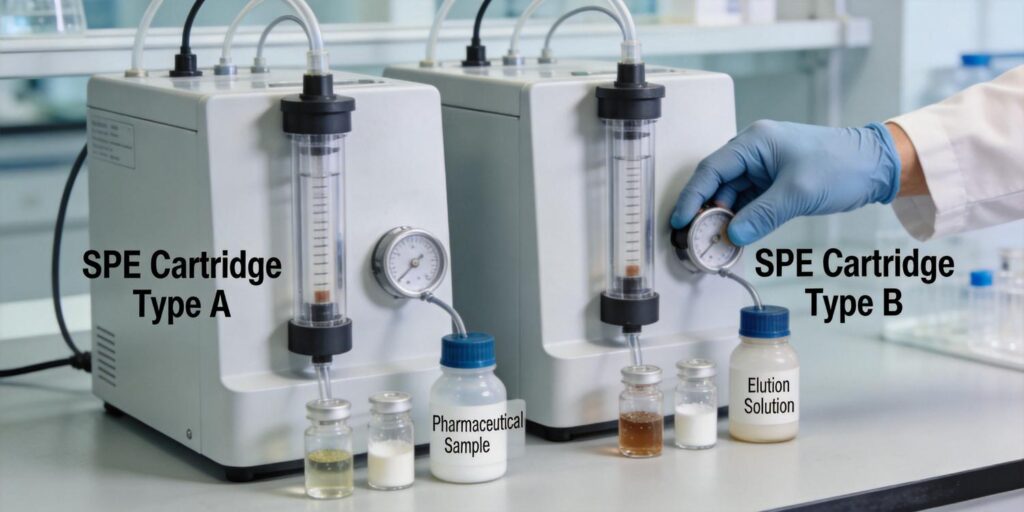
Chemical Differences Between HLB Polymeric Sorbents and Silica C18
Understanding the fundamental chemical differences between HLB (Hydrophilic-Lipophilic Balance) polymeric sorbents and silica-based C18 phases is crucial for selecting the optimal SPE cartridge for pharmaceutical analysis. HLB sorbents are typically composed of a poly(divinylbenzene-co-N-vinylpyrrolidone) copolymer, creating a balanced hydrophilic-lipophilic structure that provides dual retention mechanisms. In contrast, C18 sorbents consist of silica particles chemically bonded with octadecylsilane (C18) chains through siloxane linkages.
The silica backbone of C18 phases presents inherent limitations due to residual silanol groups (Si-OH) that remain after bonding. As noted in SPE literature, “the simple description of the common silica-based sorbent as C18 covers a range of literally hundreds of commercially available bonded phases with their own, unique sorbent properties.” These residual silanols can cause secondary interactions, particularly with basic compounds, leading to unpredictable retention behavior and potential recovery issues.
HLB polymeric sorbents eliminate this concern entirely by using a polymer matrix that contains no residual silanol groups. The balanced structure provides both hydrophilic (N-vinylpyrrolidone) and lipophilic (divinylbenzene) domains, allowing for retention of compounds across a wide polarity range without pH-dependent ionization limitations.
Retention Mechanisms for Polar and Nonpolar Drugs
The retention mechanisms employed by HLB and C18 cartridges differ significantly, particularly when dealing with polar pharmaceutical compounds. C18 phases primarily rely on hydrophobic (van der Waals) interactions for retention, which works well for nonpolar compounds but presents challenges for polar drugs. As documented in SPE technology guides, “hydrocarbons, fat-soluble vitamins, triglycerides, steroids, aflatoxins, and phthalates” are typically retained through these non-polar interactions.
For polar drugs, C18 retention often requires careful pH adjustment to suppress ionization and enhance hydrophobic character. However, this approach has limitations, especially for highly polar compounds with log P values below zero. Research shows that “very hydrophilic analytes can be difficult to retain on reversed-phase silica sorbents, and in such cases the use of an ion pairing agent in the dilution buffer is an option.”
HLB sorbents overcome these limitations through multiple retention mechanisms. The hydrophilic N-vinylpyrrolidone domains provide hydrogen bonding and dipole-dipole interactions that effectively retain polar compounds, while the lipophilic divinylbenzene domains offer traditional hydrophobic retention for nonpolar drugs. This dual-mode retention allows HLB cartridges to extract compounds across a broader polarity spectrum without requiring extensive method optimization.
Advantages of Polymeric Sorbents in pH Stability
One of the most significant advantages of HLB polymeric sorbents over silica-based C18 phases is their exceptional pH stability. Silica-based sorbents have a limited pH operating range (typically pH 2-8) due to the susceptibility of siloxane bonds to hydrolysis under acidic or basic conditions. Outside this range, C18 ligands can cleave from the silica surface, leading to reduced capacity and potential contamination of extracts.
HLB polymeric sorbents maintain stability across the entire pH range (pH 0-14), enabling extraction methods that require extreme pH conditions for optimal recovery. This characteristic is particularly valuable in pharmaceutical analysis where:
- Acidic drugs may require low pH for protonation and retention
- Basic drugs may need high pH for deprotonation and elution
- Matrix components may necessitate aggressive pH conditions for effective cleanup
This pH stability also contributes to longer column life and more consistent performance across multiple extractions, as demonstrated in studies showing that “good extraction yields can be obtained with excellent reproducibilities” across different lots of polymeric sorbents.
Sample Preparation Workflows Using Each Cartridge Type
C18 SPE Workflow for Pharmaceutical Analysis
Traditional C18 SPE workflows typically follow a standardized approach: conditioning with methanol and water, sample loading under appropriate pH conditions, washing with water or aqueous-organic mixtures, and elution with organic solvents. For basic drugs, methods often include triethylamine or other amine modifiers to overcome secondary interactions with residual silanols.
A typical C18 method for basic drugs might include: “conditioning with methanol and water, applying the sample under acidic conditions (pH approximately 6), washing with appropriate solvents, and eluting with methanol containing ammonia.” This approach leverages both hydrophobic and secondary cation-exchange interactions for comprehensive drug recovery.
HLB SPE Workflow Advantages
HLB workflows offer greater flexibility and simplicity. The balanced retention mechanism allows for:
- Conditioning with methanol followed by water or buffer
- Sample loading without strict pH requirements
- Effective washing with water or low-percentage organic solvents
- Efficient elution with common organic solvents
The absence of secondary interactions eliminates the need for complex modifier strategies, simplifying method development and validation. Studies comparing extraction methods have shown that “mixed-mode cartridges provided cleaner extracts than liquid-liquid extraction was able to deliver,” highlighting the efficiency of modern polymeric sorbents.
Recovery Comparisons for Common Pharmaceutical Compounds
Comparative studies reveal significant differences in recovery performance between HLB and C18 cartridges for various pharmaceutical compounds. Research examining serum recoveries of basic compounds demonstrated that “there is no good or bad sorbent,” but recovery variations can be substantial depending on the specific drug and sorbent combination.
For acidic drugs like NSAIDs, studies show that “the SPE of acidic drugs on a neutral phase offers the opportunity for improved recovery of such compounds. Intra- and intermolecular hydrogen bonding and pseudo-zwitterionic interactions are minimized as the sorbent and, in some cases, the eluting solvent may be regarded as aprotic.”
HLB sorbents typically show superior recovery for polar and moderately polar compounds, while C18 phases may excel with highly nonpolar drugs. However, the pH stability of HLB sorbents often provides more consistent recoveries across different drug classes and sample matrices. Data from comparative studies indicate that “recoveries exceeding 90%” are achievable with properly optimized SPE methods using either sorbent type, though HLB often requires less optimization to achieve these results.
Matrix Cleanup Efficiency Differences
Matrix cleanup efficiency represents another critical differentiator between HLB and C18 cartridges. C18 phases, with their primarily hydrophobic retention mechanism, can effectively remove nonpolar interferences but may struggle with polar matrix components. This limitation becomes particularly apparent in biological samples where endogenous acids, salts, and polar metabolites can co-elute with target analytes.
HLB sorbents offer superior cleanup capabilities due to their balanced retention profile. The hydrophilic domains effectively retain polar interferences that might pass through C18 phases, while the lipophilic domains capture nonpolar matrix components. This dual retention results in cleaner extracts with reduced matrix effects, particularly important for sensitive detection methods like LC-MS/MS.
Research comparing extraction techniques has demonstrated that “SPE has been shown to significantly increase gas (GC) and liquid chromatography (LC) column life while reducing the downtime on equipment like gas chromatography and liquid chromatography mass spectrometers (GCMS and LCMS) for source cleaning.” The improved cleanup efficiency of HLB sorbents further enhances these benefits.
Choosing the Right Cartridge for LC-MS Drug Assays
When to Select C18 Cartridges
C18 cartridges remain the preferred choice for specific applications in pharmaceutical analysis:
- Highly nonpolar drug compounds with log P > 3
- Methods requiring established, well-characterized protocols
- Applications where cost is a primary consideration
- Extractions within the pH 2-8 range with minimal polar interferences
For these applications, C18 phases provide reliable performance with extensive literature support and method validation data.
When HLB Cartridges Excel
HLB polymeric sorbents offer distinct advantages for modern pharmaceutical analysis, particularly for LC-MS drug assays:
- Broad-spectrum drug screening: The dual retention mechanism allows simultaneous extraction of acidic, basic, and neutral drugs without pH optimization
- Polar drug analysis: Superior retention of hydrophilic compounds that challenge traditional C18 phases
- Complex matrices: Enhanced cleanup efficiency for biological samples with diverse endogenous components
- Method robustness: pH stability ensures consistent performance across varying sample conditions
- Reduced matrix effects: Cleaner extracts minimize ionization suppression in LC-MS analysis
As noted in SPE optimization guidelines, “if you are not getting 90% absolute recovery of your analyte, your method is not optimized.” HLB sorbents often reach this threshold with less method development effort, particularly for challenging drug compounds.
Practical Considerations for Method Development
When developing SPE methods for pharmaceutical analysis, consider these practical guidelines:
- Start with HLB for unknown or mixed drug classes to leverage its broad retention capabilities
- Use C18 for specific, well-characterized nonpolar drug assays where cost-effectiveness is paramount
- Evaluate both sorbent types during method development for optimal recovery and cleanup
- Consider the total cost of analysis, including method development time and potential rework
- Validate method performance across multiple lots to ensure consistency
The choice between HLB and C18 ultimately depends on the specific analytical requirements, drug properties, sample matrix, and detection methodology. For most modern pharmaceutical applications, particularly those involving LC-MS analysis of diverse drug panels, HLB polymeric sorbents offer compelling advantages in recovery, cleanup efficiency, and method robustness.
For comprehensive SPE solutions including HLB, MCX, WAX, and WCX cartridges, explore our complete product line at Poseidon Scientific SPE Products.


