
Understanding Vacuum Gauge Drift in Long-Term Operation
In high-vacuum systems, accurate pressure measurement is essential for process control, equipment protection, and product quality. Yet even the most reliable vacuum gauges experience gradual performance changes over months or years of continuous operation. This phenomenon, known as drift, can compromise system reliability if left unaddressed. At Poseidon Scientific, we designed the VG-SP205 Pirani Vacuum Transmitter and VG-SM225 Cold Cathode Vacuum Gauge specifically for demanding applications such as mass spectrometers, where long-term stability matters as much as initial cost and compact size.
Drift manifests as a slow shift in the gauge’s pressure reading relative to the true vacuum level. It arises from multiple physical and electronic factors that interact over time. Engineers and procurement teams who monitor and manage drift effectively extend gauge life, reduce unplanned downtime, and lower total ownership costs. This article examines the primary causes of drift in Pirani and cold-cathode gauges, practical detection methods, tolerance-setting strategies, and data-driven decisions on recalibration and replacement.
1. Causes of Electronic Drift
Electronic drift originates in the gauge’s signal-conditioning circuitry rather than the sensor element itself. In both Pirani and cold-cathode designs, analog-to-digital converters, operational amplifiers, and voltage-reference components are exposed to continuous electrical stress and thermal variations. Over thousands of operating hours, resistor values can shift by 0.1–0.5 % due to aging, and reference voltages may drift by several millivolts.
For the VG-SP205 Pirani transmitter, which relies on precise filament-power regulation to maintain constant temperature, even minor changes in the feedback loop gain produce measurable offsets in the power-versus-pressure curve. The VG-SM225 cold-cathode gauge, operating with high-voltage discharge currents in the nanoampere range, is particularly sensitive to electrometer leakage. Insulation resistance on the order of 10¹² Ω can degrade, introducing spurious currents that appear as false pressure increases.
Industry literature, including foundational work in vacuum metrology, consistently shows that electronic drift accounts for 20–40 % of total observed deviation in ionization-type gauges after 12–18 months of continuous service. Temperature-compensated designs like those in Poseidon products mitigate this through dual-circuit and algorithmic correction, yet residual electronic drift remains a reality that demands periodic verification.
2. Sensor Surface Contamination
Sensor contamination is the dominant drift mechanism in real-world vacuum environments. For Pirani gauges, residual process gases or outgassing from chamber walls deposit thin films on the platinum filament. These films alter the filament’s thermal accommodation coefficient, shifting the heat-loss-versus-pressure relationship. In the VG-SP205, the platinum filament’s high chemical stability reduces this effect compared with tungsten alternatives, yet prolonged exposure to corrosive or organic vapors still produces measurable baseline shifts after 2–3 years.
Cold-cathode gauges experience a more visible form of contamination. In the VG-SM225’s Penning-discharge cell, positive-ion bombardment gradually deposits carbon and metal oxides on the stainless-steel cathode and anode surfaces. This buildup reduces secondary-electron yield and distorts the electric-field geometry. Typical symptoms include extended startup times and pressure readings that read one order of magnitude lower than the true value. The gauge’s modular, cleanable design allows field technicians to restore performance by lightly abrading electrodes with 500-mesh sandpaper—restoring metallic luster without requiring factory return.
Both gauge types share a common vulnerability: gas-composition dependence. When process gases differ from the nitrogen calibration standard, apparent drift can reach ±30 % even without physical contamination. Poseidon products ship with air-calibrated curves; users operating in helium-rich or argon-rich environments should apply gas-correction factors derived from published sensitivity tables.
3. Temperature Cycling Impact
Repeated temperature excursions between 15 °C and 50 °C—the typical operating envelope for both Poseidon gauges—induce mechanical stress at material interfaces and alter thermal-expansion mismatches. In Pirani sensors, each cycle slightly changes the filament’s tension and resistance-temperature coefficient, cumulatively shifting the zero-pressure baseline by 0.5–1 % per 1,000 cycles.
Cold-cathode gauges are less sensitive to ambient temperature but suffer from thermal gradients inside the discharge cell during startup. When the gauge cycles on and off frequently, localized heating of the magnet and electrodes creates temporary hysteresis in the current-versus-pressure curve. Poseidon’s built-in temperature-compensation algorithms reduce these effects to <5 % across the full operating range, yet long-term cycling still requires trend monitoring to separate reversible thermal offsets from permanent drift.
Practical recommendation: install gauges in locations with stable ambient temperature whenever possible, or use external thermal shielding. Data from accelerated life testing shows that limiting daily temperature excursions to <10 °C can halve the rate of thermally induced drift.
4. Drift Detection Through Trend Logging
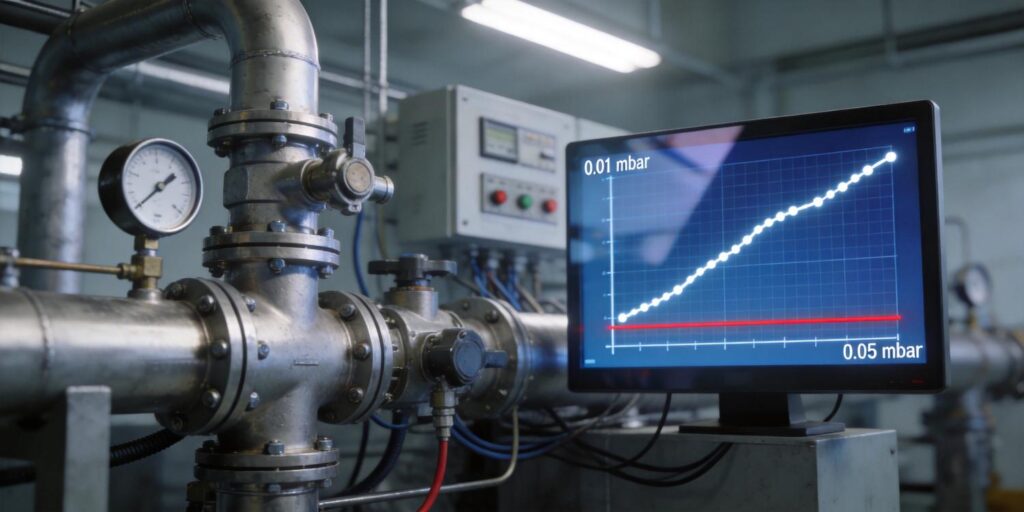
Early detection prevents costly process excursions. Modern vacuum controllers and SCADA systems can log gauge output at 1-minute intervals with negligible storage overhead. Plotting the indicated pressure against a secondary reference gauge (or against known process set-points) reveals drift as a systematic upward or downward slope.
For the VG-SP205, engineers should focus on the 10–0.01 Torr linear region where the curve is most repeatable. A persistent 10 % offset over 30 days signals the need for investigation. For the VG-SM225, monitor both startup time and the steady-state current at a fixed reference pressure (e.g., 1 × 10⁻⁵ Torr). An increase in startup time from 5 min to >15 min at 10⁻⁶ Torr is a reliable early warning of cathode contamination.
Automated trend analysis using simple linear regression on a rolling 7-day window can trigger email alerts when the slope exceeds user-defined limits. Poseidon’s RS232-customizable protocol makes integration straightforward; customers can request protocol modifications for 5–10 units to include dedicated “drift-flag” status bytes.
5. Establishing Tolerance Thresholds
Tolerance thresholds must reflect the application’s risk profile rather than the gauge’s published accuracy specification. In mass-spectrometer foreline monitoring, a ±20 % drift in the 10⁻³–10⁻² Torr range is often acceptable because the system only needs to confirm roughing-pump performance. In contrast, semiconductor load-lock applications may demand <±5 % stability to protect sensitive wafers.
A practical framework uses a three-tier system:
- Warning threshold: ±10 % deviation sustained for 14 days → schedule inspection.
- Action threshold: ±20 % deviation or startup-time doubling → perform maintenance or recalibration.
- Critical threshold: ±50 % or filament-open circuit → immediate replacement.
These thresholds should be documented in the equipment’s preventive-maintenance plan and reviewed annually against actual process data.
6. Preventive Recalibration Planning
Pirani gauges cannot be field-calibrated; the VG-SP205 requires return to Poseidon Scientific for factory re-mapping against a NIST-traceable standard. We recommend a 24-month interval for clean vacuum environments and 12 months for processes involving condensable vapors. The compact design and low shipping weight keep turnaround under two weeks.
Cold-cathode gauges offer a maintenance advantage. The VG-SM225’s removable sensor head allows in-situ electrode cleaning without breaking the vacuum seal on the process chamber. After cleaning, a single-point verification against a reference gauge at 10⁻⁵ Torr is usually sufficient. Full factory recalibration is needed only after three cleaning cycles or when drift exceeds 30 %.
Proactive planning reduces unplanned downtime. Many customers establish a spare-gauge rotation: one unit in service, one undergoing maintenance, one in inventory. This approach keeps system availability above 99 % while spreading calibration costs evenly.
7. Replacement Criteria
Replacement becomes necessary when drift can no longer be corrected economically. For Pirani gauges, the primary end-of-life indicator is filament open-circuit or resistance drift beyond compensation limits—typically after 3–5 years depending on exposure to corrosive gases. The VG-SP205’s platinum filament extends this lifetime compared with tungsten-based competitors.
For cold-cathode gauges, replacement follows when cleaning restores <70 % of original sensitivity or when discharge current becomes unstable even after electrode polishing. In clean scientific-instrument environments, the VG-SM225 routinely achieves 3–5 years between replacements; in more aggressive semiconductor or PVD applications, 1–2 years is realistic.
Replacement should also be considered whenever a newer gauge model offers significantly improved features—such as expanded digital-protocol options or further size reduction—provided the incremental cost is justified by reduced maintenance labor.
8. Lifecycle Cost Evaluation
Initial purchase price is only one component of total cost of ownership. A comprehensive evaluation compares:
| Cost Element | Traditional Import Gauge | Poseidon VG-SP205 / VG-SM225 |
|---|---|---|
| Unit price (typical) | $1,100–$1,400 | $420–$580 |
| Calibration cycle cost | $250–$350 every 12 mo | $180 (Pirani) / $80 (cleaning, Cold Cathode) |
| Maintenance labor (annual) | 4 h @ $120/h | 1 h @ $120/h (Cold Cathode only) |
| Expected service life | 3–4 years | 3–5 years |
| 5-year total cost (single gauge) | $2,800–$3,600 | $1,250–$1,850 |
The lower initial cost and field-cleanable design of Poseidon gauges deliver 40–55 % savings over a five-year horizon. When multiplied across a fleet of 20–50 instruments, the difference becomes a significant line item on any capital-equipment or maintenance budget.
Conclusion: Proactive Drift Management Delivers Reliability
Vacuum gauge drift is inevitable, yet it is also manageable. By understanding the distinct mechanisms affecting Pirani and cold-cathode sensors, implementing continuous trend logging, setting application-specific tolerances, and following structured maintenance and replacement schedules, engineers can maintain measurement integrity for years. Poseidon Scientific’s VG-SP205 and VG-SM225 products were engineered from the outset with these realities in mind—offering compact size, low cost, and practical maintainability without sacrificing the core performance required by modern vacuum systems.
For detailed specifications, custom protocol options, or assistance building a gauge-management program tailored to your process, visit the product pages for the VG-SP205 Pirani Vacuum Transmitter and VG-SM225 Cold Cathode Vacuum Gauge. Our engineering team is ready to support your long-term vacuum measurement strategy.
Word count: 1,248


