Introduction
The cold cathode ionization gauge is a cornerstone of high-vacuum measurement, offering reliable pressure readings from 10−7 to 10−3 Torr without the filament-related limitations of hot-cathode designs. At Poseidon Scientific, we developed the VG-SM225 Cold Cathode Vacuum Gauge around the proven inverted-magnetron geometry to deliver stable, low-maintenance performance for semiconductor research, PVD systems, vacuum furnaces, and analytical instruments.
This technical overview explains the fundamental physics step by step: how ionization occurs, why the magnetic field is essential, how electrons follow spiral trajectories, how the self-sustaining plasma forms, why the output is logarithmic, what causes startup delay, and where the gauge excels in real laboratory and industrial applications. The principles described here are grounded in decades of vacuum metrology literature, including the classic treatments in Foundations of Vacuum Science and Technology (Lafferty, 1998) and the foundational work on inverted-magnetron gauges.
Whether you are specifying a new system or troubleshooting an existing one, understanding these mechanisms helps you maximize gauge accuracy and longevity.
The Ionization Principle
At its core, a cold cathode gauge measures pressure by counting positive ions produced when energetic electrons collide with residual gas molecules. Unlike hot-cathode gauges, electrons are not emitted from a heated filament. Instead, a high negative voltage (typically −2000 to −2500 V on the VG-SM225) applied to the cathode extracts free electrons through field emission or cosmic-ray seeding.
Each electron accelerates toward the anode and collides with gas molecules. If the electron energy exceeds the ionization potential of the gas (≈12–15 eV for common species), it ejects an additional electron and creates a positive ion. The ion is collected at the cathode, producing a measurable current directly proportional to gas density—and therefore pressure. Because the process is self-sustaining, the gauge requires no hot filament, eliminating outgassing, filament burnout, and decomposition of reactive gases such as oxygen or halogens.
This ionization mechanism gives the cold cathode gauge its robustness in aggressive environments while maintaining sensitivity down to 10−7 Torr.
The Critical Role of the Magnetic Field
The magnetic field is what transforms a simple discharge into a highly efficient ionization sensor. In the VG-SM225 inverted-magnetron design, a pair of ring magnets produces an axial field of approximately 1200 gauss along the cathode–anode axis. This field interacts with the radial electric field to create crossed E × B conditions.
Without the magnetic field, electrons would travel straight from cathode to anode in microseconds, producing very few ions. The axial B-field forces each electron into a cycloidal or helical path, dramatically increasing its residence time and collision probability inside the gauge volume. The longer path length—often several kilometers at 10−7 Torr—raises ionization efficiency by orders of magnitude compared with a non-magnetic discharge.
The magnetic field strength is carefully optimized: too weak and electrons escape; too strong and the discharge becomes unstable. At the VG-SM225’s operating point, the field confines electrons effectively while keeping the ion-current-versus-pressure relationship reproducible and nearly linear in the most useful range.
Electron Spiral Motion
Electron motion in the gauge follows the Lorentz force equation:
F = q(E + v × B)where q is the electron charge, E the electric field, v the velocity vector, and B the magnetic field. The crossed fields cause electrons to drift in a cycloidal “spiral” or “pendulum” orbit around the cathode while oscillating axially between the end plates.
In the VG-SM225 geometry, electrons emitted near the cathode surface execute short cycloidal arcs. If they ionize a molecule during the first arc, the new electron restarts its motion with thermal energy. Escaped or newly created electrons then follow longer hypocycloidal paths that circle the cathode many times before reaching the anode. This extended trajectory is the key to the gauge’s high sensitivity: an electron may travel kilometers before being collected, colliding with gas molecules thousands of times even at 10−7 Torr.
Finite-element modeling (similar to the COMSOL studies performed during VG-SM225 development) confirms that the spiral paths are tightly confined between the cathode end plates, maximizing ionization within the small sensor volume of only a few cubic centimeters.
Plasma Formation and Self-Sustaining Discharge
Once sufficient ions and secondary electrons are generated, the discharge transitions into a self-sustaining plasma. The initial electrons trigger an avalanche: each ionization event produces more electrons, which in turn create more ions. Space charge builds until the ion current stabilizes at a value determined solely by pressure.
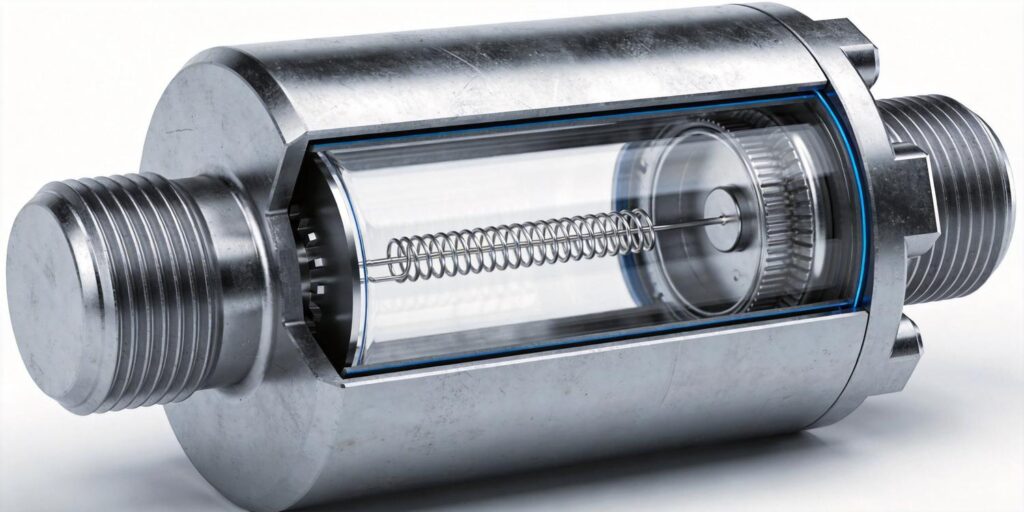
In the VG-SM225, the anode is a central wire surrounded by a cylindrical cathode, with guard electrodes suppressing spurious field-emission currents. This inverted-magnetron configuration produces a stable, low-noise plasma over the entire operating range. The collected ion current follows I ≈ kP (nearly linear) above ≈10−8 Torr; below this point the exponent increases slightly, but the logarithmic scaling of the output compensates perfectly.
The absence of a hot filament means the plasma starts from ambient electrons and remains “cold,” avoiding the thermal desorption and x-ray limits that constrain hot-cathode gauges at ultra-high vacuum.
Logarithmic Output Explanation
The VG-SM225 converts the ion current into a logarithmic 0–10 V analog signal with a fixed slope of 1.33 V per decade of pressure. This scaling matches the exponential relationship between pressure and ion current, giving uniform resolution across six decades and simplifying PLC or data-acquisition programming.
The effective voltage range is 2.0–9.6 V. The conversion formula is:
Pressure (Torr) = 10^((V_out - 7.75) / 1.33)Engineers simply feed the voltage into a single LOG10 function block—no lookup tables or piecewise linearization required. The logarithmic output also mirrors the decades-wide vacuum scale used in process charts and trending software, making real-time monitoring intuitive and accurate. Status LEDs and error voltages (<2 V) provide immediate fault indication without additional wiring.
Startup Delay Explanation
At high pressure the discharge ignites almost instantly because abundant molecules supply initiating electrons. As pressure drops, the probability of an initial ionizing collision decreases, extending the time required to build the avalanche. Typical delays for the VG-SM225 are:
- ≈2 s at 10−4 Torr
- ≈1 min at 10−5 Torr
- ≈5 min at 10−6 Torr
This is a fundamental physical limit of any cold-cathode gauge, not a fault. The red status LED flashes until the discharge stabilizes, giving operators and automation systems a clear visual cue. In practice, engineers use the companion VG-SP205 Pirani for the initial roughing phase and let the cold cathode take over once pressure falls below 10−3 Torr. Forced-start circuitry and optional UV triggering can reduce delay when ultra-fast ignition is required.
Applications in High Vacuum
The cold cathode gauge shines wherever hot filaments would be problematic: reactive-gas environments, long-term UHV experiments, or systems intolerant of filament outgassing. Typical uses include:
- Base-pressure confirmation in PVD and sputtering chambers
- Semiconductor load-lock and process-chamber monitoring
- Vacuum furnace control for brazing and annealing
- Surface-science and analytical instruments (SEM, XPS, mass spectrometers)
- Any application requiring tolerance to oxygen, halogens, or hydrocarbons
Because the VG-SM225 has no x-ray limit and tolerates pressures up to 10−3 Torr, it pairs perfectly with the VG-SP205 Pirani for continuous coverage from atmosphere to high vacuum. The compact sensor head (KF25 flange, <50 cm³ volume) fits easily inside laboratory chambers or glovebox antechambers without magnetic interference to sensitive instruments.
Conclusion
The cold cathode gauge’s working principle—crossed-field electron trapping, avalanche ionization, and self-sustaining plasma—delivers robust, filament-free high-vacuum measurement with exceptional stability and low maintenance. By understanding the magnetic confinement, spiral electron motion, logarithmic scaling, and startup physics, engineers can confidently integrate the VG-SM225 into any system and achieve repeatable, traceable pressure data.
Ready to implement this technology in your laboratory or production line? Our applications team offers free technical reviews, custom calibration curves, integration support, and rapid quotations. Contact us today—simply visit the product page or reply to this article for personalized assistance.
VG-SM225 Cold Cathode Vacuum Gauge – Full Specifications & Downloads
For complementary rough-to-medium vacuum monitoring, see the VG-SP205 Pirani Vacuum Transmitter.
At Poseidon Scientific we design vacuum instrumentation that engineers trust—delivering the accuracy, reliability, and ease of integration your high-vacuum processes demand.