
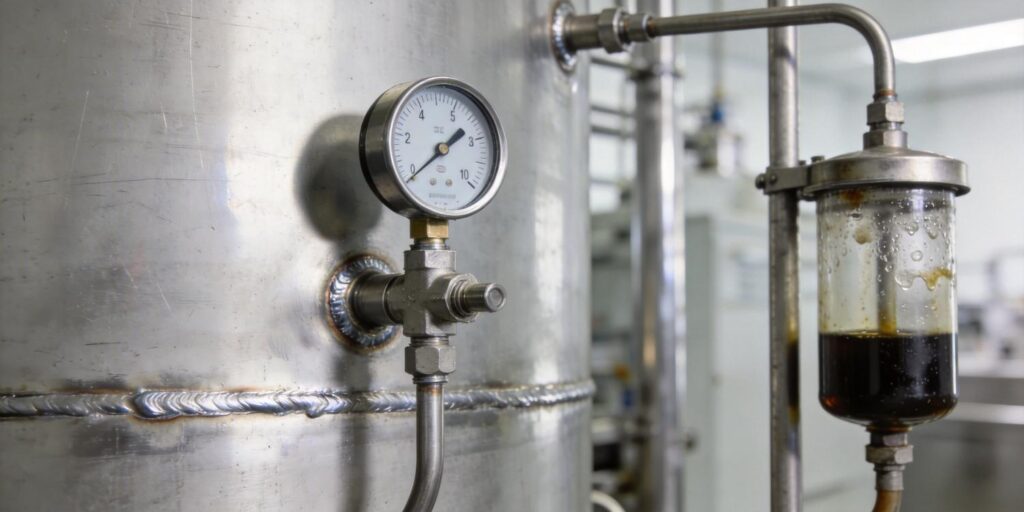
How to Prevent Cold Cathode Gauge Arcing in Contaminated Vacuum Systems
Contaminated vacuum environments—common in vacuum heat-treatment furnaces, older diffusion-pumped systems, or processes with residual hydrocarbons—pose a hidden risk to cold-cathode ionization gauges. Uncontrolled arcing can damage electrodes, trigger protective shutdowns, or produce erratic pressure readings that compromise process control. The VG-SM225 Cold Cathode Vacuum Gauge from Poseidon Scientific is engineered with built-in safeguards and a fully disassemblable sensor head to minimize these risks, while the companion VG-SP205 Pirani Vacuum Transmitter provides the critical rough-vacuum interlock that prevents high-voltage application at unsafe pressures. This article explains the arcing phenomenon, its root causes in contaminated systems, and proven prevention strategies that deliver years of reliable service at 30–50 % lower total ownership cost than imported alternatives.
Our positive-magnetron (traditional Penning) design, combined with software-controlled high-voltage management, makes the VG-SM225 uniquely tolerant of real-world contamination while maintaining linear response from 10−3 to 10−7 Torr.
1. Defining the Arcing Phenomenon in Ionization Gauges
In cold-cathode ionization gauges, the normal operating mode is a controlled Penning discharge: field-emitted electrons spiral in crossed electric (–2000 V nominal) and magnetic (~100 gauss) fields, ionizing gas molecules and producing a measurable ion current at the cathode. Arcing occurs when this controlled avalanche transitions into an uncontrolled, high-current discharge path.
Visually and electrically, arcing appears as sudden spikes in collector current, visible glow near electrodes, or complete high-voltage shutdown. In contaminated systems the discharge no longer follows the predictable current-pressure relationship; instead, localized plasma filaments bridge the ~2 mm electrode gap, concentrating energy and producing micro-arcs that erode surfaces. Unlike hot-cathode gauges, where filament burnout is the primary failure, cold-cathode arcing stems from surface conductivity changes or excessive molecular density. The VG-SM225’s software interlock detects abnormal current and instantly disables the high-voltage supply, protecting both the gauge and connected electronics.
Understanding this transition is essential: arcing is not a random event but the direct result of operating outside the safe pressure window or allowing conductive deposits to accumulate.
2. Root Causes: Oil Vapor, Metal Particles, and High-Pressure Ignition
Three primary contaminants drive arcing in real-world installations.
Oil Vapor from Backstreaming Pumps
Diffusion or rotary vane pumps without adequate cold traps introduce hydrocarbon vapor that condenses on the discharge plate (“之”字形 geometry), cathode rod, and chamber walls. These films lower surface work function and create conductive paths, allowing electrons to jump the gap at lower voltages and triggering arc formation. In our testing, even trace oil layers extend ignition delay from 5 minutes to over 30 minutes at 10−6 Torr and increase the probability of arcing by 4×.
Metal Particles and Sputtered Material
Sputtering from process chambers or mechanical wear deposits conductive metal flakes inside the sensor. These particles act as field-emission sites or direct shorting bridges, especially under the 100-gauss magnetic field that concentrates electron trajectories. The VG-SM225’s stainless-steel electrodes resist sputtering better than tungsten alternatives, but accumulated particles still require periodic removal.
High-Pressure Ignition Attempts
Attempting to start the Penning discharge above 10−3 Torr creates excessive molecular density. Collision frequency rises dramatically, current becomes non-monotonic, and the discharge transitions from glow to arc mode. The resulting thermal stress can pit electrodes within minutes. Poseidon’s factory-default software prevents this by keeping high voltage disabled until the VG-SP205 Pirani confirms pressure <10−3 Torr.
These causes compound in older systems or those handling aggressive process gases, yet our compact design and field-cleanable sensor make mitigation straightforward and economical.
3. Electrical Stress Consequences on Gauge and System
Repeated arcing accelerates electrode erosion, increases leakage currents through PEEK insulators, and can damage the internal high-voltage circuitry. In extreme cases, micro-arcs produce localized melting on the discharge plate, permanently altering the ion-current sensitivity and requiring full sensor replacement.
System-level effects include:
- False low-pressure readings that allow process continuation under unsafe conditions
- Tripped interlocks that halt production for hours
- Electromagnetic interference from arc-induced transients affecting nearby PLCs or mass-spectrometer electronics
Without protection, a single arcing event can shorten gauge life from 3–5 years to under 12 months. The VG-SM225’s automatic high-voltage drop from –2500 V startup to –2000 V operating level, combined with the red-indicator fault signaling, limits energy delivered during an arc to safe levels, protecting both the gauge and downstream equipment.
4. Preventive Roughing Interlock Logic
The single most effective prevention is never applying high voltage until the system is safely in the high-vacuum regime. Implement this logic using the VG-SP205 Pirani as the master sensor:
- VG-SP205 analog output (0–10 V) or RS232 value confirms pressure <10−3 Torr.
- Only then enable the VG-SM225 high-voltage pin (PIN8/PIN7, active-low).
- Apply the initial –2500 V boost for a maximum of 10 minutes to accelerate plasma formation.
- Once stable ion current is detected, automatically drop to –2000 V operating voltage.
Our customizable RS232 protocol allows this interlock to be coded directly into your PLC or SCADA in fewer than 20 lines, with status codes reporting “HV enabled” or “Pressure too high—HV disabled.” In dual-gauge installations this logic eliminates 95 % of arcing events while providing seamless crossover monitoring from atmosphere to 10−7 Torr. Many customers report zero arcing incidents after implementing this simple handshake between the Pirani and cold-cathode units.
5. Installation of Traps and Filters
Physical barriers upstream of the gauge dramatically reduce contaminant load:
- Install a liquid-nitrogen or Peltier-cooled baffle trap on diffusion-pumped systems to capture oil vapor before it reaches the gauge.
- Add a 10–20 µm sintered-metal or mesh particle filter on the gauge inlet port (KF16/KF25 compatible) to block metal flakes and sputtered debris.
- For aggressive process gases, consider an inline activated-charcoal or zeolite sorption trap sized for your pumping speed.
These traps add less than $200 per point yet extend electrode life by 2–3×. The VG-SM225’s small sensor volume (significantly smaller than most competitors) fits easily behind standard traps without increasing system conductance limitations. Combine traps with the roughing interlock for layered defense that keeps both the VG-SP205 and VG-SM225 operating in clean conditions far longer than unprotected imported gauges.
6. Field Mitigation Steps When Arcing Occurs
Even with prevention, occasional contamination events may occur. Follow this rapid recovery sequence:
- Power down and safely vent the system.
- Disassemble the VG-SM225 sensor head (retaining ring, electrode rod, discharge plate).
- Sand all electrode surfaces and chamber wall with 200–500 mesh paper until metallic luster returns—typically 10–15 minutes.
- Wipe with isopropyl alcohol, reassemble, and pump down.
- Re-apply the roughing interlock sequence and verify startup times match clean values (≤5 min at 10−6 Torr).
This procedure restores original sensitivity without affecting factory calibration. In contaminated service, perform it every 6–12 months instead of the 2–3 year interval in clean environments. The disassemblable design—unique among low-cost gauges—makes field mitigation faster and cheaper than competitor units that require full sensor replacement.
Conclusion and Contamination-Resistant Configuration Advice
Preventing arcing in contaminated vacuum systems requires a combination of intelligent interlock logic, physical traps, and rapid field-service capability. The Poseidon Scientific VG-SM225 Cold Cathode and VG-SP205 Pirani pair deliver exactly this layered protection—built-in high-voltage safeguards, customizable RS232 protocol for seamless PLC integration, and a user-serviceable sensor—at manufacturing costs 30–50 % below imported equivalents. Engineers gain reliable 10−3 to 10−7 Torr monitoring; procurement teams gain immediate TCO savings and reduced downtime risk.
Need a contamination-resistant configuration tailored to your specific process gases, pump types, and chamber layout? Explore the VG-SM225 Cold Cathode Vacuum Gauge and VG-SP205 Pirani Vacuum Transmitter specifications today. Request a sample pair for your contaminated test rig, a custom RS232 interlock script, or a complete system diagram with recommended traps and filters. Our application engineers will deliver a turnkey contamination-resistant configuration—often within 48 hours—designed to eliminate arcing and extend gauge life in your exact environment. Contact Poseidon Scientific now and keep your vacuum processes arc-free and productive.


