
Introduction
Pirani vacuum transmitters provide fast, reliable pressure measurement in the rough-to-medium vacuum range by exploiting the thermal conductivity of residual gas. Unlike ionization gauges that require high voltage and magnetic fields, the Pirani operates on a simple thermal principle: gas molecules carry heat away from a heated filament, and the rate of heat loss is directly related to pressure. The Poseidon Scientific VG-SP205 Pirani Vacuum Transmitter refines this classic method with a precision constant-temperature circuit, delivering repeatable readings from 1 × 10⁻³ to 760 Torr with minimal maintenance and instant response.
As the product manager who designed the VG-SP205 alongside its high-vacuum companion, the VG-SM225 Cold Cathode Vacuum Gauge, I wrote this technical overview to help engineers and procurement teams understand exactly how constant-temperature operation works, why it improves accuracy and stability, and how to integrate the transmitter into modern vacuum systems. The principles described here follow the foundational thermal-conductivity theory presented in Foundations of Vacuum Science and Technology (Lafferty, 1998) and are implemented in every VG-SP205 shipped from our facility.
Thermal Conductivity Principle
At the heart of every Pirani gauge lies the fact that gas thermal conductivity varies with pressure. In the molecular-flow regime (below ≈1 Torr), heat transfer from a hot surface to the surrounding envelope occurs primarily through individual molecule collisions. The heat-loss rate \( Q \) from a heated filament can be expressed as:
\[ Q = Q_0 + \alpha P \]
where \( Q_0 \) is the pressure-independent heat loss (radiation + conduction through supports), \( \alpha \) is a gas-specific constant, and \( P \) is pressure. At higher pressures (viscous regime), additional convective cooling appears, but the dominant effect remains molecular conduction down to roughly 10−3 Torr.
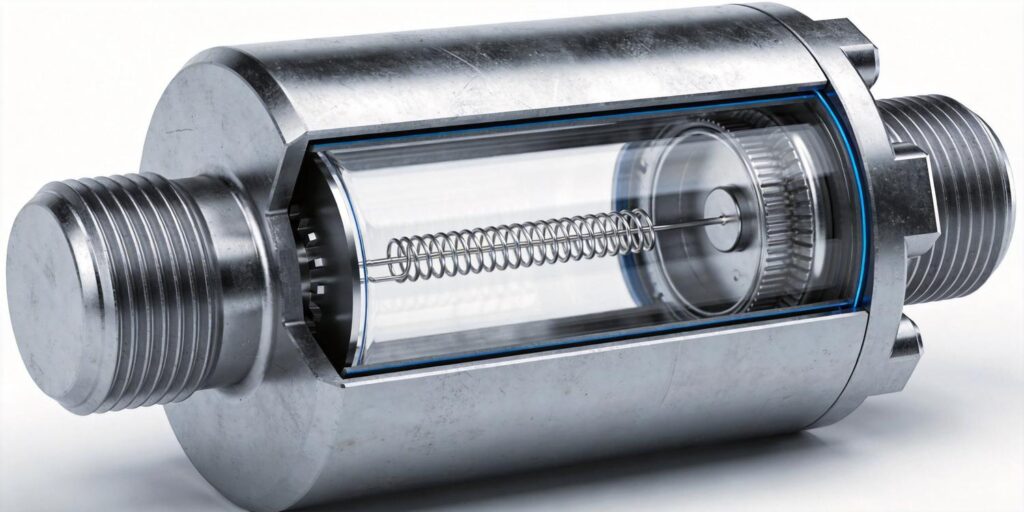
In the VG-SP205, a fine platinum or tungsten filament (resistance \( R \)) is mounted inside a compact stainless-steel envelope with KF25 flange. The filament temperature is held well above ambient (typically 100–150 °C), so any increase in gas pressure causes more molecules to strike the filament, carry away heat, and cool the wire. Without compensation, the wire resistance would drop. The transmitter’s electronics counteract this cooling by increasing power to the filament, and that increase in power (or voltage) becomes the direct measure of pressure.
This thermal-conductivity approach is inherently robust, tolerant of sudden pressure surges, and immune to the x-ray limit that constrains ionization gauges at ultra-high vacuum. It also responds in milliseconds—far faster than cold-cathode plasma buildup.
Constant Temperature Circuit
The VG-SP205 maintains constant filament temperature by continuously adjusting the electrical power supplied to the wire. Because resistance \( R \) of metals rises linearly with temperature (temperature coefficient of resistance for platinum ≈ 0.00385/°C), holding \( R \) constant automatically holds temperature constant. The circuit operates as a self-balancing Wheatstone bridge or equivalent analog feedback loop:
\[ V = \sqrt{P_{\text{heat}} \cdot R} \]
where \( V \) is the voltage applied across the filament and \( P_{\text{heat}} \) is the power needed to offset gas-induced cooling. As pressure rises and heat loss increases, the bridge detects the tiny resistance drop and instantly raises \( V \) to restore the original temperature. The resulting voltage (or current) is digitized and converted to pressure using a factory-calibrated lookup table that accounts for gas species and ambient temperature.
This constant-temperature mode eliminates the slow thermal time constants of older constant-current or constant-voltage Pirani designs. The VG-SP205 reaches operating temperature in <1 s and tracks pressure changes with <50 ms response time across its full range. Power consumption stays below 2 W, and the compact electronics package (78 × 25 × 25 mm) draws only 5 V DC, making it ideal for benchtop or rack-mounted laboratory systems.
Resistance Change Detection
Precise resistance measurement is the key to accuracy. The VG-SP205 employs a high-resolution analog-to-digital converter that samples the bridge voltage at >1 kHz. Any deviation as small as 0.01 % in filament resistance is detected and corrected within microseconds. The circuit also monitors ambient temperature via an integrated sensor and applies real-time compensation, eliminating drift caused by changes in lab or cabinet temperature.
Built-in diagnostics continuously compare measured resistance against expected values. If the filament is broken, contaminated, or operating outside safe limits, the transmitter immediately reports an error code over RS232 and sets the analog status line high. This proactive fault detection prevents silent failures that plague older thermal gauges.
Because the filament operates at moderate temperature (well below incandescent levels), evaporation and oxidation are negligible. Replacement is rarely required even after years of continuous service—another reason the VG-SP205 is favored for long-term research and production monitoring.
Accuracy Range Discussion
The VG-SP205 delivers the following performance (air reference, 20 °C):
- Measurement range: 1 × 10⁻³ to 7.6 × 10² Torr
- Accuracy: ±15 % in the 10−2 to 1 × 10⁻¹ Torr decade; ±50 % at the extremes
- Repeatability: ±5 % across the entire range
Accuracy peaks in the medium-vacuum band because molecular heat transfer dominates and is least affected by convection or radiation. At pressures above 10 Torr, viscous-flow convection adds variability; below 10−3 Torr, heat loss becomes too small to measure reliably. Gas-species correction factors (argon ≈ 0.7 × air, helium ≈ 1.4 × air) are stored in the transmitter firmware and can be selected via the RS232 interface, ensuring accurate readings regardless of process gas.
These specifications comfortably exceed typical laboratory and light-industrial requirements and align with the performance expected from modern Pirani transmitters described in vacuum metrology handbooks.
Ideal Application Range
The VG-SP205 is the first-choice sensor for any system that spends significant time between 10−3 and 760 Torr:
- Foreline monitoring and roughing-pump protection
- Load-lock and sample-introduction chambers
- Vacuum furnace pump-down and vent cycles
- Glovebox and inert-atmosphere antechambers
- Analytical instruments requiring fast pressure confirmation before high-vacuum stages
When paired with the VG-SM225 Cold Cathode Vacuum Gauge (10−7 to 10−3 Torr), the two transmitters provide seamless full-range coverage with automatic crossover at 10−3 Torr. Engineers simply wire both units to the same controller; the system switches signals without data gaps or manual intervention. This combination is standard in semiconductor research tools, PVD coaters, and university vacuum test stands worldwide.
Integration Tips
Integrating the VG-SP205 into PLCs, SCADA, or LabVIEW is straightforward:
- Use the native RS232 port (9600 baud, 8N1) for direct digital pressure values—no scaling required.
- Connect via shielded cable (max 10 m) and ground the shield at the controller end only.
- Power from a clean 5 V ±0.2 V supply (<300 mA); the transmitter includes internal regulation.
- Parse the simple ASCII data frame (pressure + status + checksum) using any serial function block.
- For analog systems, add a low-cost RS232-to-4–20 mA converter if needed.
The transmitter’s compact RJ45 connector and low power draw simplify cabinet layouts. Built-in error codes let the PLC trigger interlocks or alarms instantly. For multi-gauge installations, a single serial bus can poll multiple VG-SP205 units sequentially.
Detailed wiring diagrams, protocol definition, and sample code for Siemens, Allen-Bradley, and Python are available on the VG-SP205 product page.
Conclusion
The Poseidon VG-SP205 Pirani Vacuum Transmitter maintains constant filament temperature through a fast-feedback resistance bridge, converting gas-induced heat loss into a precise pressure signal with excellent repeatability and sub-second response. Its thermal-conductivity principle, combined with modern constant-temperature electronics, delivers reliable measurement exactly where most vacuum systems operate—rough to medium vacuum—while pairing perfectly with the VG-SM225 Cold Cathode for full-range coverage.
Ready to add stable, easy-to-integrate pressure monitoring to your laboratory or production system? Our applications team offers free technical reviews, custom calibration curves, integration support, and rapid quotations. Contact us today—simply visit the product page or reply to this article for personalized assistance.
VG-SP205 Pirani Vacuum Transmitter – Specifications & Downloads
VG-SM225 Cold Cathode Vacuum Gauge – High-Vacuum Companion
At Poseidon Scientific we design vacuum instrumentation that engineers trust—delivering the accuracy, speed, and integration simplicity your processes demand.


