Chemistry of Acidic Analytes
Acidic analytes represent a broad class of compounds characterized by their ability to donate protons, typically containing functional groups such as carboxylic acids, phenols, sulfonic acids, or phosphonic acids. These compounds exhibit unique chemical behavior that directly impacts their interaction with solid-phase extraction (SPE) sorbents. Understanding their fundamental properties is crucial for developing effective extraction methods.
The most critical parameter for acidic analytes is their pKa value, which determines their ionization state at different pH levels. As noted in SPE literature, “Many drugs have acidic or basic properties, and it can be anticipated that their cartridge retention and elution behavior will be affected by the pH of the extraction system.” At pH values approximately two units below their pKa, acidic compounds exist predominantly in their neutral, protonated form, making them amenable to reversed-phase retention mechanisms.
However, researchers must exercise caution when applying theoretical pKa values to SPE method development. As documented in SPE literature, “Care must be taken when applying these data during the SPE method development process. For example, quoted pKa values pertain to very specific conditions of temperature, concentration, and environment. The effective acidity or basicity of a functional group close to a bonded silica surface may be very different.” This underscores the importance of empirical testing alongside theoretical predictions.
Acidic analytes span a wide range of polarities and solubilities. Strong acids with pKa values below 2 (such as sulfonic acids) remain ionized across most pH ranges, while weak acids (pKa 3-5) can be effectively neutralized through pH adjustment. This distinction becomes particularly important when selecting appropriate sorbents and developing pH control strategies.
MAX and WAX Sorbents
For acidic analyte extraction, mixed-mode sorbents offer superior selectivity compared to traditional reversed-phase materials. Two primary sorbent types dominate this application space: Mixed-mode Anion eXchange (MAX) and Weak Anion eXchange (WAX) sorbents.
Oasis MAX for Acidic Compounds
The Oasis MAX sorbent represents a specialized solution for acidic compound extraction. According to Waters documentation, “The Oasis MAX (Mixed-mode Anion eXchange) Sorbent has a tightly controlled ion-exchange capacity of 0.25 meq/g, ensuring reproducible SPE protocols for extraction of acidic compounds and metabolites from biological fluids.” This controlled capacity provides consistent performance across different batches and applications.
Key advantages of MAX sorbents include:
- Dual retention mechanism: Combines reversed-phase hydrophobic interactions with strong anion exchange capabilities
- pH stability: Stable across pH 0-14, enabling flexible method development
- Water-wettable polymeric base: Eliminates the need for conditioning with organic solvents
- Silanol-free surface: Reduces secondary interactions that can complicate method development
MAX sorbents are particularly effective for acids with pKa values between 2 and 8, where they can be selectively retained through ion-exchange mechanisms while maintaining hydrophobic interactions for cleanup.
Oasis WAX for Strong Acidic Compounds
For stronger acidic compounds, WAX sorbents provide specialized retention capabilities. Waters notes that “The Oasis WAX (Weak Anion eXchange) SPE material was developed to provide sample preparation for strong acidic compounds. The retention mechanism is mixed mode (both ion-exchange and reversed-phase), which improves retention for strong acidic compounds.”
WAX sorbents feature:
- Weak anion exchange functionality: Ideal for compounds with pKa values below 1.0
- Enhanced selectivity: Particularly effective for separating strong acids from complex matrices
- Compatibility with various elution strategies: Can be used with both organic and aqueous elution systems
Both MAX and WAX sorbents are available in multiple formats, including cartridges (1cc to 6cc), 96-well plates, and method development kits. The availability of sorbent selection plates containing MCX, MAX, WCX, and WAX sorbents enables rapid method development for unknown analytes or complex mixtures.
pH Control Strategies
Effective pH control represents the cornerstone of successful acidic analyte extraction. The ionization state of acidic compounds directly determines their retention mechanism and elution characteristics. As documented in SPE literature, “At pH 3.3, acidic, neutral, and some weakly basic drugs behave as relatively nonpolar compounds, and are retained on the cartridge by the hydrophobic groups of the sorbent, while other basic drugs behave as charged species, and are adsorbed by the negative ionic groups of the sorbent.”
Initial pH Profiling
A systematic approach to pH optimization begins with comprehensive pH profiling. Research indicates that “The first experiment should be a combined screening of sorbent types and pH values of the dilution buffer. For each sorbent tested, buffers with pH values of 2, 3, 4, 5, 6, 7, 8, and 9 are used for diluting the sample before application to the SPE cartridge.”
Recommended buffer systems for pH profiling include:
- pH 2.1: Phosphoric acid
- pH 2.5-4: Sodium formate/triethylamine
- pH 4.5-5.5: Sodium acetate
- pH 6-8: Potassium phosphate
- pH 9: Tris buffer
When evaluating pH profiling results, “it is important not to reject sorbents based on lack of extract purity as this can be improved upon by optimizing the washing and elution steps. Choose instead the two to five combinations of sorbents and pH values with recoveries above 70% which yield the purest extracts.”
Practical pH Adjustment Techniques
For mixed-mode extractions involving both acidic and basic compounds, sequential pH adjustment can provide exceptional selectivity. One documented approach involves: “The cartridge is first conditioned in the normal manner with methanol and water, and then the analytes are applied under acidic conditions (pH approximately 6). The basic analytes (pKa > 6) will be ionized and retained by ionic interactions. The acids, although partially ionized, should be retained along with the neutral drugs by hydrophobic, reversed-phase interactions.”
Further pH adjustment can then be applied: “The pH on the cartridge can then be adjusted by the passage of acetic acid solution (pH approx. 3) which should enhance the ionic interaction of the bases. This pH change also reduces the ionization of the acids, which along with the neutral compounds can be eluted in a non-polar solvent.”
Washing Steps to Remove Matrix
Effective washing represents the critical step in achieving clean extracts while maintaining high analyte recovery. The washing step serves to remove interfering matrix components while retaining target acidic analytes on the sorbent.
Wash Solvent Optimization
Research demonstrates that “The parameters to optimize during this step are the composition of the washing solvent, the amount of washing solvent and the procedure used to eliminate the residual washing solvent before elution. The composition of the washing solvent should be investigated at the initial stage.”
For mixed-mode extractions involving acidic analytes, a systematic approach to wash optimization involves: “For a simple non-polar extraction, the composition of the washing solvent should first be varied using increasing concentrations of methanol or acetonitrile in water. Note that several other water-miscible solvents may be used but in practice it is seldom necessary to use more than these two common solvents. Typically the wash solvent methanol composition is increased in steps of 10% from 100% water through to 100% methanol.”
Wash Strategy for Mixed-Mode Sorbents
When using MAX or WAX sorbents, washing strategies must account for both hydrophobic and ionic retention mechanisms. Documented protocols often include:
- Initial aqueous wash: Typically 2-3 mL of water or dilute buffer to remove water-soluble interferences
- pH-adjusted wash: For MAX sorbents, washing with 2% formic acid can help remove weakly retained basic compounds
- Organic wash: 100% methanol or acetonitrile to remove hydrophobic interferences while maintaining ionic retention of acidic analytes
As noted in SPE literature, “Ideal washing removes as many interferences as possible while retaining the analyte(s).” For ion-exchange mechanisms, “Ionic bonds are strong enough to allow the analyte to remain bound while interferences are washed away with high percentages (up to 100%) of polar or nonpolar organic solvents.”
Safe Wash Volumes
Guidelines for safe wash volumes based on sorbent mass include:
- 100 mg sorbent: Safe wash volume 2.5 mL, typical assay volume 1.5 mL
- 200 mg sorbent: Safe wash volume 5.0 mL, typical assay volume 3.0 mL
- 500 mg sorbent: Safe wash volume 7.5 mL, typical assay volume 4.5 mL
- 1000 mg sorbent: Safe wash volume 25 mL, typical assay volume 15 mL
These volumes represent guidelines, and specific applications may require optimization based on analyte properties and matrix composition.
Elution Considerations
Effective elution of acidic analytes requires disruption of both hydrophobic and ionic interactions while maintaining selectivity against remaining interferences. The elution step represents the final opportunity to achieve both high recovery and extract purity.
Elution Solvent Selection
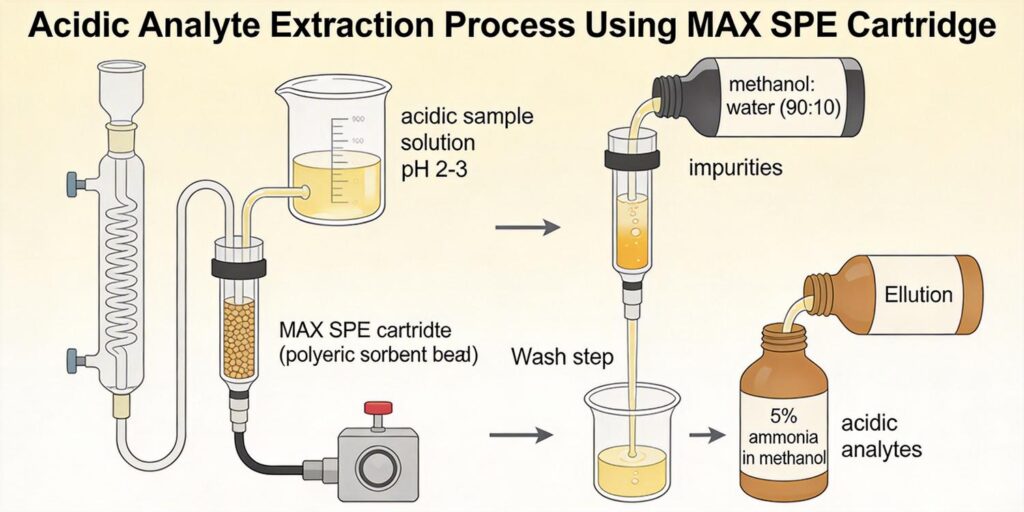
For acidic analytes retained on mixed-mode sorbents, elution typically requires both pH adjustment and appropriate solvent strength. As documented, “For ion-exchange mechanisms are used, the elution solvent must have sufficient pH strength to reverse the electrostatic bonds.” For acidic compounds retained on anion exchange sorbents, “elution solvents often utilize ammonium hydroxide to reverse the ionic state of the drugs with subsequent release from ionic bonds.”
Critical considerations for elution solvent selection include:
- pH requirements: “It is critical that the pH of the elution solvent be at least 2 units above the analyte pKa to fully protonate the compound.”
- Solvent strength: Must be sufficient to disrupt hydrophobic interactions
- Volatility: Important if evaporation and reconstitution are required
- Compatibility: With downstream analytical techniques (HPLC, GC, MS)
Optimized Elution Protocols
Documented elution strategies for acidic analytes include:
For MAX sorbents:
A typical 4-step protocol involves:
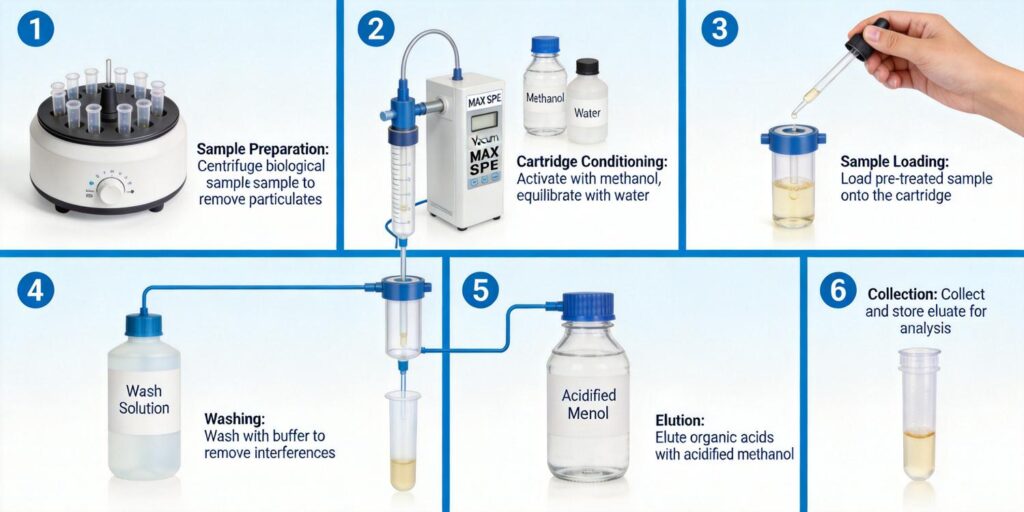
1. Load pre-treated sample
2. Wash with 5% NH4OH
3. Elute with 2% formic acid in methanol
4. Final elution with 100% methanol
For WAX sorbents:
Common protocols include:
1. Load pre-treated sample
2. Wash 1 with 2% formic acid
3. Wash 2 or Elute 1 with 100% methanol
4. Elute 2 with 5% NH4OH in methanol
Elution Volume and Technique Optimization
Research indicates that “The volume of the solvent used to elute the analyte should be minimized, as this will reduce the time required to evaporate the extract and will minimize background.” Studies have shown that “eluting twice with 1 mL of solvent will increase the recovery compared with the use of a single elution step of 2mL of the same solvent. Even if the improved recovery obtained by a two-step elution appears marginal or insignificant, this procedure may result in an improved precision.”
Flow rate during elution is particularly critical: “For the same reasons already discussed, appropriate flows are essential to allow kinetic transfer of analyte from the stationary phase to the mobile phase (elution solvent). This is the one step in which slower is better. Gravity flow is desirable if possible. Sometimes a short bump of vacuum or pressure will initiate the flow, and then gravity flow will continue.”
Special Considerations for Problematic Analytes
For highly hydrophilic acidic analytes that demonstrate poor retention on reversed-phase sorbents, alternative strategies may be required. Research has shown that “addition of 10 mM tetrabutyl ammonium hydroxide to the buffers used for diluting the sample substantially increased the recovery” of problematic analytes through ion-pairing mechanisms.
When working with complex matrices or particularly challenging analytes, “attention to correct pH, polarity, and solubility will yield both optimal recovery and selectivity for the method. If ion-exchange mechanisms are used, the elution solvent must have sufficient pH strength to reverse the electrostatic bonds.”
By systematically addressing each of these considerations—from initial sorbent selection through final elution optimization—analysts can develop robust, reproducible SPE methods for acidic analytes across diverse applications and matrices. The combination of MAX and WAX sorbents with optimized pH control, washing, and elution strategies provides a powerful toolkit for addressing even the most challenging acidic compound extraction requirements.