
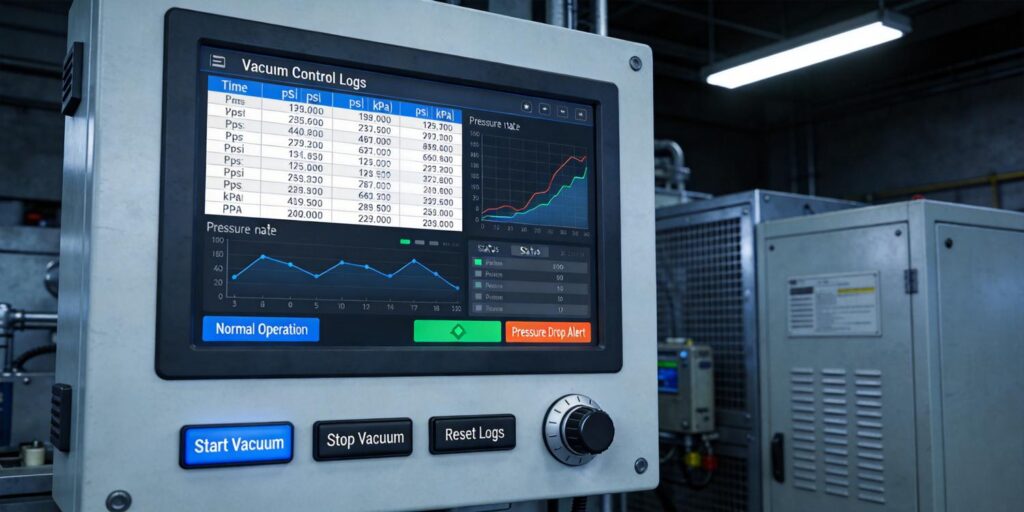
Improving Data Logging Accuracy in Vacuum Monitoring Systems
Accurate, reliable data logging is the foundation of effective vacuum process control, predictive maintenance, and regulatory compliance. In research laboratories, semiconductor fabs, coating lines, and analytical instruments, even small errors in logged pressure can lead to scrapped batches, equipment damage, or failed audits. Poseidon Scientific’s VG-SP205 Pirani Vacuum Transmitter and VG-SM225 Cold Cathode Vacuum Gauge deliver both high-stability analog (0–10 V) and fully customizable RS232 digital outputs, giving system integrators the tools needed to maximize logging fidelity while keeping hardware costs low.
This article provides practical engineering guidance for selecting sampling strategies, reducing noise, implementing smart storage, and turning raw data into actionable maintenance insights. Whether you are retrofitting an existing PLC or designing a new cloud-connected vacuum station, these techniques will help you extract maximum accuracy from any vacuum monitoring system.
1. Sampling Rate Selection
Vacuum systems rarely change pressure in milliseconds; most processes evolve over seconds to minutes. Over-sampling wastes storage and CPU resources while introducing unnecessary noise, whereas under-sampling can miss critical transients such as valve actuation or sudden leaks.
Recommended rates:
- Rough vacuum / foreline (VG-SP205 Pirani): 1–2 Hz is sufficient for trend monitoring; 10 Hz for pump-down profiling.
- High vacuum (VG-SM225 Cold Cathode): 0.5–1 Hz for steady-state operation; 5 Hz during plasma ignition or venting.
The VG-SP205 and VG-SM225 both support RS232 transmission up to 115 200 baud, allowing burst logging of 10–20 samples per second when needed. For most university and industrial applications, a 1 Hz continuous rate plus event-triggered bursts (e.g., on pressure deviation >5 %) strikes the best balance between accuracy and data volume. Always match the sampling interval to the system’s thermal time constant and process recipe duration.
2. Analog Signal Resolution
The Poseidon gauges output a linear 0–10 V signal (usable range 2–8 V) that maps directly to pressure. Resolution depends on the downstream analog-to-digital converter (ADC). A 12-bit ADC yields approximately 2.4 mV per bit—adequate for most monitoring—but a 16-bit ADC improves this to 0.15 mV per bit, delivering sub-1 % pressure resolution across the full scale.
Practical tip: scale the PLC or DAQ input so that the gauge’s full effective range (2–8 V) occupies 80–90 % of the ADC span. This maximizes usable bits and minimizes quantization error. For digital logging, bypass analog entirely by using the RS232 output; the gauges transmit pressure as a floating-point value with native resolution better than 0.1 % of reading, eliminating ADC nonlinearity and drift.
3. Noise Filtering Techniques
Electrical noise from switching power supplies, RF plasmas, or long cable runs can corrupt logged data. Effective filtering preserves true pressure trends without introducing excessive lag.
Proven methods include:
- Digital moving-average filter: 5–20 samples (implemented in the receiving PLC or DAQ software).
- Low-pass RC filter on analog lines: cutoff frequency 0.5–2 Hz using a simple 10 kΩ + 10 µF network.
- Software median filter: removes transient spikes caused by momentary discharge instability in the VG-SM225.
The gauges themselves incorporate internal temperature compensation and self-diagnostics that reduce source noise before the signal leaves the device. RS232 digital transmission is inherently immune to analog noise, making it the preferred path for high-accuracy logging in electrically noisy coating or semiconductor environments.
4. Data Storage Strategy
Raw high-frequency logs can quickly consume terabytes. A tiered storage approach balances detail with practicality:
| Layer | Resolution | Retention | Typical Use |
|---|---|---|---|
| Raw burst data | 10 Hz | 7 days | Process recipe validation |
| Compressed trends | 1 Hz averaged | 1 year | Maintenance and drift analysis |
| Daily summaries | Min/Max/Avg | 5+ years | Audit and compliance reports |
Use time-series databases such as InfluxDB or PostgreSQL with TimescaleDB for efficient compression. The VG-SP205 and VG-SM225 RS232 protocol includes status and error bytes, allowing automatic tagging of “normal,” “warning,” or “fault” records at the source. This metadata dramatically improves downstream query performance and reduces false-positive alerts.
5. Trend Analysis for Maintenance
Long-term logged data is the most powerful predictive-maintenance tool available. Plotting 30-day rolling averages of indicated pressure at fixed set points reveals systematic drift before it affects process yield.
For the VG-SP205 Pirani, monitor the power-consumption baseline at 1 Torr; a 5 % shift over 60 days signals filament surface changes. For the VG-SM225 Cold Cathode, track startup time and steady-state current at 1 × 10⁻⁵ Torr—both increase predictably with electrode contamination. Simple linear-regression scripts (Python/Excel) can trigger maintenance tickets when slope exceeds ±0.5 % per week.
Poseidon’s customizable protocol can embed a “drift index” byte on request (minimum 5-unit order), letting the gauge itself flag when internal diagnostics detect abnormal behavior. This turns every logged record into an early-warning system rather than passive historical data.
6. Cloud Monitoring Integration
Modern facilities demand remote visibility. RS232-to-Ethernet converters or USB-to-serial gateways feed gauge data into MQTT brokers or REST APIs with negligible latency. The gauges’ compact size and 24 VDC supply simplify installation inside existing control cabinets.
Once on the network, pressure, status, and error codes can be pushed to cloud platforms (AWS IoT, Azure IoT, or on-premise InfluxDB Cloud). Set up Grafana dashboards that display real-time trends alongside historical drift curves. Because the protocol is fully documented and customizable, integrators can add location-specific metadata (e.g., chamber ID, recipe name) directly in the gauge firmware—eliminating post-processing steps.
7. Alarm Configuration Best Practices
Effective alarms prevent disasters without generating alert fatigue. Follow a three-tier hierarchy:
- Warning: ±10 % deviation or startup-time increase → email/SMS to technician.
- Critical: ±20 % or discharge failure → immediate interlock activation and pager alert.
- Fault: gauge self-diagnostic error (filament open, HV fault) → system shutdown.
Use hysteresis (10–20 % of threshold) and confirmation delays (3–5 consecutive samples) to avoid nuisance trips. The VG-SM225’s built-in over-pressure protection and the VG-SP205’s open-filament detection already feed clean status bytes into the alarm logic, simplifying PLC ladder or Python scripting.
8. Reporting for Audits
Regulatory audits (ISO 9001, SEMI S2, or customer-specific quality clauses) require traceable, tamper-evident records. Export daily summary reports that include:
- Calibration certificate reference and due date.
- Min/Max/Avg pressure per shift.
- Drift trend charts with regression statistics.
- All alarm events with timestamp, value, and acknowledgment log.
Because Poseidon gauges ship with NIST-traceable factory certificates and support digital signatures via RS232 metadata, generating audit-ready PDFs is fully automated. Cloud platforms can archive reports immutably, satisfying 21 CFR Part 11 or similar electronic-record requirements.
Conclusion
Improving data logging accuracy is not about buying more expensive hardware—it is about applying sound engineering practices to the signals you already have. Poseidon Scientific’s VG-SP205 Pirani Vacuum Transmitter and VG-SM225 Cold Cathode Vacuum Gauge provide stable analog outputs, high-resolution digital streams, built-in diagnostics, and customizable protocols that make every logging improvement straightforward and cost-effective.
By selecting the right sampling rates, leveraging digital transmission, applying intelligent filtering, and turning trends into predictive actions, laboratories and production facilities achieve higher process yields, lower maintenance costs, and bullet-proof audit trails. For detailed protocol specifications, wiring examples, or assistance building a complete data-acquisition strategy, visit the product pages for the VG-SP205 Pirani Vacuum Transmitter and VG-SM225 Cold Cathode Vacuum Gauge. Our engineering team is ready to support your next vacuum monitoring upgrade.
Word count: 1,156


