Lipid Interference in LC-MS Food Analysis
In liquid chromatography-mass spectrometry (LC-MS) analysis of food extracts, lipid interference represents one of the most significant analytical challenges. Lipids can cause ion suppression or enhancement in the mass spectrometer, leading to inaccurate quantification and reduced method sensitivity. According to Simpson and Wynne (2000), co-extracted lipids from food matrices can overload analytical columns, cause signal suppression in electrospray ionization, and generate complex background signals that obscure target analyte peaks.
The problem is particularly acute in pesticide residue analysis, where target compounds are often present at trace levels (ppb to ppt) while lipids exist in much higher concentrations. The high lipid content in foods like dairy products, oils, meats, and nuts necessitates effective cleanup strategies to ensure reliable analytical results. As noted in forensic applications literature, “Biological samples are notoriously dirty; injecting them with minimum cleanup onto very sensitive and expensive instruments makes very little sense” (Forensic and Clinical Applications of Solid Phase Extraction).
Types of Lipids Found in Food Matrices
Food matrices contain diverse lipid classes that vary in polarity, molecular weight, and chemical structure. The primary lipid classes encountered in food analysis include:
Neutral Lipids
- Triglycerides (TG) – Major components of fats and oils
- Diglycerides (DG) and Monoglycerides (MG) – Partial hydrolysis products
- Cholesterol esters – Common in animal-derived foods
- Free cholesterol
Polar Lipids
- Phospholipids – Including phosphatidylcholine, phosphatidylethanolamine
- Free fatty acids (FFA) – Can be saturated or unsaturated
- Sphingolipids – Found in dairy and egg products
Kaluzny et al. (1985) developed a comprehensive separation scheme that demonstrates how these lipid classes can be fractionated based on their polarity and functional group characteristics. The complexity increases with foods like cheese, which contain both high lipid loads and significant protein content that often binds to lipids, creating additional cleanup challenges.
SPE Sorbent Chemistries for Lipid Removal
Selecting the appropriate solid phase extraction sorbent chemistry is crucial for effective lipid removal while preserving target analytes. Different sorbent types offer distinct mechanisms for lipid retention:
Normal Phase Sorbents
Silica and aminopropyl (NH2) sorbents are particularly effective for lipid class separations. The NH2 sorbent, as demonstrated by Kaluzny’s classic method, can separate chloroform extracts of lipid tissue into seven principle fractions with high efficiency and purity. This approach has been adapted for various food applications, including the determination of fatty acids in dairy products by de Jong and Badings (1990).
Reversed Phase Sorbents
C18 and C8 bonded phases are commonly used for non-polar lipid removal. These sorbents retain triglycerides and cholesterol esters while allowing more polar analytes like pesticides to pass through or be selectively eluted. However, capacity considerations are important, as noted by Simpson and Wynne: “The large sorbent bed is necessary to provide adequate capacity for the lipid load being applied.”
Mixed-Mode Sorbents
For comprehensive cleanup, mixed-mode sorbents combining reversed-phase and ion-exchange functionalities offer enhanced selectivity. These can be particularly useful when dealing with both neutral lipids and charged phospholipids in the same extract.
Washing Solvents Designed for Lipid Elimination
The strategic selection of washing solvents is critical for removing lipids while retaining target analytes. Different lipid classes require specific solvent combinations for effective elimination:
Non-Polar Wash Solvents
Hexane and hexane-dichloromethane mixtures (typically 7:3 v/v) effectively remove non-polar lipids like triglycerides and cholesterol esters. These solvents have low elution strength for more polar target analytes, making them ideal for initial cleanup steps.
Intermediate Polarity Washes
Solvents like chloroform, dichloromethane, and diethyl ether-hexane mixtures target medium-polarity lipids. As shown in lipid separation schemes, specific ratios can selectively elute different lipid classes while retaining others.
Selective Elution Systems
The comprehensive lipid separation scheme described in forensic applications literature demonstrates how sequential elution with carefully designed solvent systems can achieve remarkable class separation:
- 2:1 chloroform:propan-2-ol for all neutral lipids
- 2% acetic acid in diethyl ether for free fatty acids
- Methanol for phospholipids
- Hexane for cholesteryl esters
- Gradually increasing ethyl acetate in hexane for triglycerides, cholesterol, diglycerides, and monoglycerides
Preventing Analyte Loss During Cleanup
Maintaining high analyte recovery while removing lipids requires careful method optimization. Several strategies can minimize analyte loss:
pH Control
For ionizable analytes, adjusting sample pH can dramatically affect retention on mixed-mode sorbents. Keeping target analytes in their neutral form during lipid washing steps, then ionizing them for elution, provides excellent selectivity.
Solvent Strength Optimization
Using washing solvents with just enough strength to remove lipids without eluting target compounds requires systematic testing. As noted in method development literature, “the analyst may have to sacrifice the recovery of one compound to optimize recovery of others.”
Flow Rate Control
Maintaining optimal flow rates (typically 1-3 drops per second) ensures adequate interaction time between analytes and sorbent, maximizing retention and recovery.
Capacity Considerations
Selecting SPE devices with adequate bed mass (often 500mg or 1g for food samples) prevents breakthrough of both lipids and target analytes. Overloading leads to poor cleanup and reduced recovery.
Example Workflow for Pesticide Analysis in Food
A comprehensive SPE workflow for pesticide analysis in lipid-rich food matrices typically involves these steps:
Sample Preparation
- Homogenize food sample with appropriate extraction solvent (acetonitrile, ethyl acetate, or acetone-water mixtures)
- Add salts for partitioning (QuEChERS approach) or perform liquid-liquid extraction
- Concentrate extract if necessary
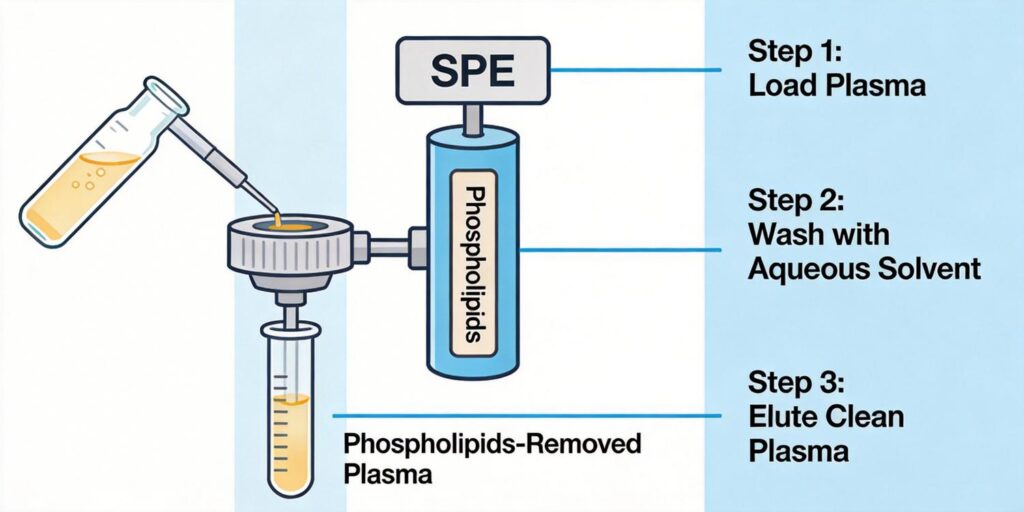
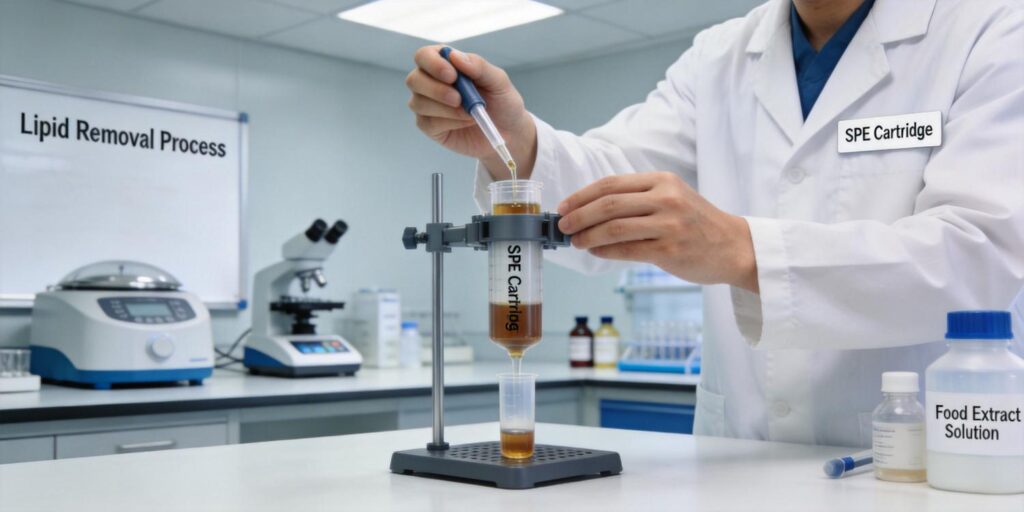
SPE Cleanup Procedure
- Conditioning: 3 mL methanol followed by 3 mL water or weak solvent
- Loading: Apply sample extract at controlled flow rate (1-2 mL/min)
- Washing: 2-3 mL hexane or hexane-dichloromethane (7:3) to remove non-polar lipids
- Additional Wash: 2-3 mL of 5-10% ethyl acetate in hexane for medium-polarity lipids
- Drying: Apply vacuum or air flow to remove residual solvents
- Elution: 4-6 mL acetonitrile, methanol, or ethyl acetate for target pesticides
Post-SPE Processing
- Concentrate eluate under gentle nitrogen stream
- Reconstitute in LC-MS compatible solvent
- Filter through 0.2 μm membrane before analysis
This approach has been successfully applied to various matrices, including the extraction of benzimidazole fungicides from fruits and vegetables reported by Pavoni and Errani (1996), where SPE cleanup effectively eliminated co-extracted waxes.
Validation Metrics for Lipid Removal Efficiency
Comprehensive method validation should include specific metrics to demonstrate effective lipid removal:
Recovery Studies
Spike recovery experiments with target analytes added to both clean solvents and matrix-matched samples provide recovery data. Acceptable recoveries typically range from 70-120% with RSD < 15%.
Matrix Effect Evaluation
Compare analyte response in neat solvent versus matrix-matched standards to quantify ion suppression/enhancement. Effective lipid removal should result in matrix effects < ±20%.
Lipid Removal Efficiency
Gravimetric analysis of extracts before and after SPE cleanup provides quantitative data on lipid removal. Complementary techniques like thin-layer chromatography (TLC) can verify the absence of specific lipid classes.
Method Detection Limits (MDL)
Determine MDLs in both cleaned and uncleaned extracts to demonstrate sensitivity improvement. Effective lipid removal typically improves MDLs by 5-10 fold.
System Suitability
Monitor chromatographic performance indicators: peak shape, retention time stability, and baseline noise. Clean extracts should show stable retention times (±0.1 min) and minimal baseline drift.
Long-term Column Performance
Track analytical column backpressure and peak shape over multiple injections to demonstrate that lipid removal protects LC-MS instrumentation. As noted in SPE literature, “SPE has been shown to significantly increase gas (GC) and liquid chromatography (LC) column life while reducing the downtime on equipment like gas chromatography and liquid chromatography mass spectrometers (GCMS and LCMS) for source cleaning.”
The lipid separation data from forensic applications demonstrates what’s achievable: recoveries exceeding 96% for most lipid classes with contamination levels below 2% for cross-class interference. While food applications may not require such complete lipid class separation, these benchmarks illustrate the potential of well-optimized SPE methods.
Effective SPE cleanup for lipid removal in food analysis requires understanding both the complexity of food matrices and the selectivity of available sorbent chemistries. By implementing systematic method development and validation approaches, analysts can achieve reliable, sensitive, and robust methods for trace analysis in even the most challenging lipid-rich food samples.