Analytical Challenges in Cosmetic Formulations
Cosmetic ingredient analysis presents unique challenges due to the complex nature of cosmetic formulations. These products typically contain a diverse array of components including oils, waxes, pigments, surfactants, and preservatives that can interfere with analytical measurements. The lipid-soluble nature of many cosmetic ingredients, combined with the presence of emulsifiers and thickeners, creates a matrix that requires careful sample preparation strategies.
According to research from Simpson and Wynne (2000), cosmetic formulations often contain difficult components that require specialized extraction approaches. The matrix, though still likely to contain plant sugars, acids, and colorants, presents many problems associated with co-formulated excipients. Lipid-soluble vitamins A and E have been successfully determined following SPE extraction of cosmetic oils and creams, demonstrating the effectiveness of proper sample cleanup techniques.
Sample Dilution Using Methanol or Acetonitrile
The first critical step in cosmetic sample preparation involves proper dilution to create a homogeneous solution compatible with SPE processing. Methanol and acetonitrile are preferred solvents due to their ability to dissolve a wide range of cosmetic ingredients while maintaining compatibility with subsequent SPE steps.
Research indicates that sample pretreatment is essential for optimal results. Waters recommends several pretreatment steps including: 1) diluting samples 1:1 with buffer to improve flow during loading, 2) diluting 1:1 or greater with 4% phosphoric acid or other acids, 3) filtering through 0.45 μm membrane, and 4) centrifuging at ≥3000 rpm. These steps help ensure consistent sample loading and improve overall method performance.
Filtration Before SPE
Filtration serves as a crucial preliminary cleanup step to remove particulate matter that could clog SPE cartridges and affect flow characteristics. A 0.45 μm membrane filter is typically recommended for cosmetic samples to remove insoluble pigments, wax particles, and other solid components.
This step not only protects the SPE cartridge but also improves the reproducibility of the extraction process. As noted in SPE literature, “Applying one or more of the following steps before loading your sample may improve your results,” with filtration being a key recommendation for complex matrices like cosmetics.
Selection of HLB Cartridges for Broad Compound Retention
Hydrophilic-Lipophilic Balance (HLB) cartridges represent the optimal choice for cosmetic ingredient analysis due to their ability to retain both polar and non-polar compounds. The copolymer which exhibits both hydrophilic and lipophilic retention characteristics plays a valid role in the extraction of medium-polar and non-polar organic compounds from mixtures of water and organic solvent.
Research on fat-soluble vitamin extraction demonstrates the effectiveness of HLB cartridges. Studies show that all vitamins can be held on the cartridge under 45%, 55%, and 65% ethanol solvent conditions, with 65% ethanol providing optimal solubility for five different vitamins. The Oasis HLB cartridge containing poly divinylbenzene-co-N-vinylpyrrolidone sorbents has proven particularly effective for clean-up of feed, including fat- or water-soluble vitamins.
Cartridge Conditioning Steps
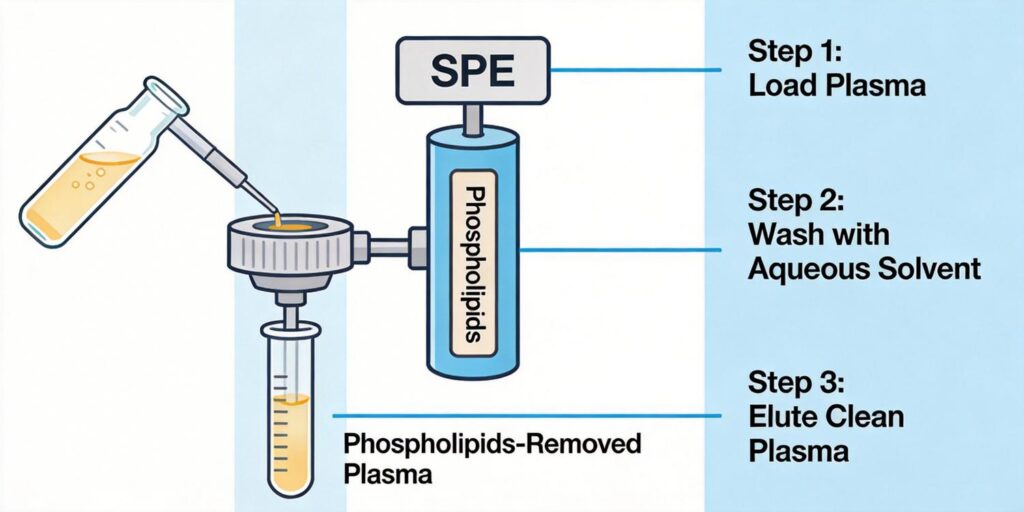
Proper conditioning is essential for activating the HLB sorbent and ensuring optimal analyte retention. The standard conditioning protocol involves sequential solvent treatments:
- 1 mL methanol to wet the sorbent surface and penetrate bonded phases
- 1 mL water to remove excess methanol and prepare for aqueous sample loading
As noted in SPE literature, “Methanol wets the surface of the sorbent & penetrates bonded alkyl phases, allowing water to wet the silica surface efficiently.” This two-step conditioning ensures that the sorbent bed is properly activated and ready to interact with the sample matrix.
Loading Diluted Cosmetic Extract
Sample loading should be performed at controlled flow rates to ensure optimal analyte retention. Research indicates that flow rate significantly impacts recovery, with slower flow rates generally providing better results. For cosmetic samples, maintaining a flow rate of 1-2 mL/min during loading is recommended.
SPE tips for improving recovery and precision recommend leaving approximately 1/4 to 1/2 tube volume above the sorbent bed when using tube reservoirs above cartridges. Using drop-wise solvent flow when time/throughput is not a major concern can also improve recovery rates.
Washing with Water to Remove Surfactants and Salts
The washing step serves to remove interfering matrix components while retaining target analytes. For cosmetic samples, water washing effectively removes surfactants, salts, and other hydrophilic interferences. Research on fat-soluble vitamin extraction found that water and 5% methanol-water solutions showed no difference as detergents, with 5% methanol solution being chosen as a common detergent.
This step is critical for removing cosmetic excipients that could interfere with subsequent analysis. As demonstrated in pharmaceutical cream analysis, washing steps effectively remove preservatives like methyl- and propyl-p-hydroxybenzoate that exhibit UV spectral properties which can interfere with spectrophotometric assays.
Elution with Methanol
Methanol serves as an effective elution solvent for a wide range of cosmetic ingredients due to its proton donor properties and ability to disrupt hydrogen bonding on the HLB sorbent. Research indicates that methanol has a relative elution strength of 1.0 and effectively disrupts H-bonding interactions.
For optimal recovery, SPE tips recommend allowing the cartridge/plate to soak with eluent for 0.5-1 minute to improve recovery. Sometimes several smaller eluent aliquots can improve recovery compared to a single large volume. The choice of elution solvent should also consider ease of evaporation if reconstitution is needed for subsequent analysis.
LC-MS Analysis of Preservatives or Active Ingredients
The final eluate, now cleaned of matrix interferences, is ready for LC-MS analysis. The methanol eluate can be directly injected or evaporated and reconstituted in mobile phase compatible solvents. This cleanup strategy has proven effective for various cosmetic analyses, including preservative monitoring and active ingredient quantification.
Research demonstrates that SPE cleanup significantly improves analytical results. In one study comparing chromatograms before and after SPE-treated concentrate feed spiked with vitamins, the importance of utilizing Oasis HLB cartridges was clearly shown, especially for compounds like vitamin K3. The method validation for fat-soluble vitamins showed recoveries ranging from 87.6% to 129.6% with coefficients of variation typically below 10%.
This comprehensive SPE strategy provides cosmetic analysts with a robust method for sample cleanup that addresses the unique challenges of cosmetic formulations while delivering reliable results for quality control and regulatory compliance purposes.