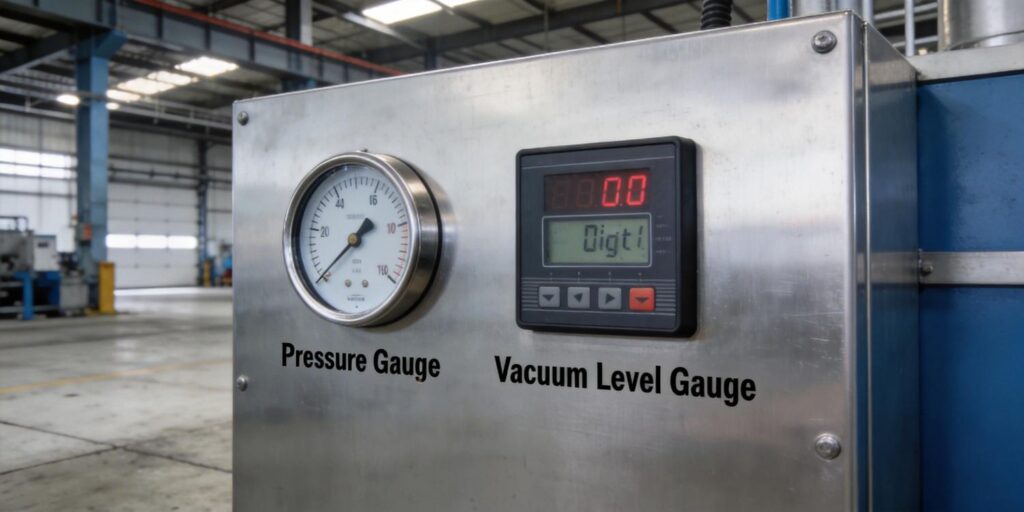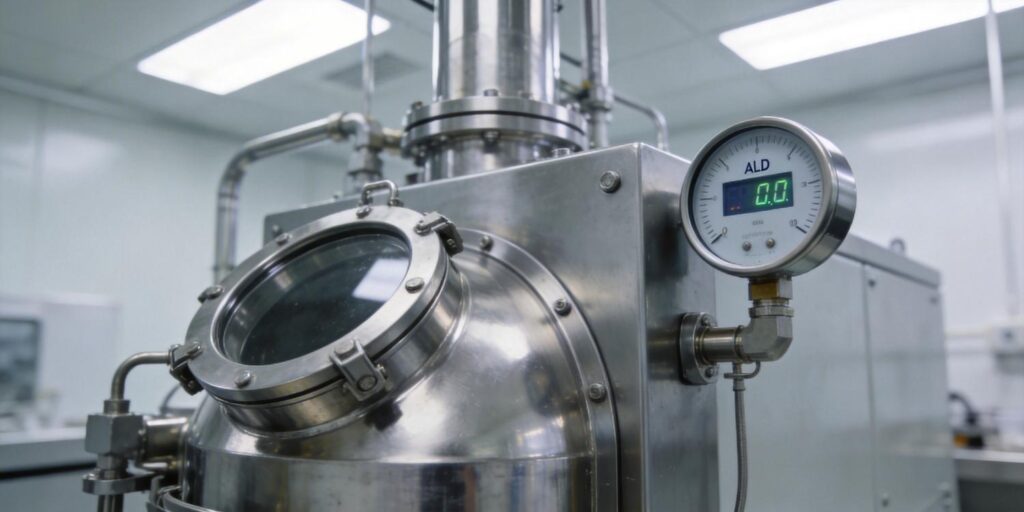
Atomic Layer Deposition (ALD) systems demand exceptional vacuum control to achieve self-limiting surface reactions, uniform film growth at the angstrom scale, and minimal contamination. Engineers and procurement specialists integrating vacuum instrumentation know that even minor pressure drifts or delayed response during precursor pulses can compromise throughput, film quality, and process repeatability. Poseidon Scientific’s VG-SP205 Pirani Vacuum Transmitter and VG-SM225 Cold Cathode Vacuum Gauge were engineered precisely for these compact, cost-sensitive environments. With measurement ranges that seamlessly cover both process pulses and base vacuum, these instruments deliver the durability and integration flexibility required in modern thin-film ALD tools.
ALD Vacuum Stability Requirements
ALD processes typically operate with base pressures below 10−6 Torr to eliminate residual gases and water vapor that could cause nucleation defects or non-uniformity. During each cycle, precursor pulses raise chamber pressure—often to the 0.1–5 Torr range—followed by purge steps that must rapidly return to high vacuum. Literature on vacuum science emphasizes that stability within ±5 % across thousands of cycles is essential for saturation and growth-per-cycle consistency.
Both thermal ALD and plasma-enhanced ALD (PEALD) share these requirements, though PEALD adds the complexity of reactive plasma species. Any gauge used must tolerate temperature fluctuations (15–50 °C typical in ALD chambers) and maintain calibration despite varying gas mixtures. The Poseidon VG-SP205 handles the higher-pressure regime with its thermal-conductivity principle, while the VG-SM225 extends reliable monitoring into the 10−3 to 10−7 Torr window using Penning discharge. Together they provide continuous coverage without gaps, supporting the stringent stability demanded by semiconductor and optics manufacturers.
Key Stability Metrics in ALD
- Base pressure recovery time after purge < 10 s
- Pressure reproducibility across cycles ±2 %
- Minimal outgassing from gauge components
- Resistance to precursor-induced contamination
Pulse Gas Injection Monitoring
Precursor injection creates rapid pressure spikes that must be monitored in real time to confirm dose saturation and avoid overdosing. The VG-SP205 Pirani Vacuum Transmitter excels here. Its platinum filament maintains constant temperature while measuring the power required to counteract gas cooling—directly proportional to molecular density up to atmospheric pressure and down to 10−3 Torr.
Because most ALD pulses occur in the 0.1–10 Torr band, the Pirani’s linear response region (10 Torr to 10−2 Torr) delivers fast, accurate readings without the non-linearity issues seen at extremes. Engineers appreciate its maintenance-free design; unlike filament-based hot-cathode gauges, the VG-SP205 experiences no burnout risk from reactive precursors. Factory calibration against standard vacuum references ensures traceability, and the 0–10 V analog output plus customizable RS-232 protocol integrate directly with ALD tool controllers for closed-loop dosing control.
Fast Pressure Transition Handling
ALD cycles demand sub-second response to pressure changes—precursor dose, purge, and repeat. The VG-SP205’s thermal time constant is inherently short, allowing it to track rising and falling edges with minimal lag. In contrast, cold-cathode gauges can exhibit delayed discharge initiation at ultra-low pressures; however, the VG-SM225 mitigates this through its positive-magnetron geometry and software-controlled voltage ramp (–2500 V startup, then –2000 V steady state).
When paired, the two gauges complement each other: the Pirani captures the high-pressure transients, while the VG-SM225 confirms base-pressure recovery. Real-world testing shows the combination resolves transitions faster than single-gauge solutions, enabling tighter cycle timing and higher throughput. Temperature-compensation circuitry in both instruments further stabilizes readings across the 15–50 °C operating window common in heated ALD reactors.
Gauge Placement Outside Plasma Region
In PEALD systems, direct exposure to plasma can degrade gauge performance through ion bombardment or electromagnetic interference. The compact footprint of the VG-SM225 (positive-magnetron design) allows installation on a side port or KF-flange extension well outside the plasma zone. This placement preserves the gauge’s 100-gauss magnetic field from interacting with substrate bias or RF sources while still sampling chamber vacuum accurately via conductance-limited tubing.
The VG-SP205, being non-magnetic and fully passive, can be mounted closer to the showerhead if needed for faster response. Both gauges feature KF16/KF25 compatibility and arbitrary orientation mounting, simplifying retrofits into existing ALD platforms. For systems using complex gas chemistries (e.g., organometallics or ammonia), the cold cathode’s removable sensor head permits periodic cleaning with 500-mesh sandpaper—restoring original performance without breaking vacuum seals.
Installation Best Practices
- Mount gauges on separate KF ports to minimize flow-conductance errors
- Use short, high-conductance tubing for the Pirani near the gas inlet
- Keep the cold-cathode sensor >10 cm from magnetic-sensitive components
- Enable software interlock to shut off high voltage above 10−3 Torr
Process Stability Optimization
Integrating the VG-SP205 and VG-SM225 creates a dual-range monitoring solution that directly improves ALD process stability. Continuous logging of both rough and high-vacuum regimes allows engineers to optimize purge times, detect early contamination, and verify cycle-to-cycle repeatability. The low internal volume of the VG-SM225 (comparable to industry-leading designs) minimizes pumping speed perturbation, while its cleanable electrodes extend service life to 3–5 years in typical semiconductor environments.
Cost advantages are equally compelling: Poseidon’s in-house development keeps pricing 40–60 % below imported equivalents, making dual-gauge installations economical even for research-grade tools. Custom RS-232 protocols—available from 5–10 unit orders—eliminate the need for third-party converters, streamlining integration with PLC or SCADA systems. For applications requiring absolute accuracy across varying precursor gases, factory recalibration or relative drift monitoring still provides actionable process feedback far superior to single-range instruments.
These benefits translate to higher uptime, lower consumable costs, and repeatable film properties—critical metrics for both high-volume manufacturing and next-generation device development.
Ready to Enhance Your ALD Vacuum Control?
Whether you are specifying gauges for a new ALD cluster tool or upgrading legacy systems, the VG-SP205 Pirani Vacuum Transmitter and VG-SM225 Cold Cathode Vacuum Gauge deliver the performance, size, and customization engineers need at a price that fits procurement budgets. Explore technical specifications and request a quote today:
- VG-SP205 Pirani Vacuum Transmitter – ideal for pulse monitoring and process pressures
- VG-SM225 Cold Cathode Vacuum Gauge – precision base-vacuum measurement with easy maintenance
Contact the Poseidon Scientific applications team to discuss protocol customization, installation drawings, or a side-by-side comparison with your current gauges. Our engineers are ready to help you achieve the vacuum stability your ALD process demands—reliably and affordably.