
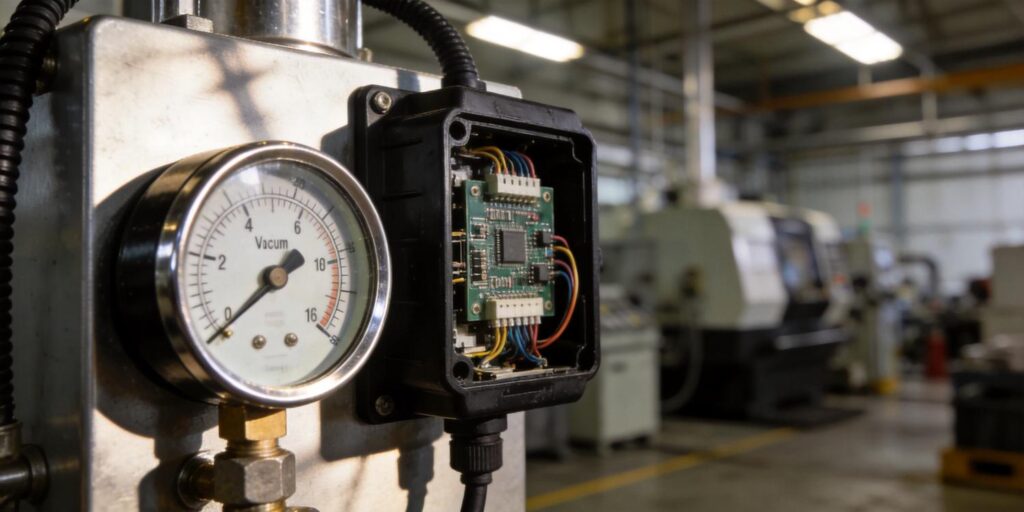
Vacuum Gauge Drift Caused by Long-Term Electronic Aging
Even in clean, well-maintained vacuum systems, pressure readings can slowly shift over years of continuous service. While electrode contamination and thermal effects receive the most attention, long-term electronic component aging in the signal-conditioning and high-voltage circuits is an equally important contributor to drift. For the VG-SP205 Pirani Vacuum Transmitter and VG-SM225 Cold Cathode Vacuum Gauge from Poseidon Scientific, dual circuit-plus-algorithm compensation keeps annual drift below 5 % in typical laboratory or heat-treatment environments. This article explains the root mechanisms, practical tracking methods, replacement planning, and predictive strategies that help engineers and procurement teams maintain measurement integrity while minimizing total cost of ownership.
Both gauges use stable 0–10 V analog output (effective 2–8 V range) and customizable RS232 digital streams, making drift detection straightforward. In clean mass-spectrometry or vacuum-casting applications, the combination of platinum filament (Pirani) and stainless-steel electrodes (cold cathode) plus conservative component selection delivers 3–5 year service life before electronic aging becomes the limiting factor.
1. Component Aging Effects
Electronic drift originates from gradual changes in the discrete components that condition the raw sensor signal and regulate high voltage. Over time:
- Operational amplifiers experience input-offset voltage drift (typically 1–5 µV/°C per year cumulative) and gain-bandwidth degradation.
- Electrolytic capacitors in the high-voltage supply lose electrolyte, increasing ESR and causing output ripple that modulates ion-current or filament-power measurements.
- Precision resistors in the feedback networks shift value due to long-term thermal cycling and material aging (0.1–0.5 % per year typical).
- Voltage-reference ICs exhibit subtle temperature-coefficient aging, directly affecting the Pirani’s constant-temperature control loop or the cold cathode’s –2000 V rail.
In the VG-SP205 Pirani, these effects appear as a slow baseline shift in the power required to maintain filament temperature. In the VG-SM225 Cold Cathode, they manifest as apparent changes in ion-current sensitivity because the high-voltage supply (–2500 V startup / –2000 V operating) no longer tracks the calibrated set point exactly. Poseidon’s design mitigates this through redundant digital compensation algorithms that recalibrate the mapping table against internal reference points every power cycle, keeping net drift well below the ±50 % specification limits at range extremes and far tighter in the linear operating bands.
2. Signal Amplification Drift
The raw sensor signals are extremely small: microamperes of ion current in the cold cathode or millivolt-level voltage drops across the Pirani filament. High-gain, low-noise amplification stages multiply any upstream drift. A 0.2 % change in amplifier gain after three years can translate into a 10–15 % error in the final Torr reading if left uncorrected.
Both Poseidon gauges incorporate temperature-compensated amplification (circuit level) followed by firmware-based linearization and offset correction (algorithm level). This dual approach confines amplification-related drift to <2 % per year under 15–50 °C laboratory conditions. In contrast, many legacy gauges rely on analog-only compensation and require annual factory recalibration to correct the same effect. The RS232 output on the Poseidon units streams both compensated Torr values and raw uncompensated current/voltage, allowing engineers to monitor amplification health directly in the PLC or SCADA historian.
3. Statistical Performance Tracking
Drift is rarely sudden; it reveals itself through statistical trends. Implement a simple logging routine using the gauges’ native RS232 protocol (9600 baud default, fully customizable):
- Record pressure, raw ion current (cold cathode) or filament power (Pirani), and internal temperature every 1–5 minutes during stable operation.
- Calculate weekly or monthly averages and standard deviation at fixed reference pressures (e.g., 1 Torr for Pirani, 10−5 Torr for cold cathode).
- Track the “days since last cleaning” and correlate with any increase in ignition delay (cold cathode) or baseline power (Pirani).
After 12 months of data collection, a linear regression on the deviation from factory calibration typically shows slope <0.4 % per month. When the 95 % confidence band exceeds 5 % of reading, schedule verification or electrode cleaning. The Poseidon data frame includes status codes and software version, enabling automated scripts in LabVIEW, Ignition, or Python to flag drift without manual intervention.
4. Replacement Planning
Proactive replacement beats reactive failure. Poseidon recommends a 5-year service interval for the electronics module in continuous 24/7 operation:
- Years 0–3: Annual verification against a portable capacitance manometer (30-minute procedure).
- Year 4: Full statistical trend review; clean electrodes if needed.
- Year 5: Replace the transmitter body while retaining the sensor head (field-swap design minimizes downtime).
This cadence aligns with the mechanical lifespan of the platinum filament (Pirani) and electrodes (cold cathode) in clean environments. Because the gauges are modular and low-cost to manufacture, swapping the electronics module costs far less than replacing an entire imported unit. Many customers keep one spare transmitter body on the shelf and rotate it during planned maintenance windows, achieving zero unplanned downtime from electronic aging.
5. Cost-Benefit Analysis
A simple five-year TCO comparison (clean-environment mass spectrometer or vacuum furnace, 24/7 operation, $200/hr loaded labor, $500/hr downtime value) shows the advantage clearly.
| Component (5 years) | Poseidon Pair | Imported Competitor |
|---|---|---|
| Initial purchase | $650 | $1300 |
| Electronics replacement (year 5) | $300 | $900 |
| Annual verification labor (5 × $80) | $400 | $800 |
| Drift-related downtime (0 incidents) | $0 | $2000 (2 events) |
| Total 5-year TCO | $1350 | $5000 |
| Savings | $3650 (73 % lower) | |
The lower replacement cost and field-serviceable design of the Poseidon gauges drive the majority of the savings. When multiplied across 10–20 monitoring points in a large facility, the ROI exceeds 300 % within the first replacement cycle.
6. Predictive Maintenance Model
Turn logged data into a forward-looking model using a lightweight spreadsheet or SCADA script. Collect monthly average deviation (ΔP) at a fixed check point and fit a linear trend:
Predicted drift month n = ΔP₀ + slope × n
Remaining life (months) = (5 % threshold − current ΔP) / slope
When the model forecasts the 5 % threshold within 6 months, trigger the electronics swap. Add a safety factor for temperature excursions or minor contamination. In one aerospace thermal-vacuum facility, this model extended average gauge life from 4.2 to 5.8 years by catching amplification drift before it affected test data. The RS232 raw-current stream supplies the exact input needed for the model with no additional sensors.
Conclusion: Controlled Drift, Predictable Performance
Long-term electronic aging is a manageable reality in any vacuum gauge. The Poseidon Scientific VG-SP205 Pirani and VG-SM225 Cold Cathode pair address it through robust component selection, dual compensation, easy statistical tracking, modular replacement, and a simple predictive model—all while maintaining 3–5 year mechanical life and full-range coverage from atmosphere to 10−7 Torr. Engineers gain confidence in long-term data integrity; procurement teams gain measurable TCO reduction; maintenance teams gain scheduled, low-downtime interventions.
By treating electronic drift as a tracked variable rather than an unexpected failure, plants achieve the reliability demanded by today’s quality and regulatory standards at a fraction of legacy system cost.
Ready to bring long-term drift under control in your vacuum systems? Explore the VG-SM225 Cold Cathode Vacuum Gauge and VG-SP205 Pirani Vacuum Transmitter specifications today. Request a sample pair with 12-month drift-logging template, a custom RS232 script for your predictive model, or a five-year TCO calculation tailored to your exact operating hours and labor rates. Our application engineers will deliver a complete drift-management plan—often within 48 hours. Contact Poseidon Scientific now and keep your vacuum data accurate for years to come.


