Overview of Biogenic Amines in Fermented Foods
Biogenic amines are nitrogenous compounds formed primarily through microbial decarboxylation of amino acids during fermentation processes. In fermented food products like wine, cheese, sauerkraut, and fermented meats, three key amines pose significant quality and safety concerns: histamine, tyramine, and putrescine. Histamine, derived from histidine, is particularly problematic as it can cause allergic-like reactions including headaches, flushing, and gastrointestinal distress at concentrations as low as 50 mg/kg. Tyramine, produced from tyrosine, is associated with hypertensive crises in individuals taking MAO inhibitors. Putrescine, formed from ornithine, while less toxic itself, can potentiate the effects of other amines and serves as a spoilage indicator.
According to research by Busto et al. (1994), SPE has been successfully applied to the determination of biogenic amines in wines, demonstrating that proper extraction techniques can provide 50-fold concentration effects that bring analytes into the linear response range of detectors. The challenge in fermented food analysis lies in the complex matrices containing proteins, fats, sugars, and organic acids that can interfere with amine detection.
Sample Preparation: Acid Extraction and Clarification
Perchloric Acid Extraction
The first critical step in biogenic amine analysis involves liberating bound amines from the food matrix. For most fermented products, perchloric acid extraction (typically 0.4-0.6 M) proves effective. The acidic environment not only extracts amines but also precipitates proteins and other macromolecules. For 5-10g samples, homogenization with 20-30mL of cold perchloric acid solution followed by vortexing for 2-3 minutes ensures complete extraction. The low temperature (4°C) minimizes amine degradation during processing.
Centrifugation and Filtration
Following acid extraction, samples require centrifugation at 10,000-15,000 × g for 15-20 minutes at 4°C to pellet precipitated proteins and cellular debris. The supernatant must then be filtered through 0.45μm membrane filters to remove residual particulates that could clog SPE cartridges. For particularly fatty matrices like cheese or fermented meats, an additional defatting step with hexane or petroleum ether may be necessary before SPE.
WCX SPE Cartridge Selection and Conditioning
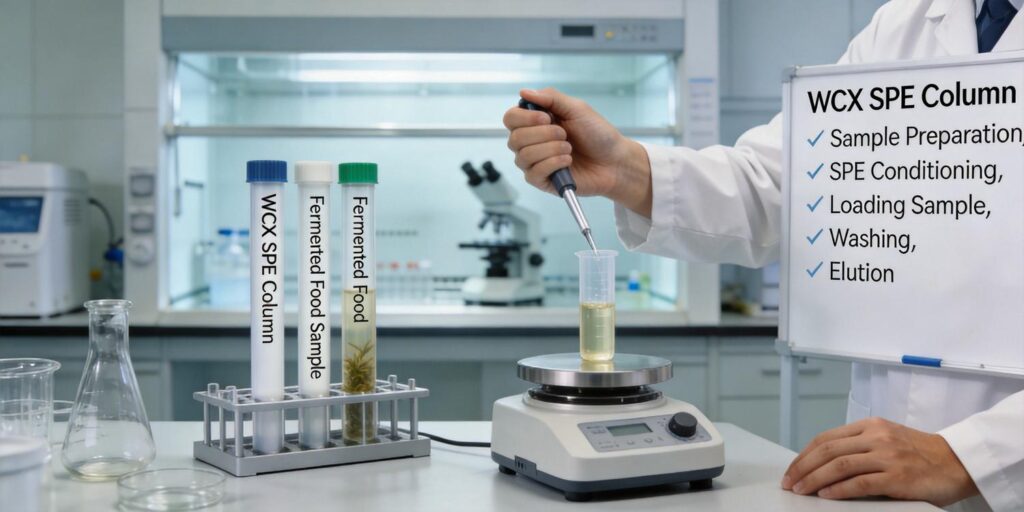
Weak Cation Exchange (WCX) cartridges provide optimal selectivity for biogenic amine extraction. Unlike strong cation exchangers (SCX) that retain all cationic species regardless of pKa, WCX sorbents with carboxylate functional groups (pKa ~4-5) offer pH-dependent selectivity. This allows selective retention of target amines while excluding strongly basic interferents. As noted in Waters documentation, WCX materials provide “better sample preparation for strong bases and quaternary amines” through mixed-mode retention combining ion-exchange and reversed-phase mechanisms.
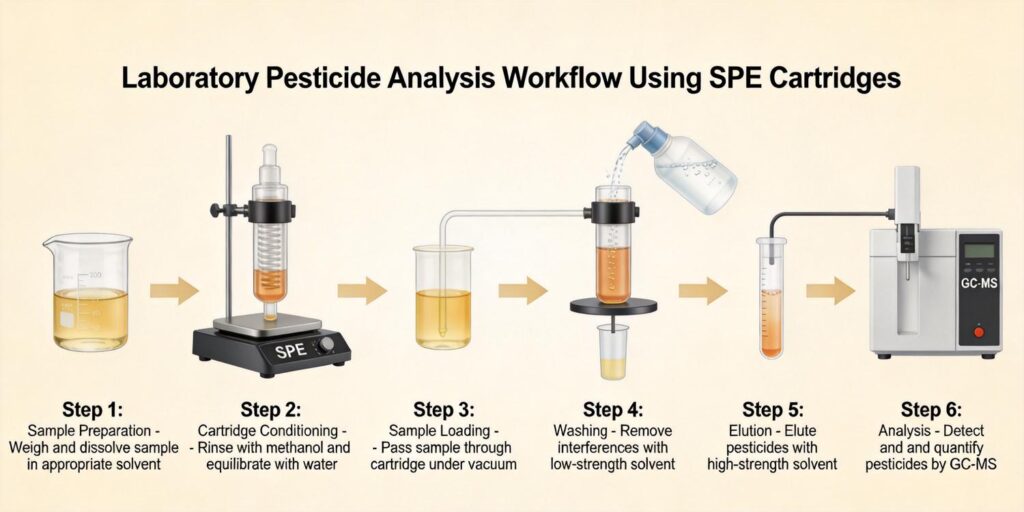
Conditioning follows a standard protocol: 3-5mL methanol to wet the hydrophobic polymer backbone, followed by 3-5mL deionized water to create an aqueous environment. For 60mg WCX cartridges (3cc format), flow rates should not exceed 1-2mL/min during conditioning to ensure uniform bed preparation.
pH Optimization for Sample Loading
The critical parameter for successful WCX extraction is sample pH adjustment to 5-6. At this pH range, biogenic amines (pKa values typically 9-11) exist predominantly in their protonated, cationic forms, while the WCX carboxylate groups remain partially ionized. This creates optimal conditions for ion-exchange retention. The extracted sample should be adjusted using dilute NaOH or HCl, with verification by pH meter. Buffer systems like phosphate or acetate at 10-50mM concentration help maintain pH stability during loading.
Wash Steps: Removing Matrix Interferences
Aqueous Wash
Following sample loading, a 3-5mL deionized water wash removes water-soluble neutral and anionic interferents—sugars, organic acids, and inorganic salts—that don’t interact with the WCX phase. This step significantly reduces matrix effects in subsequent chromatographic analysis.
Organic Wash
A 2-3mL methanol wash serves dual purposes: it removes residual water from the cartridge bed (preparing for elution) and elutes weakly retained neutral organic compounds that might have adsorbed through hydrophobic interactions. Research indicates that compounds like benzocaine and diazepam, which initially retain through non-polar interactions but lack strong cation-exchange capability, elute in methanolic washes, demonstrating the importance of this cleanup step.
Elution Strategy for Maximum Recovery
Biogenic amines are efficiently eluted using methanol containing 5% ammonium hydroxide. The alkaline conditions (pH ~11) neutralize the carboxylate groups on the WCX sorbent, eliminating ion-exchange interactions, while simultaneously deprotonating the amines, converting them to neutral species. The methanol provides sufficient elution strength to overcome any residual reversed-phase interactions. Typically, 3-6mL of elution solvent provides >95% recovery for histamine, tyramine, and putrescine. Eluates should be collected in glass tubes and either analyzed immediately or evaporated under gentle nitrogen stream at 40°C for concentration.
Derivatization and HPLC-Fluorescence Detection
Dansyl Chloride Derivatization
Most biogenic amines lack native chromophores or fluorophores for sensitive detection, necessitating derivatization. Dansyl chloride (5-dimethylaminonaphthalene-1-sulfonyl chloride) remains the reagent of choice, reacting with primary and secondary amines to form highly fluorescent derivatives. The reaction occurs in alkaline medium (pH 9-10) using sodium bicarbonate buffer, with 30-60 minute incubation at 40°C in the dark. Excess reagent is quenched with ammonia or proline.
HPLC Separation and Detection
Reversed-phase HPLC on C18 columns (150-250mm × 4.6mm, 5μm) with gradient elution using acetonitrile/water or methanol/water provides excellent separation of dansyl-amines. Typical gradients run from 50% to 95% organic over 20-30 minutes. Fluorescence detection at excitation 340nm and emission 515nm offers exceptional sensitivity with detection limits often below 0.1mg/kg. Method validation should include linearity (r²>0.995), precision (RSD<5%), accuracy (85-115% recovery), and specificity confirmed through retention time matching and spectral purity assessment.
Method Performance and Quality Control
Properly optimized WCX SPE methods for biogenic amines typically achieve 85-105% recoveries with RSDs of 2-8% across relevant concentration ranges (1-200mg/kg). Internal standards like 1,7-diaminoheptane or hexamethylenediamine should be added before extraction to correct for procedural losses. Quality control samples at low, medium, and high concentrations should accompany each batch, with acceptance criteria based on laboratory quality guidelines.
Comparative Advantages of WCX Over Alternative SPE Phases
While C18 phases have been used for biogenic amine extraction (as demonstrated by Busto et al. for wine analysis), they lack the selectivity of WCX materials. C18 retains amines primarily through hydrophobic interactions, leading to co-extraction of numerous neutral interferents. Strong cation exchangers (SCX) retain amines too strongly, requiring harsh elution conditions that may degrade analytes. WCX’s pH-dependent selectivity provides the ideal balance: efficient retention under loading conditions and gentle elution with mild alkaline methanol.
For laboratories analyzing multiple fermented food types, WCX SPE offers consistent performance across different matrices. The method described here has been successfully adapted for wine, beer, cheese, fermented vegetables, and fish products with only minor modifications to the initial extraction protocol.
Practical Considerations for Implementation
When implementing this method, consider these practical aspects: (1) Use fresh perchloric acid solutions to avoid amine oxidation, (2) Process samples quickly after extraction to minimize amine formation or degradation, (3) Ensure WCX cartridges don’t dry completely between conditioning and loading steps, (4) Verify pH at each critical step, (5) Use amber vials for dansyl derivatives to prevent photodegradation, and (6) Establish matrix-matched calibration curves for accurate quantification.
For high-throughput laboratories, 96-well WCX plates offer automation compatibility while maintaining the selectivity of cartridge formats. Poseidon Scientific’s WCX products provide consistent ion-exchange capacity and lot-to-lot reproducibility essential for regulatory compliance in food safety testing.
This comprehensive WCX SPE approach to biogenic amine analysis combines robust sample cleanup with sensitive detection, meeting the needs of quality control laboratories, regulatory agencies, and food manufacturers concerned with fermentation product safety and quality.