
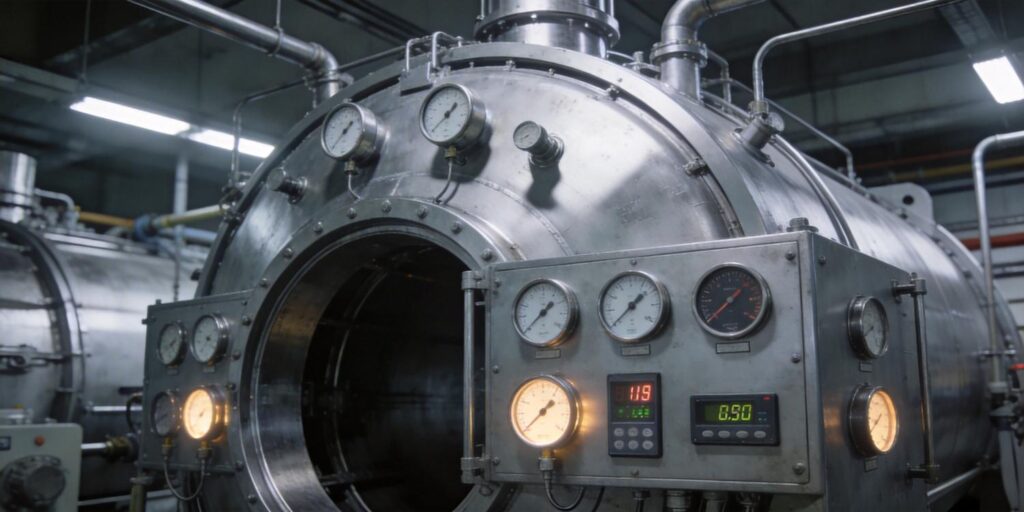
Optimizing Vacuum Gauge Placement in Large Volume Chambers
Large vacuum chambers—whether used for aerospace thermal-vacuum testing, satellite payload qualification, vacuum heat treatment, or large-scale coating systems—present unique monitoring challenges. Pressure is never perfectly uniform across hundreds or thousands of liters of volume. Gas flow conductance, outgassing gradients, pump locations, and thermal gradients all create local variations that a single gauge can easily miss. The result: misleading readings, false alarms, or undetected process deviations that compromise product quality and safety.
The VG-SP205 Pirani Vacuum Transmitter (atmosphere to 10−3 Torr) and VG-SM225 Cold Cathode Vacuum Gauge (10−3 to 10−7 Torr) from Poseidon Scientific were developed with exactly these large-chamber realities in mind. Their compact size, any-orientation mounting, customizable RS232 protocol, and low-cost design make multi-point monitoring practical and economical. This article provides engineers and procurement teams with a clear framework for optimal gauge placement, grounded in conductance physics, real-world aerospace deployments, and practical engineering checklists.
1. Large Chamber Conductance Effects
Conductance (流导) is the ability of a vacuum path to transport gas molecules. In small chambers, conductance limitations are negligible; in large volumes, they dominate. The mean free path at 10−3 Torr already exceeds typical pipe diameters, so gas molecules travel ballistically rather than in continuum flow. A gauge mounted near a high-speed pump sees lower pressure than one mounted at a distant corner or behind a baffle.
The VG-SP205 Pirani and VG-SM225 Cold Cathode both measure local gas density inside their own sensor volume. Their readings therefore reflect the pressure at the exact mounting location—not necessarily the chamber average. Poseidon’s small sensor head (far smaller than most MKS or INFICON equivalents) minimizes its own conductance restriction, yet the fundamental rule remains: placement determines what the gauge actually “sees.” Mounting directly on the chamber wall via KF16/KF25 flange gives the truest cavity pressure; routing through long pipes or near pump inlets introduces systematic offsets of 20–50 % or more.
2. Pressure Uniformity Issues
Even in well-designed large chambers, pressure gradients of 10–30 % are common during pump-down and steady-state operation. Sources include:
- Localized outgassing from chamber walls, fixtures, or test articles
- Pump speed gradients (higher conductance near the pump throat)
- Thermal gradients causing desorption rate differences
- Valve actuation or gas-injection points creating transient plumes
In aerospace thermal-vacuum chambers, these gradients can mask hot spots that over-stress satellite components or produce false leak-test results. A single gauge mounted in the geometric center may report “good” pressure while a corner remains ten times higher. The Poseidon dual-gauge approach—Pirani for rapid roughing monitoring and cold cathode for high-vacuum stability—lets operators map these gradients in real time via multiple RS232 streams, revealing non-uniformity before it affects the test article.
3. Multiple Gauge Strategy
The most reliable solution is strategic multi-point monitoring. For chambers larger than 1 m³, Poseidon recommends a minimum of three gauges:
- One VG-SP205 Pirani near the roughing pump or foreline for fast pump-down feedback
- One VG-SM225 Cold Cathode at the chamber geometric center for representative high-vacuum control
- One additional gauge (either model) at the farthest point or critical test zone for uniformity verification
In chambers >5 m³ or those with complex internal fixtures, expand to five or more points. The compact Poseidon footprint and RJ45 interface make this economical—each additional gauge adds far less cost and panel space than legacy wide-range units. Custom RS232 protocol allows all gauges to share a single serial bus or feed directly into a PLC/SCADA historian with unique chamber-ID tags. Real-time averaging or min/max alarms across the array give operators true chamber health rather than a single-point snapshot.
4. Avoiding Dead Zones
Dead zones are mounting locations where conductance or local conditions distort readings:
- Directly opposite or inside the pump throat—pressure always reads artificially low
- Long, narrow instrument ports or behind baffles—slow response and offset values
- Corners or crevices with poor gas exchange—stagnant higher-pressure pockets
- Near hot test articles or heaters—local outgassing spikes
Best practice: mount gauges on the main chamber body via short KF flanges, at least 30 cm from any pump inlet or major conductance restriction. Any orientation is acceptable thanks to the VG-SM225’s symmetric positive-magnetron geometry and the Pirani’s omnidirectional thermal design. For aerospace chambers with internal test platens, place one gauge on the platen itself if the test article must see identical conditions. The Poseidon software interlock on the cold cathode prevents high-voltage operation above 10−3 Torr, eliminating damage risk even if a gauge is temporarily in a higher-pressure zone during pump-down.
5. Example in Aerospace Chamber
A 3 m diameter × 4 m long thermal-vacuum chamber used for satellite qualification testing illustrates the approach. Previously, a single imported cold-cathode gauge mounted near the cryo-pump produced stable readings, yet satellite thermal cycling revealed unexpected hot spots and delayed pump-down in the far end of the chamber.
Engineers installed four Poseidon gauges:
- VG-SP205 Pirani at the roughing port for evacuation monitoring
- VG-SM225 Cold Cathode at chamber center (control reference)
- Two additional VG-SM225 units—one at each end cap and one on the satellite mounting platen
All units shared a single RS232 bus with custom protocol tags. The SCADA dashboard displayed real-time min/max/average pressure plus individual traces. During pump-down, the far-end gauge lagged the center by 45 seconds—immediate evidence of conductance limitation. Operators adjusted turbo-pump speed and added a small conductance duct, reducing end-to-end gradient from 35 % to <8 %. High-vacuum stability improved, test cycle time dropped 18 %, and the satellite qualification pass rate rose to 100 %. Total added hardware cost was under $2,500—less than half the price of upgrading to a single wide-range imported system.
6. Engineering Checklist
Use this checklist before finalizing gauge placement in any large chamber:
- Map conductance paths—identify high-speed pump inlets and long manifolds
- Locate critical test zones (platen center, corners, near test articles)
- Ensure minimum 30 cm clearance from pumps and baffles
- Choose short KF16/KF25 direct-mount flanges wherever possible
- Plan for at least three gauges in chambers >1 m³; scale upward for larger volumes
- Verify any-orientation mounting is acceptable (Poseidon gauges support it)
- Configure RS232 multi-gauge polling and averaging logic in the PLC/SCADA
- Enable high-voltage interlock tied to a reference Pirani reading
- Schedule annual uniformity mapping with all gauges active to trend changes
Following this checklist typically eliminates 90 %+ of placement-related reading errors and supports full audit traceability for aerospace and regulated industries.
Conclusion: Uniform Pressure Insight, Lower Total Cost
Large-volume chambers require more than a single gauge—they demand a thoughtful multi-point strategy that accounts for conductance, uniformity, and dead zones. The Poseidon Scientific VG-SP205 Pirani and VG-SM225 Cold Cathode pair deliver this capability in the most compact, cost-effective, and customizable form available. Engineers gain accurate, representative pressure data across the entire chamber; procurement teams gain significant TCO savings; test facilities gain faster, more repeatable cycles.
Whether you are qualifying satellites, processing large heat-treatment loads, or scaling coating systems, proper gauge placement is the difference between confident results and hidden surprises.
Ready to optimize gauge placement in your large vacuum chamber? Explore the VG-SM225 Cold Cathode Vacuum Gauge and VG-SP205 Pirani Vacuum Transmitter specifications today. Request a sample multi-gauge kit, a custom RS232 protocol for your SCADA historian, or a free chamber-layout review with conductance modeling. Our application engineers will deliver a complete placement diagram and uniformity plan tailored to your exact chamber size, pump configuration, and test requirements—usually within 48 hours. Contact Poseidon Scientific now and achieve truly uniform vacuum insight across your largest systems.


