Overview of Metabolomics Workflows and Need for Clean Extracts
Metabolomics has emerged as a critical analytical discipline in systems biology, pharmaceutical research, and clinical diagnostics, focusing on the comprehensive analysis of small molecule metabolites in biological systems. The success of any metabolomics study hinges on the quality of sample preparation, particularly when coupled with sensitive detection techniques like liquid chromatography-mass spectrometry (LC-MS).
As noted in SPE literature, successful sample preparation for analytical techniques like LC-MS has a threefold objective: it must provide the sample component of interest in solution, free from interfering matrix elements, and at a concentration appropriate for detection or measurement. In metabolomics, this translates to the critical need for clean extracts that preserve the integrity of the metabolome while removing interfering substances that can compromise analytical performance.
The importance of clean extracts cannot be overstated. Matrix interferences such as proteins, salts, phospholipids, and other endogenous compounds can cause ion suppression in MS detection, leading to inaccurate quantification and reduced sensitivity. These interferences can also foul LC columns and MS interfaces, increasing maintenance costs and reducing instrument uptime. According to Waters documentation, phospholipids in particular are major contributors to matrix effects, ion suppression, shortened column life, increased MS maintenance costs, and increased LC-MS quantitative variability.
Sample Extraction from Plasma Using Methanol Precipitation
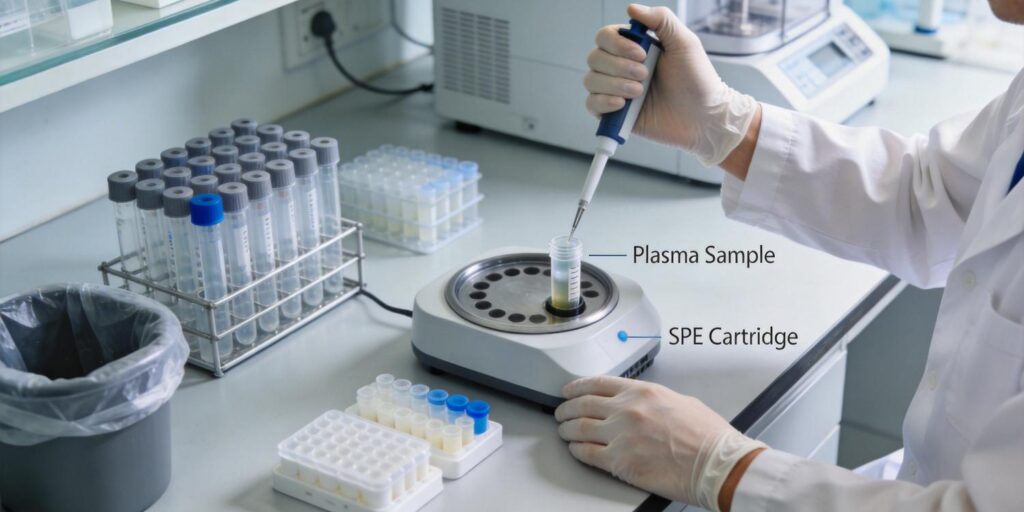
The first step in plasma metabolomics sample preparation typically involves protein precipitation to release metabolites from protein binding and remove the bulk of proteinaceous material. Methanol precipitation has become the method of choice due to its effectiveness in precipitating proteins while maintaining metabolite stability.
A standard protocol involves adding cold methanol to plasma samples at a ratio of 3:1 (methanol:plasma, v/v). This mixture is vortexed vigorously for 30-60 seconds, then incubated at -20°C for 20-30 minutes to enhance protein precipitation. The samples are subsequently centrifuged at high speed (typically 10,000-15,000 × g) for 10-15 minutes at 4°C to pellet the precipitated proteins.
The methanol precipitation step serves multiple purposes: it effectively denatures and precipitates proteins, releases protein-bound metabolites, and provides an initial cleanup by removing high molecular weight components. The resulting supernatant contains the metabolite-rich fraction ready for further purification.
Dilution of Supernatant Prior to SPE Loading
Following methanol precipitation, the supernatant contains methanol at a concentration that may be too high for optimal retention on HLB (Hydrophilic-Lipophilic Balanced) SPE cartridges. HLB sorbents, composed of a balanced ratio of lipophilic divinylbenzene and hydrophilic N-vinylpyrrolidone monomers, perform optimally when samples contain no more than 5-10% organic solvent.
The supernatant should be diluted with water or aqueous buffer to reduce the methanol concentration to approximately 5%. This dilution serves several important functions:
- Reduces organic solvent content to ensure proper retention of metabolites on the HLB sorbent
- Provides appropriate sample volume for efficient loading onto the SPE cartridge
- Helps maintain consistent flow rates during the loading process
- Ensures that hydrophilic metabolites are not prematurely eluted during sample loading
The dilution factor should be carefully optimized based on the initial methanol concentration and the specific metabolites of interest, as excessive dilution may reduce sensitivity for low-abundance metabolites.
Conditioning HLB Cartridges with Methanol and Water
Proper conditioning of HLB cartridges is essential for optimal performance. Unlike newer sorbents like Oasis PRiME HLB that eliminate conditioning steps, traditional HLB cartridges require careful preparation to ensure the sorbent is properly solvated and ready to retain analytes.
The standard conditioning protocol involves:
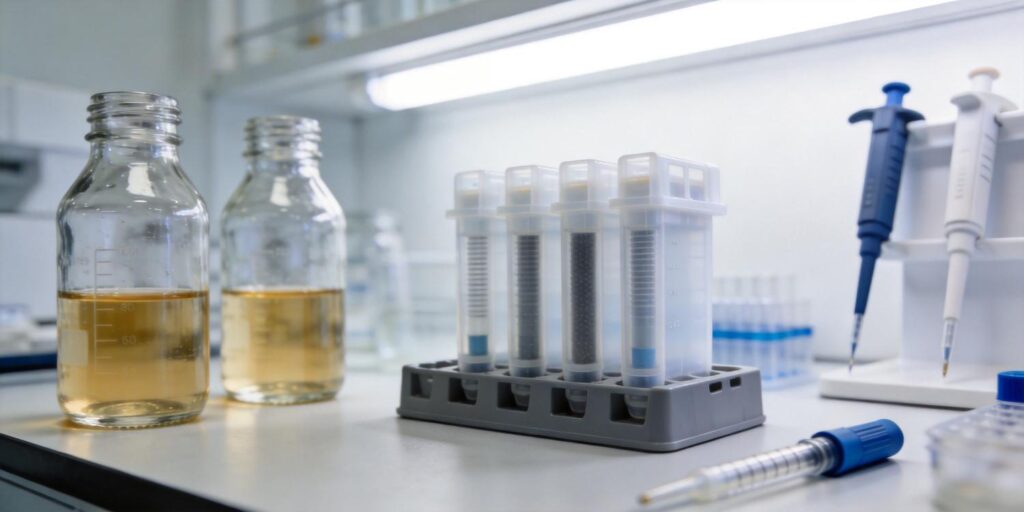
- Methanol Conditioning: Pass 2-3 column volumes of methanol through the cartridge at a flow rate of 1-2 mL/min. This step solvates the polymeric sorbent, opening up the pore structure and ensuring proper wetting of the hydrophobic components.
- Water Equilibration: Follow with 2-3 column volumes of water or aqueous buffer at the same flow rate. This step removes the methanol and prepares the sorbent for aqueous sample loading, ensuring that metabolites are properly retained during the loading phase.
It’s crucial to never let the sorbent bed dry out between conditioning and sample loading, as this can create channels in the sorbent bed and reduce recovery. The conditioning solvents should be allowed to flow through the cartridge until the sorbent bed is just covered with liquid before proceeding to sample loading.
Loading Metabolite Extract and Retaining Broad Metabolite Classes
HLB sorbents are particularly well-suited for metabolomics applications due to their ability to retain a broad range of metabolite classes with varying polarities. The balanced hydrophilic-lipophilic nature of the sorbent allows for retention of both polar and non-polar metabolites in a single extraction step.
During sample loading:
- Apply the diluted supernatant to the conditioned HLB cartridge at a controlled flow rate of 1-2 mL/min. Slower flow rates generally improve retention and recovery.
- Collect the flow-through in case any metabolites of interest are not retained (though this is uncommon with properly conditioned HLB cartridges).
- Rinse the sample container with a small volume of water or dilute aqueous solution to ensure complete transfer of metabolites to the cartridge.
The HLB sorbent’s unique copolymer structure provides several advantages for metabolomics:
- Broad Retention: Retains compounds across a wide polarity range (log P from -2 to 7)
- High Capacity: Typically 5-15 mg per 100 mg sorbent, depending on metabolite characteristics
- pH Stability: Compatible with solvents across pH 0-14, allowing flexibility in method development
- Excellent Recovery: Consistently high recovery (>90%) for most metabolite classes
Washing with Aqueous Solution to Remove Salts
Following sample loading, a washing step is essential to remove salts, residual proteins, and other polar matrix components that may have been retained on the sorbent. For HLB cartridges in metabolomics applications, the wash typically consists of 5% methanol in water.
The washing protocol involves:
- Apply 2-3 column volumes of 5% methanol in water to the cartridge
- Maintain a flow rate of 1-2 mL/min to ensure thorough washing without premature elution of metabolites
- Collect the wash fraction separately if monitoring for potential metabolite loss
This wash step serves several critical functions:
- Salt Removal: Eliminates inorganic salts that can cause ion suppression in MS analysis
- Matrix Cleanup: Removes polar interfering compounds that may co-elute with metabolites
- Reduced Ion Source Contamination: Minimizes fouling of MS ion sources
- Improved Chromatography: Reduces background noise and improves peak shapes
According to SPE literature, proper washing is particularly important for LC-MS applications where ion source quenching or other disruptions of the MS fragmentation/ionization process can occur due to residual matrix components.
Elution Using Methanol/Acetonitrile Mixture
Metabolite elution from HLB cartridges typically employs a mixture of organic solvents that effectively disrupt the interactions between metabolites and the sorbent. A common elution solvent for metabolomics applications is a mixture of methanol and acetonitrile (typically 90:10 or 80:20 ACN:MeOH).
The elution protocol includes:
- Apply 2-3 column volumes of the methanol/acetonitrile mixture to the cartridge
- Use a slower flow rate (0.5-1 mL/min) to ensure complete elution of retained metabolites
- Collect the eluate in a clean, labeled tube
- Optionally, apply a second elution with pure methanol to ensure complete recovery of highly retained metabolites
The choice of elution solvent depends on several factors:
- Metabolite Polarity: More polar metabolites may require higher water content in the elution solvent
- Downstream Analysis: The elution solvent should be compatible with LC-MS mobile phases
- Evaporation Considerations: Acetonitrile evaporates more readily than methanol
- Solvent Strength: The mixture provides intermediate elution strength suitable for broad metabolite classes
For optimal recovery, it’s often beneficial to elute metabolites in the smallest possible volume to maximize concentration for subsequent analysis.
Drying and Reconstitution in LC-MS Mobile Phase
Following elution, the organic solvent must be removed and the metabolites reconstituted in a solvent compatible with LC-MS analysis. This step is crucial for achieving optimal chromatographic performance and MS sensitivity.
The drying and reconstitution process involves:
- Solvent Evaporation: Evaporate the eluate to dryness under a gentle stream of nitrogen or using a vacuum concentrator. Temperature should be kept below 40°C to prevent degradation of heat-sensitive metabolites.
- Complete Drying: Ensure complete removal of organic solvents, as residual solvents can affect chromatographic performance and cause peak splitting.
- Reconstitution: Reconstitute the dried extract in an appropriate volume (typically 50-200 μL) of initial LC mobile phase or a solvent with slightly lower elution strength.
- Vortex and Sonication: Thoroughly mix the reconstituted sample by vortexing followed by brief sonication to ensure complete dissolution of metabolites.
- Centrifugation: Centrifuge at high speed (10,000-15,000 × g) for 5-10 minutes to pellet any insoluble material before LC-MS analysis.
The choice of reconstitution solvent is critical and should:
- Be compatible with the initial LC mobile phase
- Provide adequate solubility for the metabolite classes of interest
- Minimize injection solvent effects on chromatographic performance
- Be compatible with MS detection (avoid non-volatile buffers when possible)
Evaluation of Metabolite Coverage and Recovery
Comprehensive evaluation of the SPE workflow is essential to ensure adequate metabolite coverage and recovery. Several approaches can be employed to assess method performance:
Recovery Studies
Spike known concentrations of metabolite standards into blank matrix and process through the entire workflow. Calculate recovery as:
Recovery (%) = (Concentration in processed sample / Concentration in unprocessed standard) × 100
Target recoveries should typically exceed 70% for most metabolites, with consistent performance across the concentration range of interest.
Matrix Effect Evaluation
Compare the response of standards in neat solvent versus matrix-matched samples to assess ion suppression/enhancement. Matrix effects can be calculated as:
Matrix Effect (%) = (Response in matrix / Response in neat solvent) × 100
Values close to 100% indicate minimal matrix effects, while significant deviations suggest the need for further optimization.
Metabolite Coverage Assessment
Use metabolite standards representing different chemical classes (amino acids, organic acids, lipids, nucleotides, etc.) to evaluate coverage across the metabolome. Monitor recovery for each class to identify potential biases in the extraction method.
Reproducibility Testing
Process multiple replicates of quality control samples to assess method precision. Calculate coefficients of variation (CV) for peak areas of key metabolites, with target CVs typically below 15-20% for biological samples.
Comparison with Alternative Methods
Compare the HLB SPE workflow with alternative sample preparation methods (protein precipitation only, liquid-liquid extraction, etc.) to validate advantages in terms of metabolite coverage, sensitivity, and matrix cleanup.
Real Sample Analysis
Finally, apply the optimized method to real biological samples and evaluate:
- Number of detected metabolite features
- Signal-to-noise ratios for key metabolites
- Chromatographic performance (peak shapes, resolution)
- Long-term method robustness
Proper validation ensures that the HLB SPE workflow provides reliable, reproducible results for metabolomics studies, enabling accurate biological interpretation and meaningful comparisons across samples.
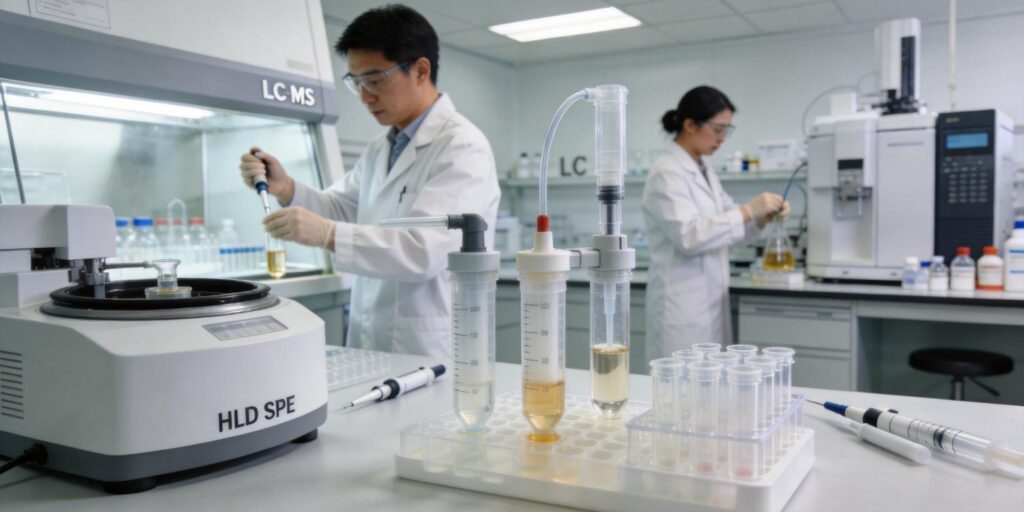
For researchers seeking high-throughput solutions, 96-well SPE plates offer significant advantages in automation compatibility and processing efficiency. As noted in SPE automation literature, automated SPE workstations can dramatically increase throughput while maintaining consistency and reducing operator exposure to samples and reagents.