Types of Biological Matrices in SPE Applications
Solid-phase extraction (SPE) has become an indispensable tool for biological sample preparation across diverse fields including clinical chemistry, forensic science, and pharmaceutical research. The technique’s popularity stems from its ability to achieve high selectivities and recoveries while minimizing hazardous solvent consumption. Biological matrices present unique challenges that require specialized SPE approaches.
Common Biological Matrices
The most frequently encountered biological matrices in SPE applications include:
Blood-Derived Samples
Plasma and serum represent the most common biological matrices for pharmacokinetic studies and clinical monitoring. Plasma contains approximately 7% protein content, primarily albumin, which can bind to target analytes and complicate extraction. Serum, with approximately half the protein concentration of plasma, presents similar challenges but with reduced protein interference.
Whole blood presents additional complexities due to cellular components that can clog SPE cartridges. As noted in forensic applications, “whole blood or diluted whole blood will clog the extraction cartridge, requiring pretreatment before application.” Sonication followed by dilution with potassium phosphate buffer and centrifugation has proven effective for disrupting cell membranes and preventing cartridge clogging.
Urine Samples
Urine is characterized by low protein content but presents a less well-defined sample matrix than plasma. Normal urine pH varies between 4.5 and 8, and electrolyte content fluctuates considerably depending on diet and urine production rates. The occasional presence of bacteria can compromise analyte stability, requiring careful method development.
A common feature of urine extraction is the need for hydrolysis steps, since many drugs are excreted as sulfates, glucuronides, or other conjugated forms. Acid hydrolysis effectively cleaves these groups, though enzyme-based approaches using specific glucuronidases may be preferable for sensitive analytes like 6-monoacetyl morphine.
Tissue Samples
Solid tissue samples, particularly liver and brain in forensic toxicology, require specialized pretreatment before SPE application. Tissue homogenization in appropriate buffers or organic solvents liberates analytes from solid tissue constituents. As noted in the literature, “homogenized tissue samples cannot be applied directly onto SPE cartridges because this will result in clogging.”
Matrix Solid-Phase Dispersion (MSPD) offers an alternative approach for solid samples, though traditional SPE requires liquefaction or analyte solubilization from the bulk matrix solids.
Other Biological Matrices
Meconium, the first intestinal discharge of newborns, serves as a reservoir of compounds to which the fetus was exposed during development. Successful extraction involves homogenization in methanol, centrifugation, and concentration before SPE application.
Animal-derived samples, particularly in equine sports testing, present unique challenges. Horse urine tends to be comparatively viscous, potentially due to polymucosaccharides or proteoglycans that can cause clotting on SPE cartridge frits.
Challenges in Protein and Lipid Removal
Protein and lipid interference represents one of the most significant challenges in biological sample preparation. These matrix components can bind analytes, clog analytical columns, and interfere with detection methods.
Protein Binding and Removal Strategies
Protein binding presents a dual challenge: it can reduce analyte recovery and introduce variability into analytical results. Modern drug candidates are often highly potent substances administered at low doses, making assay sensitivity and clean plasma extracts essential for pharmacokinetic studies.
Several strategies effectively address protein interference:
Solvent Denaturation
Organic solvents like acetonitrile or methanol effectively denature proteins, precipitating them from solution. This approach must be balanced against potential analyte co-precipitation and the need for subsequent sample dilution to restore appropriate solvent strength for SPE.
pH Manipulation
Adjusting samples to highly acidic or basic pH effectively denatures proteins and disrupts protein-analyte binding. This approach also lyses erythrocytes in whole blood samples. After protein removal via centrifugation, pH can be restored to appropriate levels for SPE extraction.
Enzymatic Digestion
Proteolytic enzymes like Subtilisin Carlsberg can hydrolyze proteins, though this approach requires careful optimization to avoid analyte degradation.
Lipid Removal Challenges
Lipids present particular challenges due to their hydrophobic nature and tendency to co-extract with target analytes. In forensic and clinical applications, lipid removal is crucial for obtaining clean chromatograms and preventing column degradation.
Selective elution strategies have been developed for different lipid classes based on their solubility characteristics. These approaches enable separation of:
- Fatty acids
- Phospholipids
- Cholesterol esters
- Cholesterol
- Triglycerides
- Diglycerides
- Monoglycerides
As demonstrated in lipid separation protocols, “various lipid classes have different solubility characteristics that can be used to purify or separate these compounds.” This selective approach allows for excellent yields and purity when extracting lipids from adipose tissues or serum.
SPE Workflow for Plasma and Urine Samples
Developing effective SPE methods for biological samples requires systematic optimization. The following workflow outlines key considerations for plasma and urine sample preparation.
Method Development Strategy
A rational approach to SPE method development involves several key steps:
1. Research and Characterization
Begin by researching previous SPE and analysis conditions for the analyte and matrix. Characterize the analyte’s structure, pKa, polarity, functional groups, and solvent solubility/stability. Simultaneously, characterize the sample matrix for potential interferences, pH, ionic strength, and variability.
2. Sorbent Selection and Conditioning
Select appropriate sorbents based on analyte characteristics. Mixed-mode cartridges providing both hydrophobic and cation exchange interactions have proven particularly effective for broad-spectrum drug screening. Proper conditioning with methanol or acetonitrile followed by weak solvent (water or buffer) prepares the cartridge to accept the sample.
3. Sample Pretreatment and Application
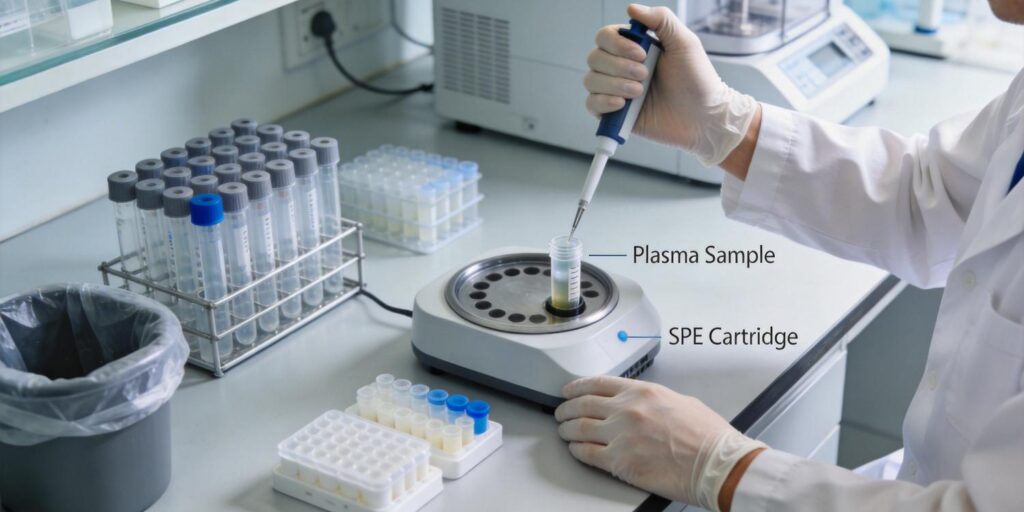
For plasma samples, dilution with appropriate buffer (typically 2-5 fold) reduces viscosity and protein binding. For urine samples, pH adjustment may be necessary, particularly for ionizable analytes. Sample application should occur at controlled flow rates (1-3 drops per second) to ensure optimal recovery.
4. Washing Optimization
Washing steps remove weakly retained matrix components while retaining target analytes. For plasma, the first wash must be aqueous to remove proteins. Subsequent washes with organic solvents of appropriate strength remove additional interferences without eluting analytes.
5. Elution Optimization
Elution solvents should recover analytes in the smallest possible volume while leaving highly retained matrix components on the cartridge. Solvent strength, pH, and composition must be optimized for each application.
Specific Considerations for Plasma
Plasma extraction serves multiple objectives beyond simple clean-up:
- Prevention of analytical column clogging
- Elimination of protein binding
- Prevention of enzymatic degradation
- Sample concentration
As noted in method development guidelines, “SPE recoveries should exceed 90% absolute recovery. If you don’t get that kind of recovery you are not adjusting other parameters (such as solubility, pH, and solvent strength) correctly.”
Specific Considerations for Urine
Urine extraction benefits from the matrix’s low protein content but presents challenges related to variable composition and conjugate formation. Procedures developed for plasma often apply directly to urine or require only minor adjustments. However, extracting hydrophilic analytes from urine containing high levels of endogenous hydrophilic compounds presents particular difficulties.
For basic drug screening from urine, washing with 20% acetonitrile/80% water has proven effective for removing polar interferences while maintaining recoveries over 80% with relative standard deviations less than 7.3%.
Improving Analyte Recovery in Biological SPE
Optimizing analyte recovery represents a critical aspect of SPE method development for biological samples. Several factors influence recovery rates and reproducibility.
Key Factors Affecting Recovery
Ionization Status and pH Control
The ionization status of analytes significantly impacts retention on SPE sorbents. For weak acids like ibuprofen (pKa 5.9), lowering sample pH below the pKa increases the non-ionic molecular form, enhancing recovery on hydrophobic phases. At the pKa, drugs exist as 50% ionized and 50% non-ionized forms.
Silanol Interactions
Incomplete desorption from silica-based sorbents often results from silanol interactions. Substituting less hydrophobic sorbents (C2 instead of C18) or including silanol blocking agents like ammonium acetate in elution solvents addresses this issue. Alternatively, including 0.1 M potassium acetate in methanol used for cartridge conditioning reduces ionic interactions.
Flow Rate Control
Recovery is inversely proportional to flow rate during sample loading. Optimal flow rates typically range from 1-3 drops per second to ensure adequate interaction between analytes and sorbent.
Strategies for Improving Low Recoveries
When faced with suboptimal recoveries, several approaches can be implemented:
1. Sorbent Modification
Switching to alternative sorbent chemistries can dramatically improve recovery. As demonstrated in opiate extraction from urine, moving from C18 to high-efficiency copolymeric SPE columns significantly improved both recovery and extract cleanliness.
2. Solvent System Optimization
Adjusting elution solvent composition, strength, and pH can enhance recovery. For problematic analytes, sequential elution with solvents of increasing strength may be necessary.
3. Sample Pretreatment Enhancement
Improving sample pretreatment to better release analytes from matrix components can boost recovery. For whole blood, sonication not only prevents cartridge clogging but also helps release drugs from protein binding sites.
4. Combined Cleanup Approaches
In some cases, a combination of SPE with additional cleanup steps yields better results than either approach alone. As noted in forensic applications, “often a combination of SPE and an additional cleanup step will yield better results than one or the other.”
Automation Considerations
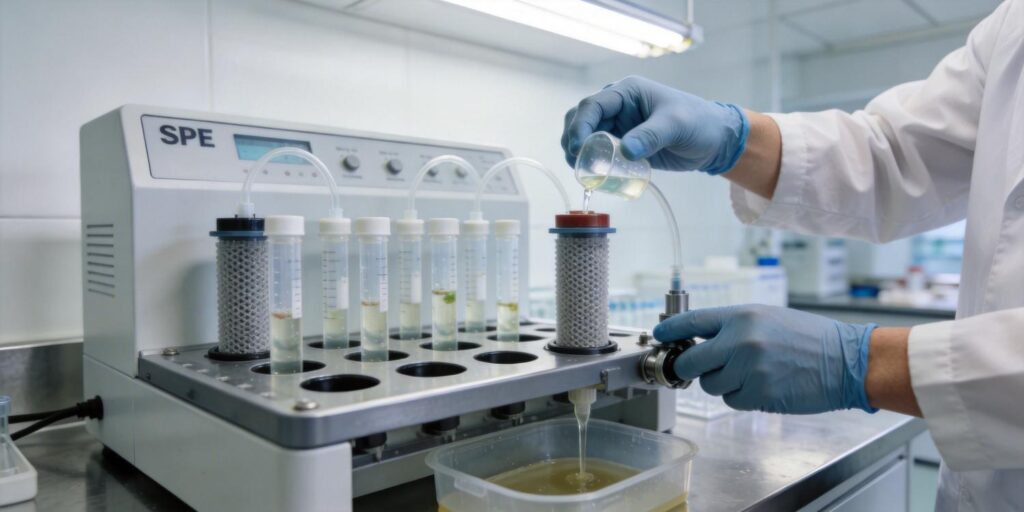
Automated SPE systems offer improved reproducibility and throughput but require careful optimization to prevent carryover and ensure consistent recovery. Key considerations include:
- Fluid path cleaning between samples to prevent carryover
- Sample pretreatment to prevent clotting or precipitation
- Waste handling system design
- Compatibility between cleaning reagents and sample matrices
For protein-rich samples like plasma, the first cleaning step must use aqueous reagents to remove proteins before organic solvent cleaning.
Quality Control and Validation
Regular monitoring of SPE cartridge performance through quality control samples ensures consistent recovery. Lot-to-lot reproducibility of SPE cartridges should be verified, particularly when working with sensitive assays requiring high precision.
For comprehensive drug screening applications, mixed-mode cartridges combining hydrophobic and cation exchange interactions have demonstrated excellent performance, providing recoveries over 80% with good reproducibilities (RSD less than 8.2%) even at concentration levels of 2 μg/mL.
Conclusion
Solid-phase extraction remains a powerful technique for biological sample preparation, though method development can be time-consuming, particularly when high sensitivities are required. The diversity of biological matrices—from plasma and urine to tissue samples—demands tailored approaches that address specific matrix challenges.
Successful SPE methods balance multiple objectives: removing proteins and lipids that interfere with analysis, maximizing analyte recovery, and producing clean extracts compatible with downstream analytical techniques. By understanding matrix characteristics and systematically optimizing SPE parameters, researchers can develop robust methods that meet the demanding requirements of modern bioanalysis.
As SPE technology continues to evolve with new sorbent chemistries and automation platforms, the technique’s utility in biological sample preparation will only expand, enabling more sensitive, reproducible, and high-throughput analyses across clinical, forensic, and pharmaceutical applications.